🎯 New here? BallCaddie matches golfers to the right ball. → Take the 90-second quiz
Back to BlogBest Golf Ball for 90 MPH Swing Speed (2026 Picks Tested)
The best golf balls for a 90 mph driver swing balance compression, urethane spin, and price. Here are the top tour, tour-lite, and value picks ranked on match fit — not marketing.

Answer a few questions about your swing and BallCaddie matches you against a 70+ ball catalog.
Take the 90-second quizQuick answer
For a 90 mph driver swing, the best golf ball is a mid-compression urethane tour ball in the 70–92 compression range. Top picks: Bridgestone Tour B RX (~89, softer-feeling than the Pro V1), Callaway Chrome Soft (~73–78, four-layer construction), and Titleist Pro V1 (~92, the default premium pick). Best value: Srixon Q-Star Tour (~70–75) at roughly two-thirds of tour-ball pricing.
BallCaddie engine results
Scored across all 72 balls in our catalog for a 90 mph driver swing, an all-around game, no strong feel preference, and a smart-value budget.
Best-fitting balls
| # | Ball | Compression | Cover | ~$/dz | Match |
|---|---|---|---|---|---|
| 1 | Vice Pro | 89 | urethane | $40 | 97% |
| 2 | Bridgestone Tour B RX | 89 | urethane | $55 | 96% |
| 3 | Srixon Q-Star Tour | 70 | urethane | $40 | 96% |
Smart-value alternative: Kirkland Signature Performance+ ($15), Cut Grey ($25), Wilson Triad ($40).
Top picks for a 90 mph swing speed
| Ball | Compression | Cover | Layers | Price/dozen | Best for |
|---|---|---|---|---|---|
| Bridgestone Tour B RX | ~89 | Urethane | 3 | $55 | Softer than the Pro V1, 90–105 mph fit |
| Callaway Chrome Soft | ~73–78 | Urethane | 4 | $55 | Soft-tour balance, high greenside spin |
| Titleist Pro V1 | ~92 | Urethane | 3 | $57.99 | Default premium pick, trusted consistency |
| Srixon Q-Star Tour | ~70–75 | Urethane | 3 | $35 | Best value urethane, tour-lite pricing |
| TaylorMade Tour Response | ~74 | Urethane | 3 | $40 | Mid-tier tour option, good spin/value mix |
| Bridgestone Tour B XS | ~89 | Urethane | 3 | $50 | Slightly firmer feel, Tiger Woods’ choice |
How 90 mph fits in the swing-speed spectrum
A 90 mph driver swing speed sits near the middle of the amateur golfer range. TrackMan’s amateur database puts the average male driver swing speed at roughly 93–94 mph, with mid-handicap women trending below 85 mph. At 90 mph, you’re firmly in the 85–100 mph mid-compression tier, which means premium tour balls become legitimate — you generate enough clubhead speed to fully activate their cores and extract the urethane cover spin advantage.
What 90 mph is not:
- Not slow enough to need the Supersoft tier. The Callaway Supersoft and similar ultra-low-compression balls are designed for swing speeds below 85 mph. At 90, you’re above their activation sweet spot.
- Not fast enough to need the Pro V1x or TP5x. Firm tour balls like the Pro V1x (~102) and TP5x (~97–102) are designed for 100+ mph swings. At 90, they play too firm — you’ll lose ball speed and give up feel.
At 90 mph, the right answer lives in the middle: urethane-covered balls in the 65–90 compression range, with the specific pick driven by feel preference and price.
The top three picks, explained
1. Bridgestone Tour B RX — Softer-feeling tour ball for 90+ mph
Compression: ~89 | Cover: Urethane | Layers: 3 | Price: ~$55/dozen
The Tour B RX is the softer-feeling of Bridgestone’s tour balls, well under the firm Tour B X (~100). At ~89 compression it sits in the upper-mid tour tier, a step softer than the Pro V1 (~92) — which means it activates from about 90 mph up, returning softer feel than the firm X and XS models without sacrificing urethane greenside spin.
For 90 mph swingers who want tour-level short-game control but prefer a soft-landing feel off the face, the Tour B RX is a clean pick. Bridgestone’s SMART-CORE Technology (larger, softer inner core) is engineered for swing speeds under 105 mph. Past PGA champions including Bryson DeChambeau have played Bridgestone Tour B models, though the Tour B XS and Tour B X are the tour’s more common Bridgestone picks.
Best for: 90–100 mph swingers who want a softer-feeling tour ball with greenside control.
2. Callaway Chrome Soft — Best balance of soft feel and tour spin
Compression: ~73–78 | Cover: Urethane | Layers: 4 | Price: ~$55/dozen
The Chrome Soft is Callaway’s flagship soft-tour ball — urethane cover, four-layer construction, and a compression in the 73–78 range that sits squarely in the 90 mph activation window. It delivers tour-level greenside spin with a noticeably softer feel than the Pro V1 or Chrome Tour, which is why it’s been Phil Mickelson’s ball for over a decade.
At 90 mph, the Chrome Soft activates cleanly off the driver and delivers a high launch angle with moderate spin — a good combination for golfers who want to maximize carry without ballooning. The four-layer design provides more separation between driver feel and greenside feel than a three-piece ball.
Best for: 88–95 mph swingers who want tour-level spin with a softer, higher-launching feel.
3. Titleist Pro V1 — Default premium pick
Compression: ~92 | Cover: Urethane | Layers: 3 | Price: ~$57.99/dozen
The Pro V1 is the most-used ball on the PGA Tour and the most-tested ball in independent labs. At 92 compression it sits at the upper edge of what a 90 mph swinger fully activates — but it does activate, and it rewards the player with exceptional consistency round to round.
Two things make the Pro V1 the default pick: consistency of manufacture (Titleist’s quality control is consistently rated among the industry’s best in independent testing) and consistency of flight (the Pro V1 launches and spins predictably across a wide range of conditions). For a 90 mph swinger who plays multiple courses, multiple climates, and wants the same ball to behave the same way every round, the Pro V1 is hard to beat.
The trade-off versus the Tour B RX or Chrome Soft is feel — the Pro V1 feels firmer off the driver. If you prefer soft feedback, the softer options are better. If you prefer consistency and trusted behavior, the Pro V1 is the pick.
Best for: 88–105 mph swingers who want trusted premium consistency and don’t need the softest feel.
Underrated value picks at 90 mph
Srixon Q-Star Tour — Best value urethane
Compression: ~70–75 | Cover: Urethane | Price: ~$35/dozen
The Q-Star Tour is a legitimate urethane tour ball at a value price. At 70–75 compression it sits in the same range as the Tour Response, but it retails for $10–$20 less per dozen. In independent testing, the Q-Star Tour has consistently shown up within 1–2 yards of the premium tour balls on driver distance and within 300–500 RPM on wedge spin — differences that exist on a launch monitor but rarely change a score.
Best for: Budget-conscious 90 mph swingers who want urethane greenside spin without premium-tier pricing.
TaylorMade Tour Response
Compression: ~74 | Cover: Urethane | Price: ~$40/dozen
The Tour Response is TaylorMade’s mid-tier urethane offering — positioned between the SpeedSoft (ionomer, value) and the TP5/TP5x (premium tour). At 74 compression it sits nicely in the 90 mph window, and the three-piece construction delivers solid greenside spin at about $15 less per dozen than the TP5.
Best for: TaylorMade-brand golfers at 90 mph who want premium feel without the TP5 price.
What 90 mph players get wrong about ball choice
“I should play a soft ball because I don’t swing fast.” At 90 mph you’re above the ultra-soft tier. The Supersoft and Wilson Duo Soft are designed for swing speeds below 85 mph; at 90 you’ll give up urethane greenside spin without gaining meaningful distance.
“Pro V1 is the best ball, so I should play Pro V1.” The Pro V1 is an excellent ball — for the right swing profile. At 90 mph it’s at the lower edge of its activation range, and a softer option like the Tour B RX or Chrome Soft often feels better while delivering comparable on-course results. Test both before defaulting to the Pro V1 out of habit.
“All tour balls are basically the same.” They’re not. Chrome Soft (four-layer, softest) plays very differently from Pro V1 (three-layer, mid-firmness) from TP5 (five-layer, slightly firmer) from Tour B RX (three-layer, distance-focused). At 90 mph these differences show up most in feel and in short-game spin — test at least two before committing.
“A $20 ionomer ball is the same as a $55 urethane ball if you can’t tell the difference on the range.” On the range, yes. On the course inside 50 yards, the urethane-vs-ionomer spin gap (roughly 2,000–3,500 RPM — see urethane vs. ionomer) shows up as check spin that holds tight flags and partial shots that check up instead of running through. At 90 mph with a consistent short game, the upgrade earns its keep.
What the full report shows a 90 mph swing
The engine picks above come straight from the fitting engine’s scoring run; the Ball Fitting Report is where the reasoning lives. Its spec section turns your answers into requirements with a sentence of justification each — at 85–99 mph that reads as a mid-range compression band (the test of whether you’re compressing the ball or just hitting it), a spin line set by the miss you described, and a cover material set by how much you need the ball to check on chips.
Six sections come free after the 90-second quiz, which asks for your first name and email before question 1: your swing read back to you, those spec requirements, where your strokes are leaking, and how many of the 70+ scored balls cleared the bar for your profile. The seventh section names your #1, #2, and #3 with the reasoning — $29, one time.
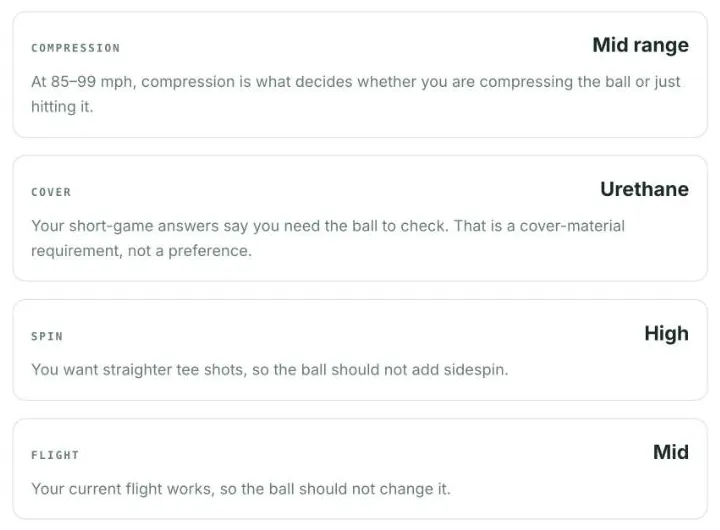
The spec section from a real report — a sample 12-handicap profile at 85–99 mph, the exact band this post covers. See every section of the report.
The next step
Numbers on a page narrow the field; on-course testing closes it. The BallCaddie quiz scores all 70+ balls in the catalog against your exact swing profile — including weight distribution on short-game priority, trajectory preference, and budget. Run the numbers in 90 seconds, then use the Smart Buy Plan to test a sleeve of your top pick before committing to a dozen.
Related reads
- Golf ball recommendations by swing speed — specific picks at every speed bracket, including the full 85–100 mph tier
- Best value golf ball in 2026 — how the Kirkland, Vice Pro, and Snell compare to Pro V1 at this speed
- Pro V1 vs TP5 — the most common choice golfers face at 90 mph
Key takeaways
- A 90 mph driver swing fits the 65–90 compression range — skip ultra-soft balls and skip firm tour balls (Pro V1x, TP5x).
- Top overall: Callaway Chrome Soft for soft-tour balance; Bridgestone Tour B RX for softer-than-Pro-V1 feel; Titleist Pro V1 for trusted consistency.
- Best value: Srixon Q-Star Tour delivers urethane feel at roughly two-thirds of premium pricing.
- The biggest fit gains at 90 mph come from cover material and short-game spin, not driver distance — the urethane vs. ionomer difference is worth 2,000–3,500 RPM on wedge shots.
- Cold costs yards through ball temperature. Keep sleeves warm and rotate two balls; change tiers only if winter layers drop your swing speed a band.
- Full context: how to choose a golf ball for your swing speed and the complete golf ball compression chart.
Stop guessing your golf ball
Take the 90-second fitting quiz · matched from a 70+ ball catalog · sign up to see your match
Take the quiz →Related posts
How online golf ball fitting works: what brand selectors and neutral fitters ask, where a questionnaire beats a launch monitor, and how to answer it right.
The best golf ball for you comes from your swing speed, short game, and budget. Match yourself to one of five player profiles and get the balls that fit.
Answer five questions — swing speed, short game, miss, weather, budget — and the right golf ball falls out. The decision framework, with 2026 robot-test data.
How golf ball fitting works: the green-to-tee method pro fitters use, the swing speed and cover-material data behind it, and how to fit your own ball.
Frequently asked questions
- What's the best golf ball for a 90 mph swing speed?
- For a 90 mph driver swing speed, the best overall pick is a mid-compression urethane-covered ball in the 70–92 compression range. The Bridgestone Tour B RX (~89) and Callaway Chrome Soft (~73–78) are strong tour options; the Titleist Pro V1 (~92) is the default premium pick at this speed. If you prioritize budget, the Srixon Q-Star Tour (~70–75) delivers urethane feel at roughly two-thirds of tour-ball pricing.
- What compression should a 90 mph swinger use?
- A 90 mph driver swing sits in the middle of the 85–100 mph mid-compression tier. Anywhere from 65 to 95 compression activates the core adequately at this speed, with the lower end (65–80) emphasizing soft feel and the upper end (85–95) emphasizing firmer feel and lower spin on mid-irons. Most 90 mph players find their best match between 72 and 90 compression — see the golf ball compression chart for every ball's measured rating.
- Is the Pro V1 too firm for a 90 mph swing?
- No, but it's near the lower edge of the Pro V1's activation range. The Titleist Pro V1 measures ~92 compression and is designed for swing speeds roughly 88 to 105 mph. At 90 mph the Pro V1 fully compresses and returns its designed ball speed — but a softer option like the Callaway Chrome Soft or Bridgestone Tour B RX may feel more comfortable off the face while delivering comparable greenside spin. Test both before committing.
- Should a 90 mph swinger play a 'soft' ball like the Supersoft?
- Usually not if you want urethane greenside spin. The Callaway Supersoft (~49 compression) is an excellent ball for slow swing speeds, but at 90 mph it's below the optimal compression range and gives up the short-game spin that urethane tour balls provide. If greenside control matters to your score, stick with urethane tour or tour-lite balls in the 65–90 compression range. If durability and price matter more, the Supersoft is still a reasonable pick — just accept the spin trade-off.
- How much does the right ball actually add for a 90 mph swinger?
- Independent robot testing typically shows a 2 to 5 yard driver-carry gain from matching compression correctly at this swing speed. The larger gains come from cover material: switching from ionomer to urethane adds roughly 2,000–3,500 RPM of wedge spin, which translates to more stopping power inside 100 yards. The short-game improvement is where most of the 'right ball' benefit shows up at 90 mph, not the tee box.
- Does weather affect ball choice at 90 mph?
- Yes, and the answer is keeping the ball you are fitted for warm. MyGolfSpy's freezer test moved compression only 2 to 3 points while the same ball gave up more than 6 mph of ball speed and over 21 yards, so the cold penalty is lost resiliency rather than a firmer number. Titleist calls the winter switch to a lower-compression ball a common misconception. Cold air costs every ball about 1 to 2 yards per 10°F. Store sleeves indoors, rotate two balls through a warm pocket, and re-fit only if winter layers drop your swing speed a band.
Stop guessing your golf ball
Take the 90-second fitting quiz · matched from a 70+ ball catalog · sign up to see your match
Take the quiz →