🎯 New here? BallCaddie matches golfers to the right ball. → Take the 90-second quiz
Back to BlogUrethane vs Ionomer Golf Balls: Which Cover Material Is Right for You?
Urethane covers generate 8,000–10,000 RPM of wedge spin; ionomer generates 5,500–7,500 RPM. Here's the data on when that gap changes your score — and when paying extra for urethane is wasted money.
Answer a few questions about your swing and BallCaddie matches you against a 70+ ball catalog.
Take the 90-second quiz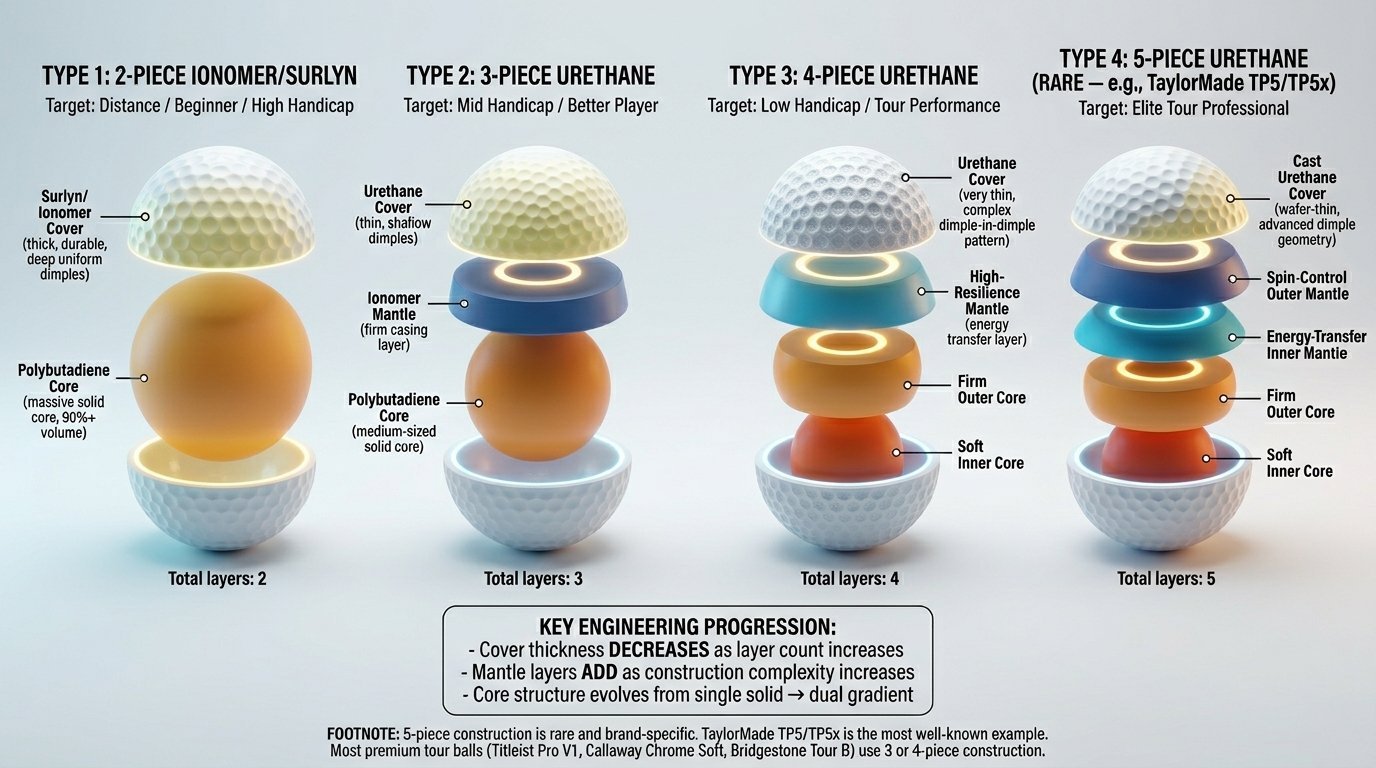
Quick answer
Urethane covers generate 8,000–10,000 RPM of wedge spin; ionomer covers generate 5,500–7,500 RPM — a gap of roughly 2,000–3,500 RPM. That difference wins strokes when you make consistent contact inside 100 yards. If you’re shooting 90+ or making frequent off-center contact, ionomer’s lower cost and better durability usually outperform the premium urethane option for your game.
BallCaddie engine results
Scored across all 72 balls in our catalog for a short game that matters a lot, a wish for shots that stop fast, and a performance budget.
Best-fitting balls
| # | Ball | Compression | Cover | ~$/dz | Match |
|---|---|---|---|---|---|
| 1 | Srixon Q-Star Tour | 70 | urethane | $40 | 97% |
| 2 | Titleist Pro V1 | 92 | urethane | $58 | 96% |
| 3 | Bridgestone Tour B XS | 89 | urethane | $55 | 94% |
Smart-value alternative: Kirkland Signature Performance+ ($15), Cut Grey ($25), Wilson Triad ($40).
Cover material spin comparison
Spin data from MyGolfSpy’s 2025 ball testing, measured with a consistent robot and launch monitor setup across driver, 7-iron, and wedge distances.
| Cover type | Driver spin | 7-iron spin | Wedge spin (full) | Wedge spin (partial) | Price/dozen |
|---|---|---|---|---|---|
| Urethane (tour) | 2,600–3,200 RPM | 5,500–7,200 RPM | 8,000–10,000 RPM | 6,500–9,000 RPM | $40–$60 |
| Urethane (tour-lite) | 2,500–3,000 RPM | 5,000–6,800 RPM | 7,000–9,000 RPM | 5,800–8,200 RPM | $28–$42 |
| Ionomer (premium) | 2,200–2,700 RPM | 4,500–5,800 RPM | 5,500–7,500 RPM | 4,500–6,500 RPM | $18–$30 |
| Ionomer (value) | 2,000–2,500 RPM | 4,000–5,200 RPM | 5,000–6,800 RPM | 4,000–5,800 RPM | $12–$22 |
Ball examples by category
| Ball | Cover | Category | Price |
|---|---|---|---|
| Titleist Pro V1 | Urethane | Tour | $57 |
| Titleist Pro V1x | Urethane | Tour | $57 |
| Callaway Chrome Tour | Urethane | Tour | $58 |
| TaylorMade TP5 / TP5x | Urethane | Tour | $54 |
| Srixon Z-Star / Z-Star XV | Urethane | Tour | $48 |
| Bridgestone Tour B XS / Tour B X | Urethane | Tour | $48 |
| Bridgestone Tour B RX | Urethane | Tour-lite | $44 |
| Callaway Chrome Soft | Urethane | Tour-lite | $42 |
| Srixon Q-Star Tour | Urethane | Tour-lite | $32 |
| TaylorMade Tour Response | Urethane | Tour-lite | $38 |
| Titleist TruFeel | Ionomer | Premium | $28 |
| Srixon Soft Feel | Ionomer | Premium | $24.99 |
| Callaway Supersoft | Ionomer | Value | $26.99 |
| Wilson Duo Soft | Ionomer | Value | $24.99 |
| Maxfli SoftFli | Ionomer | Value | $20 |
What urethane and ionomer actually are
Urethane is a thermoplastic elastomer — a polymer that is simultaneously soft and highly resilient. In golf ball engineering, the urethane cover grips the micro-ridges of iron and wedge grooves during impact, generating friction that transfers to spin. The softness also transmits tactile feedback to the player’s hands, which is why urethane balls have a distinctive “click” and feel at impact.
Ionomer (commonly sold as Surlyn, DuPont’s brand-name ionomer resin) is a harder, more rigid polymer. It doesn’t grip grooves as aggressively, which limits spin but also reduces scuffing, cut marks, and surface wear. Ionomer covers last noticeably longer under repeated use and mishits.
The choice between them is not about quality — it’s about which performance profile matches your game. Both are engineered materials with decades of testing behind them. The question is what you need them to do.
The spin gap: when it changes your score
The 2,000–3,500 RPM wedge spin gap between urethane and ionomer matters when you can:
- Make consistent center contact — off-center wedge strikes significantly reduce spin for both cover types, compressing the gap between them
- Use high spin to hold greens — firm, fast greens reward spin control; soft greens make high spin less valuable since the ball already stops
- Hit partial wedge shots with intention — the spin advantage of urethane is most pronounced on 30–80 yard partial shots where you need the ball to check and stop predictably
If those three conditions describe your game — consistent contact, fast greens, short-game variety — urethane earns its premium. If you’re making inconsistent contact from inside 100 yards or playing courses with soft, receptive greens, the spin gap shrinks to the point where $30 per dozen in savings is the better outcome.
According to MyGolfSpy’s independent testing, wedge spin ranged from 5,500 to over 10,000 RPM across the 2025 ball lineup — a wider range than any other tested shot type. Cover material was the single largest predictor of where in that range a ball landed.
The driver distance myth
One of the most persistent misconceptions: “urethane balls go farther off the tee.” The data consistently shows they don’t — not meaningfully.
MyGolfSpy’s robot testing puts the driver distance difference between comparable urethane and ionomer balls at 1–3 yards, well within the statistical noise of real-world conditions. Any perceived distance gain from switching to a tour ball is almost always explained by compression matching, not cover material.
Cover material changes short-game behavior. Compression changes driver behavior. They’re separate variables solved by separate ball specifications.
Who should play urethane
Low handicappers (0–12): Consistent contact quality, enough rounds to feel the spin difference, greenside scores good enough to take advantage of tour-level spin. At this level, urethane is often the right tool.
Mid handicappers who prioritize the short game (13–20): If you’re already making up and down 30–40% of the time and want to improve your conversion rate, the urethane spin premium starts paying dividends. The Srixon Q-Star Tour, TaylorMade Tour Response, and Bridgestone Tour B RX offer urethane covers at tour-lite prices ($28–$42) — a middle ground for this group.
Players on firm, fast courses: High-spin balls reward players who can shape trajectory and stop the ball on a specific spot. If your home course is firm and fast in summer, urethane’s spin advantage compounds.
Who should play ionomer
High handicappers (20+): Off-center contact reduces the urethane spin advantage significantly. A $20 ionomer ball hit solidly performs better than a $55 urethane ball hit off the toe. Durability and consistent low-spin behavior are genuine advantages when contact quality is still developing.
Players who lose more than two balls per round: At $55 per dozen, losing two urethane balls per round costs roughly $9.17 per round in ball expenses. An ionomer ball that costs $18–$22 per dozen cuts that to $3–$4. Over 30 rounds, that’s $150–$180 saved — real money for practice balls or lessons.
Cold-weather rounds: In temperatures below 40°F, urethane’s elasticity decreases noticeably, shrinking the spin differential. If you play primarily in cold conditions, the premium for urethane diminishes further.
Players focused on distance: If your primary scoring improvement comes from driving the ball further and avoiding penalty strokes, cover material is a small lever. A properly fit ionomer ball at the right compression will perform as well off the tee as a premium urethane option.
How cover and compression interact
Cover material and compression are independent variables, but they interact in the fitting equation:
- Low compression + urethane (Callaway Chrome Soft, Bridgestone Tour B RX): Soft driver feel with tour-level short-game spin. The sweet spot for 80–95 mph swingers who prioritize greenside control.
- Low compression + ionomer (Wilson Duo Soft, Callaway Supersoft): Maximum forgiveness and soft feel without the short-game spin. Best for under-85-mph players focused on distance and durability.
- High compression + urethane (Pro V1x, TP5x, Z-Star XV): Firm driver feel with maximum greenside spin. Designed for 98+ mph swings. The complete package at the performance extreme.
- High compression + ionomer (Titleist Velocity): Rare combination — hard feel everywhere. Used by high-swing-speed players who don’t need greenside spin and want maximum distance with low maintenance.
If you want to know which cover and compression combination matches your swing speed, short-game priorities, and budget, the BallCaddie fitting quiz scores the full ball catalog against your profile in 90 seconds.
Key takeaways
- Urethane covers generate 2,000–3,500 RPM more wedge spin than ionomer covers — the largest performance variable in short-game ball selection.
- The spin gap matters when you make consistent center contact and play firm, fast greens. It shrinks with off-center contact and soft receptive greens.
- Off the driver, cover material is nearly irrelevant — compression drives driver distance, not cover type.
- Urethane’s case gets stronger as your handicap drops. Ionomer’s case gets stronger as your ball-loss rate rises.
- Tour-lite urethane balls (Srixon Q-Star Tour, TaylorMade Tour Response, Bridgestone Tour B RX) at $28–$42 per dozen offer a middle path for mid-handicap golfers who want urethane spin without tour ball prices.
- Cover material and compression are separate variables — see the golf ball compression chart to understand how to match both to your swing.
Stop guessing your golf ball
Take the 90-second fitting quiz · matched from a 70+ ball catalog · sign up to see your match
Take the quiz →Related posts
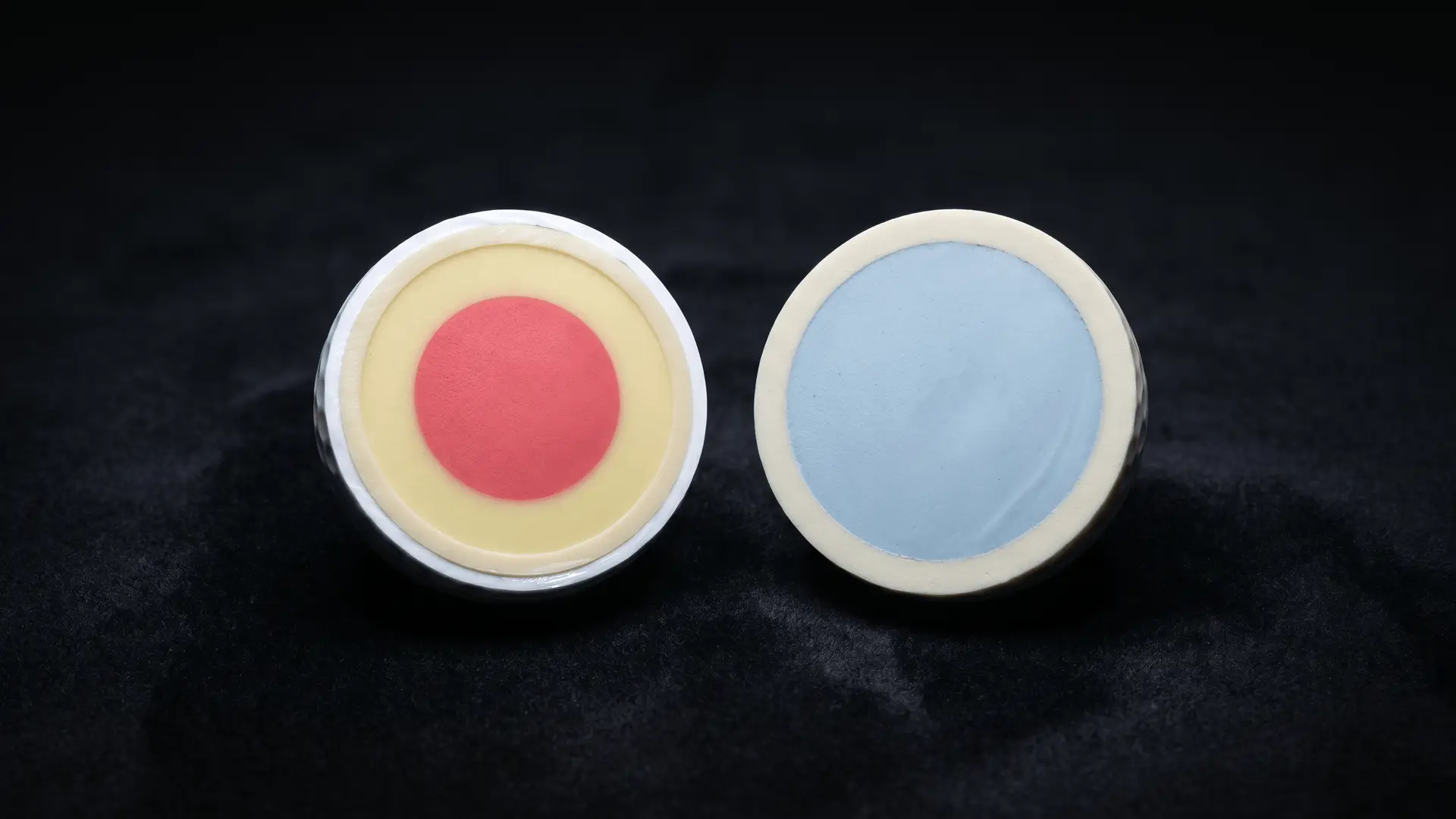
Cut a golf ball open and you find a rubber core, up to 3 mantle layers and a urethane or ionomer cover. What each part does and how many pieces you need.
MyGolfSpy put 48 balls through a robot at three swing speeds. The findings that actually change which ball you should play, and the ones that don't.
Match golf ball compression to your driver swing speed — what robot testing really says about soft versus firm, and the three bands that pick your ball.
Where pro shops, leagues, and bulk buyers get golf balls cheapest: Vice and Snell volume tiers, used 5-dozen lots, Costco, and logo minimums, per ball.
Frequently asked questions
- What is urethane in golf balls?
- Urethane is a synthetic polymer used as the outer cover layer on premium golf balls. It is softer and more elastic than ionomer (Surlyn), which allows it to grip the grooves of wedges and irons more aggressively at impact. The result is higher short-game spin — typically 8,000–10,000 RPM with wedges, compared to 5,500–7,500 RPM from ionomer covers. Urethane is used on virtually all professional tour balls.
- Is ionomer the same as Surlyn?
- Surlyn is DuPont's brand name for a specific ionomer resin — the original ionomer cover material for golf balls. Most non-tour balls use Surlyn or similar ionomer compounds. The two terms are often used interchangeably in golf, though technically Surlyn is one ionomer product among several. Both offer similar performance characteristics: high durability, lower spin, and firmer feel compared to urethane.
- Do urethane balls go farther than ionomer balls?
- Not necessarily off the driver. Most independent testing shows urethane and ionomer balls perform within 1–3 yards of each other on driver shots. The meaningful performance gap is at short-game distances, where urethane generates 2,000–3,500 RPM more spin than ionomer with the same wedge. Urethane balls are worth the premium for short-game control, not tee-shot distance.
- Why do professional golfers all use urethane covers?
- Tour players have consistent enough ball-striking to use urethane's higher spin as a precision tool around the greens — stopping the ball on specific spots, generating spin to hold tight flags, and controlling trajectory on partial shots. The same spin that is an advantage for a scratch player can be difficult to control for inconsistent strikers, which is why ionomer's more predictable lower-spin behavior is actually preferred by many high-handicap golfers.
- Can I use a urethane ball as a beginner?
- Yes, but you'll likely lose the advantage. Beginners typically make off-center contact that reduces the spin differential between urethane and ionomer. A beginner playing a $58 Pro V1 vs. a $20 Srixon Soft Feel will see minimal performance difference in practice — the money is better spent on lessons or range time. Once you're making consistent center contact and scoring in the low-to-mid 90s, revisiting urethane makes sense.
- Does cover material affect ball durability?
- Yes. Ionomer covers are significantly harder and more cut-resistant than urethane. Urethane balls scuff more easily on cart paths, mishits, and sand shots — which is part of why premium urethane balls develop visible wear more quickly. For players who lose fewer than two balls per round, durability is rarely a practical concern. For players who hit multiple cart paths or fairway bunkers per round, ionomer's resilience is a real advantage.
Stop guessing your golf ball
Take the 90-second fitting quiz · matched from a 70+ ball catalog · sign up to see your match
Take the quiz →