🎯 New here? BallCaddie matches golfers to the right ball. → Take the 90-second quiz
Back to BlogBest Golf Balls for Beginners in 2026 (Affordable, Forgiving Picks)
The right golf ball for a beginner is soft, low-compression, and cheap enough to lose without flinching. Here are the top picks under $25 that forgive mishits and match slower swing speeds.
Answer a few questions about your swing and BallCaddie matches you against a 70+ ball catalog.
Take the 90-second quizQuick answer
The best golf balls for beginners are soft, low-compression, durable ionomer balls under $27/dozen. Top picks: Callaway Supersoft ($27, softest), Wilson Duo Soft ($25, best value), Srixon Soft Feel (~$25, more feedback). Skip tour balls (Pro V1, TP5) — they’re designed for 88+ mph consistent strikers; beginner contact doesn’t activate or use them.
Best golf balls for beginners: top picks
| Ball | Compression | Cover | Price/dozen | Best for |
|---|---|---|---|---|
| Callaway Supersoft | ~49 | Ionomer | $26.99 | Softest feel, maximum forgiveness |
| Wilson Duo Soft | ~35–46 | Ionomer | $24.99 | Best value, most consistent at the price |
| Srixon Soft Feel | ~55–62 | Ionomer | $24.99 | More feedback, slightly firmer feel |
| Titleist TruFeel | ~70 | Ionomer | $28 | Titleist brand-trust for beginners who like consistency |
| Bridgestone e6 | ~45 | Ionomer | $23.99 | Anti-side-spin design — reduces slices |
| Callaway Supersoft MAX | ~40 | Ionomer | $25 | Oversized ball (USGA-approved) — maximum forgiveness on mishits |
Why beginners need a different ball
Golf ball marketing is dominated by tour balls (Pro V1, TP5, Chrome Tour) because that’s where the brand-equity spending lives. But tour balls are the wrong ball for most beginners. Three reasons:
1. Beginner swing speeds don’t activate firm balls
The Pro V1 (~92 compression) and TP5 (~93) are designed for swing speeds above 88 mph. Most beginners swing 70–85 mph. A low-compression ball (30–60, like the Supersoft or Duo Soft) fully compresses at those slower speeds and returns more energy as ball speed — which means more distance. Playing a firm tour ball below its activation window is a direct distance penalty.
2. Beginner contact can’t use urethane spin
Urethane-covered tour balls generate 8,000–10,000 RPM of wedge spin per MyGolfSpy’s 2025 testing data. That’s a short-game control tool — but only for golfers who strike the center of the wedge face consistently. Beginners typically make variable contact (thin, fat, bladed), which reduces the urethane spin advantage. You pay $55 for a ball whose defining feature you can’t use yet.
3. Ball-loss rate crushes tour-ball economics
Beginners often lose 3–6 balls per round while they’re still learning the range. At $55/dozen, each lost ball costs $4.58 — so a 5-ball-loss round costs $22.91 just in golf balls. At $24.99/dozen (Duo Soft), the same round costs $10.41 in balls. Over a season of 25 rounds, that’s a $312.50 savings — enough to fund lessons that reduce the handicap faster than any ball upgrade ever will.
The top three picks, explained
1. Callaway Supersoft — Best overall for beginners
Compression: ~49 | Cover: Ionomer | Price: ~$20/dozen
The Callaway Supersoft has been a US best-seller for over a decade — not because it’s the “best” ball by pro metrics, but because it does exactly what most beginners need: soft feel, maximum forgiveness, and low cost. At 49 measured compression (one of the lowest in any independent test), the Supersoft fully activates at swing speeds from the 60s up through the high 80s — covering essentially every beginner.
The HEX aerodynamic cover pattern delivers a penetrating flight that helps slower swingers carry the ball farther. It’s available in white, yellow, and colors — useful for finding balls in the rough.
Best for: Beginners who prioritize soft feel and the broadest swing-speed fit.
2. Wilson Duo Soft — Best value
Compression: ~35–46 | Cover: Ionomer | Price: ~$18/dozen
The Wilson Duo Soft measures among the softest balls in MyGolfSpy’s Ball Lab testing — compression in the mid-30s to mid-40s, comparable to the Supersoft. Price is roughly $2 less per dozen. Performance in independent testing is consistent ball-to-ball.
For a beginner losing 3–5 balls per round, the Duo Soft’s $24.99/dozen cost vs. $26.99 for the Supersoft means $0.17 per lost ball. Over a season, it’s real money that compounds.
Best for: Budget-conscious beginners who want maximum dollars-per-round-of-play.
3. Srixon Soft Feel — Best for feedback
Compression: ~55–62 | Cover: Ionomer | Price: ~$22/dozen
The Srixon Soft Feel sits slightly firmer than the Supersoft and Duo Soft — 55–62 compression. For beginners, this is actually useful: a slightly firmer ball gives more feedback at impact, which helps you feel the difference between a centered strike and a mishit. That feedback is a learning tool.
The 338-speed dimple pattern also produces a more penetrating flight in wind than the ultra-soft tier — useful on days when the ultra-soft Supersoft balloons.
Best for: Beginners who want to feel the strike (not just absorb it) and play in occasional wind.
The anti-slice option
Bridgestone e6 — If you slice
Compression: ~45 | Cover: Ionomer | Price: ~$26/dozen
If your dominant miss is a slice (common for new golfers), the Bridgestone e6 is engineered specifically to reduce side spin. The anti-side-spin core design minimizes the off-axis rotation that causes slicing and hooking — roughly 5–15 yards of reduced curvature versus a tour ball on the same swing. It’s the only mainstream ball that explicitly markets around slice reduction, and independent testing reproduces the curvature reduction.
For a full discussion, see best golf ball for a slice.
Best for: Beginners who slice consistently.
What beginners should avoid
Tour balls (Pro V1, TP5, Chrome Tour). Designed for 88+ mph swings with consistent contact. At beginner swing speeds and contact quality, the premium is wasted — you pay triple the price for features that don’t yet translate to your game. Revisit once you’re shooting under 100 consistently.
X-Outs and range balls. Rejected tour balls with cosmetic defects. Compression can vary 10–20 points across a sleeve, which makes it impossible to learn how a ball reacts — because each one reacts differently. A $18 sleeve of consistent Duo Softs performs more predictably than a $10 sleeve of X-Outs.
Switching balls every round. Consistency is a learning tool. Pick one ball, play it for 5–10 rounds, learn how it launches and how it responds to different swings. Ball-switching teaches you nothing about your swing — the ball variable confounds everything.
Buying a dozen of an untested ball. Start with a sleeve (3 balls). If you like it, buy a dozen. If you don’t, you’re only out $5–$8, not $25. This is how every pro and coach recommends starting.
Ignoring weather. A cold ball keeps almost the same compression — MyGolfSpy measured a 2 to 3 point shift after six hours in a freezer — but it loses resiliency, and their robot gave up more than 21 yards with one. Cold air costs every ball another 1 to 2 yards per 10°F. Keep sleeves indoors and rotate two balls through a warm pocket if you play cold-weather golf.
When to upgrade
Consider moving to tour-lite urethane options (Srixon Q-Star Tour, TaylorMade Tour Response, Callaway Chrome Soft) when:
- Your scores reach the mid-90s consistently — stable scoring means small ball differences start mattering
- Your swing speed reaches 85+ mph — urethane tour balls activate in this band
- Your up-and-down rate from inside 50 yards reaches 30% — your short-game contact is now consistent enough to use urethane spin
Until those three conditions hold, the $18–$22 soft-ionomer tier is the right pick — see best golf balls for high handicappers for the full framework.
How BallCaddie fits a beginner
A ball fitting sounds like something for good players with launch monitors. The Ball Fitting Report needs neither — it asks for things you already know after a handful of rounds: a driver-speed range (there’s a “no idea” option), roughly how far your 7-iron goes, what your chips do when they land, and what you want to spend. The engine scores 70+ balls against those answers, with budget among the scored inputs and fit carrying the most weight — a value dozen that fits your stage can outrank a premium dozen that doesn’t.
The report opens by reading your answers back in the units a fitter would use, which for a beginner doubles as a plain-English summary of your own game. Six sections are free after the 90-second quiz (first name and email before question 1); the seventh names your #1, #2, and #3 — $29, one time.
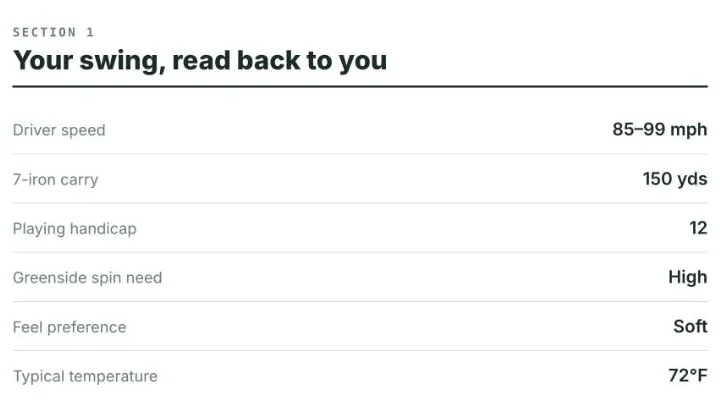
A real report’s first page, generated for a sample 12-handicap profile at 85–99 mph — yours is built from your own answers. See every section of the report.
The next step
Take the BallCaddie fitting quiz — it asks for swing speed, short-game priority, and budget, then ranks the right beginner options for your specific profile. Ninety seconds.
Key takeaways
- The best golf balls for beginners are soft, low-compression, forgiving, and under $25/dozen.
- Top picks: Callaway Supersoft (softest), Wilson Duo Soft (best value), Srixon Soft Feel (most feedback).
- If you slice: Bridgestone e6 for anti-side-spin design.
- Avoid tour balls (Pro V1, TP5, Chrome Tour) until you’re shooting under 100 consistently and swinging above 85 mph.
- Avoid X-Outs. Compression consistency matters when you’re learning how the ball reacts.
- Start with a sleeve, not a dozen — you haven’t played enough rounds to know what feel you’ll like.
- Related reading: best golf balls for high handicappers, best golf ball for a slice, how to choose a golf ball for your swing speed.
Stop guessing your golf ball
Take the 90-second fitting quiz · matched from a 70+ ball catalog · sign up to see your match
Take the quiz →Related posts
A 20-handicapper averages 213 yards off the tee and gets up-and-down 21.7% of the time. Soft-ionomer territory — premium urethane rarely pays back.
A 15-handicapper averages 93 mph and converts 25% of up-and-downs. That's the value-urethane tier — premium tour pricing usually doesn't pay off here.
The best value golf balls ranked by swing speed tier — from the most affordable urethane options to budget ionomer picks that beat premium balls for recreational golfers.
A 10-handicapper has the swing speed and short-game consistency to use urethane tour balls. Here are the top picks — plus the soft-tour alternatives if you're early in the 10-handicap range.
Frequently asked questions
- What's the best golf ball for a beginner?
- For most beginners, the Callaway Supersoft (~49 compression, ~$27/dozen) is the best overall pick. The Wilson Duo Soft (~35–46, ~$25) is the best value. For beginners who want slightly more feedback at impact, the Srixon Soft Feel (~55–62, ~$25) is a strong alternative. All three are soft, low-compression, forgiving, and priced low enough to replace when you lose them.
- Should beginners play Pro V1?
- No. The Pro V1 is designed for swing speeds above 88 mph with consistent ball-striking. Most beginners have swing speeds under 85 mph and inconsistent contact — the Pro V1's firm core doesn't activate and its urethane cover generates short-game spin that inconsistent strikers can't control. For roughly one-third of the price of a Pro V1, the Callaway Supersoft or Wilson Duo Soft delivers better on-course results for a beginner's swing.
- How much should a beginner spend per dozen golf balls?
- Between $15 and $27 per dozen. Below $15, you're in X-Out or generic-knockoff territory where compression varies wildly across the sleeve — not useful when you're trying to learn how the ball reacts. Above $27, you're paying for greenside spin that beginner short-game contact can't reliably use. The $25–$27 band covers the top picks (Duo Soft, Supersoft, Soft Feel) with consistent construction.
- How many balls should a beginner buy?
- Start with two sleeves (six balls) of one model. Two sleeves is enough for a first round with normal beginner ball-loss rates, and it commits you to one ball long enough to learn how it flies. Once you're scoring under 110 consistently, move to a dozen of the same ball — ball-to-ball consistency starts mattering. Avoid buying a dozen of a ball you've never played — if you don't like the feel, you're stuck with 11 more.
- Are used (lake) balls okay for beginners?
- Grade A or Grade B used balls (recovered after one round of play, graded for cosmetic wear) are fine for beginners — often the same performance at 30–50% of retail price. Stick to reputable resellers that inspect and grade. Avoid 'Grade C' or 'Practice Grade' used balls, which can have compression inconsistencies that mess with feedback. Used Callaway Supersofts or Wilson Duo Softs at $10/dozen are a legitimate starter option.
- When should a beginner upgrade to a tour ball?
- When three conditions hold: you're shooting under 100 consistently, your swing speed has reached 85+ mph, and you're making up-and-down from inside 50 yards at least 30% of the time. Those thresholds indicate your contact quality can use urethane spin and your scoring is stable enough that small ball differences matter. Until then, save the $35+ per dozen — it doesn't translate to lower scores at beginner skill levels.
Stop guessing your golf ball
Take the 90-second fitting quiz · matched from a 70+ ball catalog · sign up to see your match
Take the quiz →