🎯 New here? BallCaddie matches golfers to the right ball. → Take the 90-second quiz
Back to BlogBest Golf Balls for High Handicappers (15–25 Handicap)
The 5 most forgiving balls for 90+ shooters: soft, low-spin, low-compression, and cheap enough to lose. Plus the 4 mistakes that cost high handicappers strokes.
Answer a few questions about your swing and BallCaddie matches you against a 70+ ball catalog.
Take the 90-second quizQuick answer
High handicappers (roughly a 15 handicap and up, usually scoring 90+) need soft, low-compression, forgiving, affordable balls — not the urethane tour balls marketed to professionals. The best options in 2026 are the Callaway Supersoft, Wilson Duo Soft, Srixon Soft Feel, Titleist TruFeel, and Bridgestone e6. All share low compression (35–68), ionomer covers, forgiving construction, and sub-$30-per-dozen pricing.
Looking for a specific handicap? This post covers the high-handicap range broadly (20+ handicaps, 90+ scores). For tighter targeting, jump to the dedicated posts: best golf ball for a 20-handicap, 15-handicap, or 10-handicap. All four posts share the same underlying fitting logic — the dedicated 20-handicap pick is the Callaway Supersoft at $20.
Best golf balls for high handicappers: comparison table
| Ball | Compression | Cover | Layers | Price/dozen | Best for |
|---|---|---|---|---|---|
| Callaway Supersoft | ~49 | Ionomer | 2-piece | $26.99 | Softest feel, cold weather |
| Wilson Duo Soft | ~37 | Ionomer | 2-piece | $24.99 | Best value, consistent |
| Srixon Soft Feel | ~58 | Ionomer | 2-piece | $24.99 | More feedback, slight spin edge |
| Titleist TruFeel | ~70 | Ionomer | 2-piece | $28 | Brand trust, durability |
| Bridgestone e6 | ~45 | Ionomer | 2-piece | $23.99 | Straighter shots, low side spin |
| Callaway Supersoft Max | ~40 | Ionomer | 2-piece | $22 | Oversized, maximum forgiveness |
Why high handicappers need a different ball than tour players
Golf ball marketing spends most of its energy on the Pro V1 tier, because that’s where the brand equity lives. The Pro V1 is designed for golfers who:
- Swing above 90 mph
- Strike the center of the face consistently
- Can use tour-level wedge spin to stop the ball on specific spots
Most high handicappers don’t yet do those things consistently — and that’s fine. The ball that matches where your game actually is performs better than the ball you aspire to play. That’s not a compromise; it’s fitting.
The technical reasons:
-
Compression: Most high handicappers swing under 90 mph. A low-compression (35–70) ball fully activates the core at those speeds, returning more energy as ball speed. A 90+ compression tour ball never fully compresses, meaning you lose distance before you even start.
-
Cover material: Urethane generates 8,000–10,000 RPM of wedge spin — which is a greenside control tool for consistent strikers. Off-center contact drastically reduces that advantage. High handicappers making variable contact with wedges get less value from urethane than their consistent-striking counterparts.
-
Price: At $55 per dozen, losing two balls per round costs $9.17 per round in ball expenses. Over 30 rounds, that’s $275. A $20-per-dozen ionomer ball cuts that to $100. The $175 difference pays for lessons that will reduce your handicap faster than any ball upgrade.
The best high handicap golf balls for 2026
1. Callaway Supersoft — Best overall for high handicappers
Compression: ~49 | Cover: Ionomer | Price: ~$20/dozen
The Callaway Supersoft has been one of the best-selling golf balls in the US for over a decade because it delivers on its core promise: soft feel and distance for moderate swing speeds. At 49 measured compression (one of the lowest in any independent testing), it activates easily for swing speeds from 60 to 90 mph.
The HEX aerodynamic cover pattern delivers a penetrating ball flight that helps slower swingers carry the ball farther. It’s available in white, yellow, and other colors. For high handicappers who just want a ball that feels good, goes far, and costs $20, this is the standard recommendation.
Best for: Swing speeds 65–88 mph, golfers who prioritize soft feel, cold-weather rounds.
2. Wilson Duo Soft — Best value
Compression: ~35–46 | Cover: Ionomer | Price: ~$18/dozen
The Wilson Duo Soft consistently measures as one of the softest balls in MyGolfSpy’s Ball Lab, measuring 35–46 compression on their calibrated gauge — comparable to the Callaway Supersoft but at roughly $2 less per dozen. It comes in multiple colors, travels well in wind, and holds up to typical wear.
The Duo Soft doesn’t have the brand recognition of Titleist or Callaway, but in independent testing its performance is consistent. For high handicappers on a budget who want a reliable, soft, distance-friendly ball, it’s the best dollars-per-round-of-use option available.
Best for: Budget-conscious high handicappers, beginners, high-volume players who go through multiple balls per round.
3. Srixon Soft Feel — Best for feedback
Compression: ~55–62 | Cover: Ionomer | Price: ~$22/dozen
The Srixon Soft Feel sits slightly firmer than the Supersoft or Duo Soft — at 55–62 measured compression — which translates to marginally more feedback at impact. Golfers who want to feel the strike (rather than absorb it) often prefer this response, even at the cost of some softness.
The 338-speed dimple pattern provides consistent flight in wind. Srixon’s Ball Lab data shows the Soft Feel generates slightly more greenside spin than comparable ionomer balls, making it a reasonable choice for high handicappers who are developing short-game feel and want a bit more feedback from chip shots.
Best for: High handicappers who want more shot feedback, players transitioning toward mid-handicap range.
4. Titleist TruFeel — Best for brand loyalty and durability
Compression: ~70 | Cover: Ionomer | Price: ~$28/dozen
The TruFeel is Titleist’s entry-level offering — which means it has the construction quality and consistency that the Titleist name implies, at about half the cost of a Pro V1. It measures 70 compression, the firmest of the soft-ionomer picks here, and delivers consistent feel and flight round to round.
Titleist’s quality control is consistently rated above average in independent testing. If you play Titleist equipment, like the brand feel of a Titleist ball, or want reliable consistency over rounds, the TruFeel is the right entry point. At $28 per dozen it’s on the high end of the value tier, but the consistency-per-dollar is solid.
Best for: Titleist brand loyalists, golfers who value consistent round-to-round performance, players with swing speeds of 75–92 mph.
5. Bridgestone e6 — Best for straighter shots
Compression: ~45 | Cover: Ionomer | Price: ~$26/dozen
Bridgestone engineered the e6 specifically for golfers who struggle with curvature — hooks and slices. The anti-side-spin core design reduces the off-axis spin that causes the ball to curve, which for high handicappers with big misses can translate to fewer penalty strokes and more balls in play.
It doesn’t guarantee straight shots — swing path still matters — but for golfers whose biggest miss is a significant curve, the e6’s design works with the physics of the problem rather than against it. It measures 45 compression and comes in both white and optic yellow.
Best for: High handicappers with a consistent curve (big slice or hook), golfers focused on keeping the ball in play more than generating maximum distance.
Most forgiving golf balls for high handicappers
The most forgiving high handicap golf balls attack the mistake that costs high handicappers the most strokes: the curve. Off-center contact and an out-to-in path put sidespin on the ball, and that sidespin is what sends a drive out of bounds. The forgiving picks all lean on low spin, and the strongest ones pair it with a soft, easy-launching build.
- Low spin off the driver. The soft, low-compression balls — the Callaway Supersoft (~49) and Wilson Duo Soft (~37) — spin less off the tee, and low spin is what keeps a mishit from ballooning into a slice. Both are cataloged as low-spin, high-launch balls built for swing speeds under 90 mph.
- Straight-flight core design. The Bridgestone e6 uses a large gradational core (firmer from center to edge) and a tough Surlyn cover to deliver low spin and a smoother flight, so hooks and slices curve less and stay in play more often. Independent testing consistently shows lower-compression ionomer balls produce less driver spin than tour urethane, which makes them a better straight-flight fit for high-handicap swings (MyGolfSpy 2025 ball test).
- Oversized profile for confidence. The Callaway Supersoft Max is the larger-diameter version — a bigger look at address on the same soft two-piece ionomer formula — built for beginners who want maximum forgiveness.
For most high handicappers the honest read is simple: pick the softest low-spin ball you’ll commit to for a full season. The Bridgestone e6 is the sharpest anti-curve tool here; the Callaway Supersoft is among the softest all-round options. Both use low-spin designs that reduce the curve a mishit produces. Neither replaces range time on your swing path.
What to avoid: common high-handicapper mistakes
Buying a dozen Pro V1s because a YouTube video said so. Pro V1s are an excellent ball — for the right swing profile. Below 88 mph with inconsistent contact, you’re paying $57 to not use the urethane spin advantage and not fully compress the core. Buy what fits the game you have, not the game you want.
Playing “X-Out” or bargain bin balls. Rejected tour balls with cosmetic defects often have compression inconsistencies that can’t be fixed by sanding a spot off the cover. The compression range across a sleeve of X-Outs can vary 10–20 points. A $18 sleeve of consistent Wilson Duo Softs performs more predictably than a $10 sleeve of mystery-compression X-Outs.
Switching balls every round. Consistency in equipment helps you learn what a ball does. Pick one ball for a full season, learn how it launches and how it responds on chips, and only switch when you have a clear reason. Ball switching in golf is a way to avoid addressing swing problems with the same problems every round.
Ignoring swing speed when selecting. The advice “play a soft ball” is usually right for high handicappers, but swing speed tells the full story. A 95-mph high handicapper with an inconsistent short game is a different player than a 75-mph high handicapper with the same handicap. Use your swing speed to find the right compression tier, then choose among options in that tier.
When to upgrade from high-handicapper balls
Consider moving up to tour-lite urethane options (like the Srixon Q-Star Tour or Bridgestone Tour B RX) when:
- Your handicap drops to 18 or below consistently
- You’re making up-and-down from inside 50 yards at least 35–40% of the time
- You’ve measured your swing speed at 88+ mph
- You notice ionomer balls stopping less consistently on chip shots than you’d like
The upgrade from ionomer to urethane is worth making — but only when your game is ready to translate the spin advantage into real strokes saved. Until then, keep the extra $30 per dozen.
The BallCaddie fitting quiz asks for handicap, swing speed, and short-game priority to identify the exact transition point for your profile — whether that’s staying in the ionomer tier or moving toward tour-lite urethane.
How BallCaddie fits a high handicapper
The picks in this post are tier advice; a fitting report is the same logic run against your specific answers. The quiz takes about 90 seconds and asks for your first name and email before question 1 — then handicap, driver-speed band, typical miss, short-game priority, feel, and budget. The engine scores 70+ balls against that profile, with budget and handicap among the scored inputs — it even gives value-tier balls a small scoring nudge at 16-plus handicaps, so a value dozen that fits your profile can outrank a premium dozen that doesn’t.
The report opens by reading your answers back in the units a fitter would use, states the spec ranges your game calls for, and counts how many of the scored balls cleared the bar for your profile. Those six sections are free. The seventh names your #1, #2, and #3 — $29, one time.
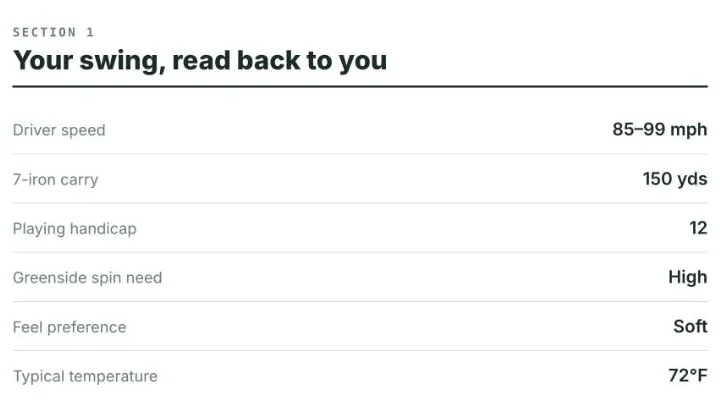
The opening section from a real report — a sample 12-handicap profile at 85–99 mph; your report shows your own numbers. See every section of the report.
Key takeaways
- High handicappers benefit from soft, low-compression (30–70), ionomer-covered balls that forgive off-center contact and match lower swing speeds.
- Best overall: Callaway Supersoft ($26.99) for cold-weather feel; Wilson Duo Soft ($24.99) for the softest feel and the best value; Srixon Soft Feel ($24.99) for more feedback.
- Avoid premium tour balls (Pro V1, Chrome Tour, TP5) until you’re shooting consistently in the 80s and swinging above 88 mph — the advantages don’t activate at high-handicap swing speeds and contact quality.
- Ball loss rate matters: at $55/dozen, losing 2 balls per round costs $275 over a season; the same loss rate with $20 balls costs $100. The difference funds real instruction.
- Cover material drives short-game spin — urethane vs ionomer explains when the upgrade makes sense.
- Compression determines driver distance — see the golf ball compression chart to match your swing speed to the right tier.
- Not sure where your swing speed sits? Read how to choose a golf ball for your swing speed for measurement methods and per-tier recommendations.
Stop guessing your golf ball
Take the 90-second fitting quiz · matched from a 70+ ball catalog · sign up to see your match
Take the quiz →Related posts
The best golf balls for distance by swing speed — AVX at 95–105, Tour B X above 105 — and the 2026 robot data on why the field barely separates under 90 mph.
The right golf ball for a beginner is soft, low-compression, and cheap enough to lose without flinching. Here are the top picks under $25 that forgive mishits and match slower swing speeds.
The 7 online golf ball fitting tools worth running in 2026, ranked by brands scored, what they ask past swing speed, and whether the result explains itself.
How online golf ball fitting works: what brand selectors and neutral fitters ask, where a questionnaire beats a launch monitor, and how to answer it right.
Frequently asked questions
- Should high handicappers use Pro V1?
- Not usually. The Titleist Pro V1 is designed for swing speeds above 90 mph with consistent ball-striking. High handicappers with swing speeds under 85 mph don't fully compress the firmer Pro V1 core, which can cost ball speed off the tee. The Pro V1's urethane cover also generates high greenside spin — which is an advantage only when contact is consistently centered. For most high handicappers, a softer ionomer ball at one-third the price performs as well or better.
- Does ball choice actually matter for high handicappers?
- Yes, but for different reasons than low handicappers. The right ball for a high handicapper reduces the penalty for off-center contact (softer ionomer forgives mishits), matches the lower swing speed (low compression maximizes distance at slower club speeds), and fits the budget (losing two balls per round with a $55 dozen costs $9+ per round in ball expenses alone). The wrong ball doesn't make the game unplayable — but the right one removes unnecessary friction.
- What compression should a high handicapper play?
- High handicappers typically benefit most from low compression (30–70), because most players in this category have swing speeds under 90 mph. A low-compression ball fully activates at impact with a slower swing, returning more energy as ball speed. Playing a 90+ compression tour ball below 85 mph means the core never fully compresses — you lose distance and don't gain the tour-level greenside spin the premium is paying for.
- Are lake balls (used balls) worth buying for high handicappers?
- Grade A or Grade B used balls (recycled from courses after one round of play) offer excellent value for high handicappers — often the same performance at 30–50% of retail price. The primary risk is with used urethane-covered balls, which can absorb moisture over time and lose compression consistency. Used ionomer balls are more durable and hold their properties longer. If buying used, stick to reputable resellers that grade and inspect for damage.
- What's the best budget golf ball for high handicappers?
- The Wilson Duo Soft (~$25/dozen) and Callaway Supersoft (~$27/dozen) consistently rank as the best value options for high handicappers in independent testing. Both are low-compression (35–47 measured), two-piece ionomer construction, forgiving, and durable. The Wilson Duo Soft offers a slightly firmer feel for players who prefer feedback; the Callaway Supersoft is the softest option on the market and plays well in cold weather.
- What is the most forgiving golf ball for a high handicapper?
- The most forgiving high handicap golf balls are low-compression, two-piece ionomer balls with low-spin, straight-flight designs. The Bridgestone e6 pairs a large gradational core with a tough Surlyn cover to lower spin and curve on hooks and slices; the Callaway Supersoft (~49) and Wilson Duo Soft (~37) are among the softest low-spin balls tested, which keeps mishits straighter; and the oversized Callaway Supersoft Max adds a larger profile for confidence at address. Lower driver spin is what limits the sidespin that turns a mishit into a lost ball.
- How many golf balls should a high handicapper carry in a round?
- Most instructors and caddies recommend high handicappers carry at least six balls per round, depending on the course and conditions. Rounds with water hazards, thick rough, or narrow fairways can easily require four or five replacements. Running out of balls mid-round adds stress that compounds score — it's one of the most avoidable problems in amateur golf.
Stop guessing your golf ball
Take the 90-second fitting quiz · matched from a 70+ ball catalog · sign up to see your match
Take the quiz →