🎯 New here? BallCaddie matches golfers to the right ball. → Take the 90-second quiz
Back to BlogCostco Golf Balls Review: Kirkland Signature Performance+ vs Pro V1
Independent review of the Costco Kirkland Signature Performance+ golf ball — construction, performance data, and how the ~$15 Costco ball compares to the $57.99 Pro V1.
Answer a few questions about your swing and BallCaddie matches you against a 70+ ball catalog.
Take the 90-second quizQuick answer
Kirkland Signature golf balls are sold only at Costco, in exactly one model — the Kirkland Signature Performance+, at about $15 per dozen ($29.99 per 2-dozen box at the warehouse). It’s a legitimate 3-piece cast-urethane tour ball, roughly $43 less than the Pro V1. Buy the yellow. MyGolfSpy’s 2026 ball test scored yellow and white separately — they come from different factories — and the yellow beat the white by 10-plus spots in five of six full-swing conditions. On full swings the yellow runs with premium balls. Greenside is the catch: Kirkland’s wedge spin has slipped to roughly ionomer level, so golfers who score from inside 50 yards are now giving up something real.
Costco golf balls: just the Kirkland Signature
Costco doesn’t sell golf balls plural — it sells one in-house ball, the Kirkland Signature Performance+, available at Costco warehouse locations and Costco.com. There’s no Costco-branded distance ball, women’s ball, or value ionomer. Everything below applies to that single SKU. If you’ve seen a “Kirkland v3.5” referenced online, that’s a media nickname, not a separate product: Costco quietly improved the current V3.0 spec, and reviewers tagged the tweaked batch “v3.5” to mark the change. The older “v2” and “v3” labels are just earlier generations of the same in-house ball, updated multiple times since the original 2016 launch.
At a glance
| Spec | Kirkland Performance+ |
|---|---|
| Price per dozen | ~$15 (Costco warehouse; $29.99 per 2-dozen box; $39.99 shipped on Costco.com) |
| Construction | 3-piece |
| Cover | Cast urethane |
| Compression | ~95 (high) |
| Spin category | Mid |
| Best swing speed | 85–105 mph |
| Where to buy | Costco only |
What you’re actually getting
The Kirkland Signature Performance+ is a 3-piece golf ball with a cast urethane cover — the same cover class used on the Titleist Pro V1, Callaway Chrome Soft, and TaylorMade TP5. Urethane is what produces tour-level greenside spin; ionomer covers on budget balls cannot replicate it regardless of price.
The construction is a large, high-energy core surrounded by an ionomer mantle layer and the urethane outer cover. This is a conventional tour-ball architecture. The compression rating sits around 95 — high-compression territory, a touch firmer than the Pro V1’s ~92 — meaning it is well-matched to swing speeds from about 85 mph to 105 mph.
What’s different from a Pro V1 at about $15 a dozen? Primarily margin, brand research investment, and the retail supply chain. Kirkland cuts all three. The ball itself is manufactured to a defined spec under a Costco quality contract, not R&D-lead engineering from a dedicated ball laboratory.
2026 update: yellow vs. white
MyGolfSpy’s 2026 ball test (48 balls, robot-controlled, published August 2026) did something no previous test did: it entered the yellow and the white Performance+ as two separate balls. Its stated reason: “As readers have noted, the yellow and white versions of the ball are produced in different factories.” The Ball Lab teardowns name them — the yellow made by SM Global in China, the white by SM Parker in Vietnam. Same box art, same $29.99 two-dozen price, different factories — and the data follows the factory, not the logo.
Full swings — the yellow wins clearly. The yellow finished top-five for driver spin at high swing speed, third-highest for driver spin at the top speed tested, and top-ten for full-swing spin in every condition on the test list. The white landed 10-plus spots lower in five of six conditions, typically 13th to 17th. The one place they behave alike is low driver speed, where they came out 8th and 9th.
Greenside — both have slipped. Kirkland’s short game used to be the headline: urethane spin at ionomer money. MyGolfSpy’s read now is that “across recent tests we’ve seen its greenside spin dip appreciably.” On the 35-yard wedge in 2026, the white spun less than the best ionomer ball in the test, and the yellow was effectively tied with it. Premium urethane balls spin roughly 1,250 rpm more than ionomer around the green. The Kirkland is no longer collecting that advantage.
Quality control has improved. The July 2026 Ball Lab teardown of the yellow V3.0 scored it 84 — a grade B — with a 100% good-ball rate: zero defects across 36 balls, weight and diameter both conforming. Compression measured 91–97 on their gauge across recent tests. That is a different ball from the 2023 batch that posted a 15-point compression spread.
What to do with that: buy the yellow. It costs the same, it’s the better ball on full swings, and it’s the one with the recent clean Ball Lab result. If your scoring comes from spinning wedges, price the Kirkland against a premium urethane ball on short-game merit rather than assuming the gap is small.
Performance: what independent testing shows
MyGolfSpy runs robot-controlled ball tests with consistent strike conditions across dozens of models each year. Their repeated finding on Kirkland balls: driver ball speed and total distance are within the measurement margin of mid-tier premium balls for most swing speeds.
Driver: Ball speed differences between the Kirkland and Pro V1 in robot testing typically run under 1 mph at the same clubhead speed — translating to 1–3 yards of carry difference. At real-world swing speeds with natural variability, this gap disappears in normal play.
Irons: Mid-iron spin is competitive with other 3-piece urethane balls, and in the 2026 test the yellow was top-ten for full-swing spin in every condition measured. The urethane cover activates at iron contact speeds, which is where the cover-material upgrade over ionomer balls pays off in short-game feel and stopping power.
Short game: This is where honest reviews of Kirkland have changed. Older tests put greenside spin close to Pro V1 levels in dry conditions, with the gap opening in wet or damp ones. The 2026 test moved the baseline: on a 35-yard wedge, both Kirklands now sit at ionomer level, with the white below the test’s best ionomer ball and the yellow tied with it. Premium urethane is worth about 1,250 rpm more greenside, and the Kirkland is not capturing that any more. If you shape wedge shots to landing zones, treat this as a real cost rather than a rounding error.
Durability: Expect 9–12 holes of cosmetic freshness, versus 12–18 for a Pro V1. The Kirkland scuffs more quickly on cart paths and chip shots, which affects aerodynamics meaningfully only if the scuff is deep. In practice, most golfers switch at natural round breaks anyway.
“The Kirkland ball consistently finishes in the top third of our value-category testing — and some years it beats balls costing twice as much off the driver. The performance is real.” — MyGolfSpy Most Wanted Ball Testing
Who should play the Kirkland ball
Play it if:
- Your swing speed is 85–105 mph — and buy the yellow, not the white
- You score in the 80s or 90s and want a tour-quality cover without tour pricing
- You lose several balls per round and want to stop doing math on premium ball costs
- You want to test whether a urethane ball improves your short game without committing to $58 per dozen
Look elsewhere if:
- Your swing speed is under 85 mph — a lower-compression ball will serve you better regardless of price
- You depend on high greenside spin — as of the 2026 test, both Kirklands wedge like an ionomer ball
- You’re a single-digit handicapper who scores from precise distance control inside 50 yards — in that case, a few extra dollars per round for a Pro V1 or Chrome Soft is justifiable
How it compares to the closest alternatives
| Ball | Price/dozen | Cover | Compression | Notes |
|---|---|---|---|---|
| Kirkland Performance+ | ~$15 | Urethane | ~95 | Best value in urethane category |
| Titleist Pro V1 | $58 | Urethane | ~92 | Premium spin consistency |
| Callaway Chrome Soft | $55 | Urethane | ~77 | Softer, higher launch |
| Vice Pro | $40 | Urethane | ~89 | DTC alternative, similar price |
| Snell PR3 | $35 | Urethane | ~91 | DTC, former Titleist engineer |
| Srixon Z-Star | $55 | Urethane | ~81 | Tour-proven, mid-range pricing |
The Kirkland’s ~$15 price point makes it unique — nothing in urethane construction comes close at that price point outside of occasional sales. The Vice Pro at $40 and Snell PR3 at $35 are the nearest competitors, also direct-to-consumer, and both earn high marks in testing. All three represent meaningful savings versus major-brand tour balls.
The $43 question
The difference between a Kirkland dozen and a Pro V1 dozen is about $43. Over a 20-round season where you go through two dozen balls, that’s $86 saved — enough to cover a range session, a fitting, or another round of golf.
The Pro V1 is better. Off the tee and on full irons the margin is narrow — the yellow Kirkland is genuinely close. Around the green, after the 2026 test, it isn’t narrow any more. The question worth asking is “is it $43 per dozen better for my game?” For most recreational golfers, the honest answer is no.
How BallCaddie scores the Kirkland for your game
The engine scores the Kirkland Signature alongside 70+ balls on the same axes — compression, cover material, spin profile, trajectory, and your short-game priority. Budget is one of the scored inputs, and fit carries the most weight — a $15 dozen that fits your swing can outrank a $55 dozen that doesn’t. BallCaddie takes no affiliate money from any ball maker, Costco included.
For a value shopper, the useful number in the free report is the count. Every ball gets scored against your ideal spec, and the report tells you how many came in below 80% of it — which is the honest way to see whether the cheap ball made your shortlist without anyone naming the shortlist. Six sections are free after the 90-second quiz (first name and email come before question 1); the seventh names your #1, #2, and #3 for $29, one time.
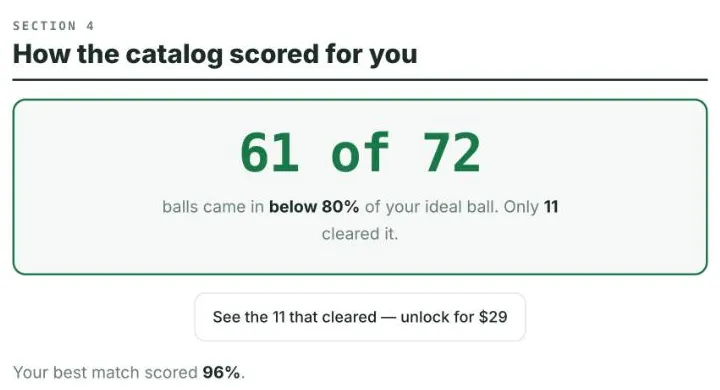
From a real report for a sample 12-handicap profile at 85–99 mph — 61 of 72 balls scored below 80% for that swing. See every section of the report.
Next steps
If the Kirkland is unavailable at your local Costco, the DTC alternatives above are worth considering. If you want to know which ball in the full catalog — Kirkland included — scores best against your swing speed, typical miss, and green-game priorities, the BallCaddie fitting quiz runs the comparison across 70+ balls in about 90 seconds.
Related reads:
- Best value golf ball in 2026 — the full ranked list across all price tiers
- Urethane vs. ionomer covers — why cover material matters more than brand
- Golf ball compression chart — where the Kirkland lands on a calibrated scale
Key takeaways
- The Kirkland Performance+ uses cast urethane — the same cover class as a Pro V1, not a budget ionomer ball
- About $15/dozen ($29.99 per 2-dozen box) makes it the most affordable urethane tour ball by a significant margin
- Robot testing shows driver and iron performance within 1–3 yards of premium alternatives
- Buy the yellow. MyGolfSpy’s 2026 test scored yellow and white separately — different factories — and the yellow was top-ten for full-swing spin in every condition while the white sat 10-plus spots lower in five of six
- Greenside spin is now the real gap. On a 35-yard wedge both Kirklands measure at ionomer level; premium urethane spins about 1,250 rpm more
- Best for swing speeds 85–105 mph and golfers shooting 80–95 who want to stop paying $58 for a dozen
Stop guessing your golf ball
Take the 90-second fitting quiz · matched from a 70+ ball catalog · sign up to see your match
Take the quiz →Related posts
Robot-test data on the ~$15-a-dozen Kirkland Signature ball vs the $57.99 Pro V1 — where the Costco hype is earned, where it breaks, and who should actually play it.
What Costco's Kirkland Signature golf ball costs in 2026, who actually manufactures it, and what robot testing says the $15 ball gives up to a Pro V1.
Maxfli Tour vs Tour X, settled by the data: 94 vs 102 compression, 3-piece vs 4-piece, launch-monitor results, and the swing speed where the choice flips.
Vice Pro Plus vs Pro V1: the Pro Plus is a firm 4-piece ball that plays closer to the Pro V1x. Compression, spin, price, and which swing speed each one fits.
Frequently asked questions
- Is the Kirkland golf ball as good as a Pro V1?
- That now depends on which Kirkland. MyGolfSpy's 2026 ball test — 48 balls, robot-controlled — scored the yellow and white Performance+ as separate models because they are made in different factories. The yellow finished top-five for driver spin at high swing speed and top-ten for full-swing spin in every condition tested; the white sat 10-plus spots lower in five of six conditions. Off the driver and on full irons, the yellow holds its own with premium balls. Greenside is where the old answer no longer stands: on a 35-yard wedge the white spun less than the best ionomer ball in the test and the yellow was effectively tied with it, so the short-game gap to a Pro V1 is now wide, not narrow.
- Who makes the Kirkland golf ball?
- Costco contracts manufacturing to third-party factories, and as of 2026 it uses two at once. MyGolfSpy's Ball Lab teardowns name the plants: the white Performance+ comes from SM Parker in Vietnam and the yellow from SM Global in China. Its 2026 ball test states only that the colors are produced in different factories, which is why it entered them separately. The specific manufacturer has also changed across versions. The original 2016 version sparked a patent lawsuit from Acushnet (Titleist's parent company) that Costco eventually settled. The current Signature Performance+ is formulated independently and tested to Costco's specs, not a rebadged version of any major brand's ball.
- What compression is the Kirkland Signature golf ball?
- The Kirkland Signature Performance+ has a measured compression of approximately 95, putting it in the high-compression bracket — a touch firmer than the Titleist Pro V1 at ~92. It is best suited for swing speeds of 85 mph and above.
- Can I use the Kirkland ball on tour?
- Yes. The Kirkland Signature Performance+ is on the USGA conforming ball list and qualifies for competition at all levels including tour events. Conformance is the only requirement — brand or price is not a factor under the Rules of Golf.
- Where can I buy Kirkland golf balls?
- Kirkland Signature golf balls are sold exclusively at Costco warehouse locations and Costco.com. They are not available at golf retailers. Availability is occasionally limited — Costco sells them in high volume and restocks periodically.
Stop guessing your golf ball
Take the 90-second fitting quiz · matched from a 70+ ball catalog · sign up to see your match
Take the quiz →