Best Golf Ball for Seniors: Match Compression to Your Swing Speed (2026)
Senior golfers with slower driver swing speeds need low compression. Eight specific picks under $30, the data behind the rule, and cold-weather tradeoffs.
Quick answer
The best golf ball for most seniors is a low-compression (sub-60) two-piece ball that fully activates at driver swing speeds under 90 mph. Top picks: Callaway Supersoft ($28), Wilson Duo Soft ($23), Maxfli SoftFli ($20), and Titleist TruFeel ($25). Active seniors over 90 mph can step up to the Bridgestone Tour B RX ($55) for urethane greenside spin without paying Pro V1 prices.
Senior swing speed → ball compression chart
| Driver swing speed | Typical age range | Compression target | Recommended balls |
|---|---|---|---|
| 70–80 mph | Men 75+, women 60+ | 35–50 (ultra low) | Maxfli SoftFli (~35), TaylorMade Soft Response (~35), Wilson Duo Soft (~37), Callaway Supersoft (~38) |
| 80–90 mph | Men 65–75, women 50–60 | 45–60 (low) | Bridgestone e6 Soft (~45), Titleist TruFeel (~50), Srixon Soft Feel (~60) |
| 90–100 mph | Men 55–65, fit seniors | 70–90 (mid, urethane) | Bridgestone Tour B RX (~85), Titleist AVX, Callaway Chrome Soft |
Why compression is the right starting point for seniors
Driver swing speed decides how much energy reaches the ball, and compression decides how efficiently the core converts that energy. A senior swinging at 78 mph hitting a 100-compression Pro V1x leaves several yards on the tee because the core never fully deforms — energy reflects back into the shaft instead of forward into ball speed. A senior swinging at 78 mph hitting a 38-compression Supersoft uses every bit of the core. The physics is the same as the swing-speed → compression rule for any tier; seniors just live at the slow end of it.
The baseline numbers most equipment brands quote come from TrackMan launch-monitor aggregates and the SuperSpeed Golf age-group dataset. Men aged 50–60 average roughly 98 mph driver speed; men 60+ trend down to 93 mph; men 70+ typically sit in the 75–85 mph range. Women in those same brackets average 13–25 mph slower (73 mph at 50–60, 72 mph at 60–70, 62–72 mph at 70+) — driven by lower lean body mass and shorter average lever length, not by age decline alone. That places almost the entire senior population in the under 90 mph tier — which is where low-compression balls earn their keep.
If you don’t know your swing speed, the rough-but-honest rule of thumb is driver carry (yards) × 0.55 ≈ club head speed (mph). A consistent 170-yard carry is around 94 mph; a 150-yard carry is around 83 mph. For a real number, a Garmin R10 or Rapsodo MLM under $600 gets close enough for fitting decisions — see the swing-speed pillar for the full measurement guide.
Senior driver swing speeds, by age
The data from launch-monitor aggregates and SuperSpeed Golf’s age-stratified study:
| Age bracket | Men avg | Women avg | Typical range |
|---|---|---|---|
| 50–60 | ~98 mph | ~73 mph | 85–110 |
| 60–70 | ~93 mph | ~72 mph | 75–105 |
| 70+ | 75–85 mph | 62–72 mph | 60–90 |
A few honest caveats. Individual variation inside any age bracket is wider than the bracket-to-bracket gap — a fit 72-year-old can outswing a deconditioned 58-year-old by 10 mph. SuperSpeed’s training data also shows that seniors can gain meaningful clubhead speed with structured speed work; their study of 47 golfers averaging 70 years old produced a 5% gain over the program. That’s roughly 4 mph at 80 mph baseline — enough to bump you up a tier on the chart above.
The takeaway: pick the ball for your measured swing speed, not your birthday. Re-measure once a year.
The eight balls worth playing at senior swing speeds
These are the balls that BallCaddie’s fitting engine surfaces most often for senior profiles in the catalog. All specs come from each ball’s manufacturer page and BallCaddie’s measured compression data.
Callaway Supersoft — the default recommendation
Compression 38 · ionomer cover · 2 layers · $27.99 MSRP
The Callaway Supersoft is the most-recommended senior ball at retail for good reason. Ultra-low 38 compression activates at any swing speed above ~70 mph, the high-launch dimple pattern helps senior players who tend to flight the ball low, and the ionomer cover holds up to a full season of cart-path bounces. Greenside spin is moderate — the cover prioritizes durability over wedge bite — so don’t expect tour-level zip on chip shots. Buy it if your scoring strength is off the tee, not around the green.
Wilson Duo Soft — the cheapest “actually compresses” ball
Compression 37 · ionomer cover · 2 layers · $22.99 MSRP
The Wilson Duo Soft is functionally a less-marketed Supersoft at $5 cheaper per dozen. The 37-compression core delivers nearly identical ball speed off the driver at slow swing speeds, and the feel off the putter is genuinely soft. The drawback is shelf availability — Wilson distribution is thinner than Callaway’s, so you’ll find more dozens at Dick’s than at a smaller pro shop. If price is the deciding factor and you can find them, buy a six-pack.
Maxfli SoftFli — the visibility play
Compression 35 · ionomer cover · 2 layers · $19.99 MSRP
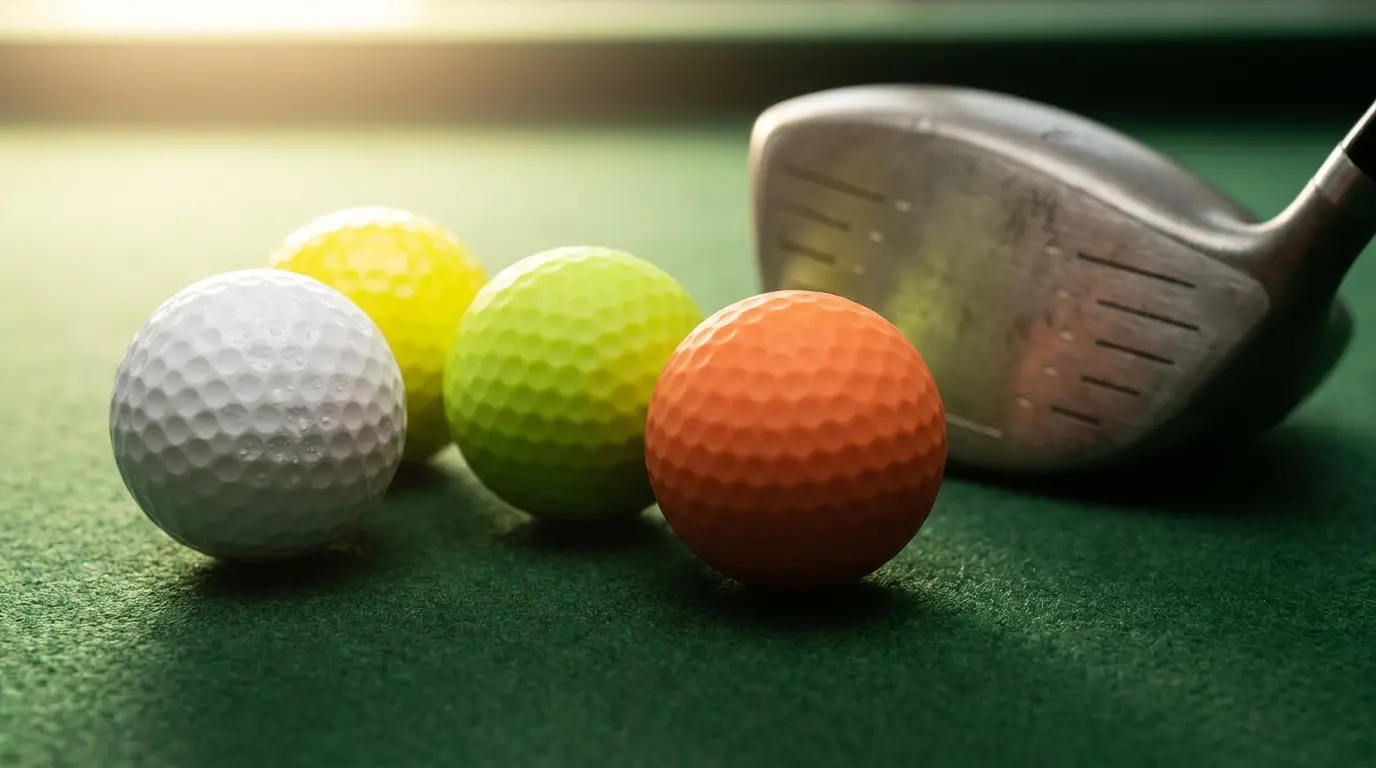
The Maxfli SoftFli is the cheapest ball on this list and ships in the widest color range — yellow, orange, red, pink, and green matte finishes alongside white. For senior golfers with reduced contrast vision, the high-optic colors track measurably better against blue sky and against rough than gloss white does. Performance off the driver is on par with Supersoft and Duo Soft at this swing-speed tier.
TaylorMade Soft Response — comparable mid-tier value
Compression 35 · ionomer cover · 2 layers · $24.99 MSRP
The TaylorMade Soft Response gives you the TaylorMade brand cachet at the same compression as Maxfli for $5 more. Performance is in the same envelope as Supersoft. Pick it if you already play TaylorMade clubs and want everything in one bag color.
Bridgestone e6 Soft — the alternative cover
Compression 45 · surlyn cover · 2 layers · $21.99 MSRP
The Bridgestone e6 Soft is the only surlyn-covered option in the senior shortlist, which buys you slightly tougher scuff resistance than ionomer at the cost of a touch less greenside grip. The gradational core (firmer toward the cover) is built to compress easily for slow swings while still producing penetrating ball flight in wind. A solid windy-course pick.
Titleist TruFeel — the premium-brand value play
Compression 50 · ionomer cover · 2 layers · $24.99 MSRP
The Titleist TruFeel is Titleist’s softest ball and the cheapest one with the script logo on it. Compression sits slightly above the Supersoft tier, which means a senior at 85+ mph gets a little more pop, while a senior at 75 mph leaves a couple of yards on the table compared to a 35-compression ball. Buy it if you’ve played Titleist for thirty years and don’t want to switch.
Srixon Soft Feel — for higher-tier seniors
Compression 60 · ionomer cover · 2 layers · $24.99 MSRP
The Srixon Soft Feel sits at the upper edge of the “low compression” definition. At 60, it’s a better fit for active seniors in the 85–95 mph range than for golfers swinging in the 70s. Mid-high launch and tight dispersion make it a good handicap-improvement choice for someone graduating off ultra-soft balls.
Bridgestone Tour B RX — the active-senior urethane upgrade
Compression 85 · urethane cover · 3 layers · $54.99 MSRP
The Bridgestone Tour B RX is the right answer for the senior who still swings 90–105 mph and scores in the 80s. The urethane cover delivers tour-level greenside spin (2,000–3,500 rpm more wedge spin than ionomer balls per MyGolfSpy’s spin testing), the 85-compression core fully activates above 90 mph, and the price comes in $3–$5 below a Pro V1 dozen. If you want the Pro V1 experience without overpaying for compression you can’t activate, this is the ball.
What the data actually says about “soft is slow”
The slogan you’ll hear at every fitting bay is soft is slow — meaning a low-compression ball produces lower ball speed off the driver than a firm one. It’s true at the extremes, and ball marketing leans on it hard.
Independent robot testing tells a more nuanced story. MyGolfSpy’s compression analysis found that even at swing speeds as low as 60 mph, golfers successfully compress moderately firm ball cores. The bigger driver-distance variable at slow speeds turns out to be dimple pattern and aerodynamic profile, not compression magnitude.
Translated to senior reality:
- At 75 mph, the ball-speed difference between a 35-compression Supersoft and a 70-compression Tour Soft is roughly 1–2 mph. That’s 2–4 yards of carry. Real, but smaller than ball marketing suggests.
- At 90 mph, the gap closes further — both balls compress fully, and the dimple/cover combination drives the difference.
- At 105+ mph (rare for seniors), the soft ball starts to over-compress, and the firm ball wins by 5–10 yards.
The honest read: at senior swing speeds, compression matters most for feel and cold-weather performance, less for raw distance. Pick the soft ball because it feels right and stays alive in the cold, not because it adds a dozen yards.
Urethane or ionomer? When to pay up
A urethane cover delivers 2,000–3,500 rpm more wedge spin than an ionomer one. That’s the entire reason Pro V1s cost $58 a dozen and Supersofts cost $28. The full breakdown is in the urethane vs. ionomer guide.
For a senior, the math usually goes:
- If you score in the 90s and lose strokes off the tee or in the trees: stay ionomer. The greenside spin upgrade pays nothing if your ball doesn’t reach the green-side rough. Save the $30 per dozen and buy lessons.
- If you score in the 80s and your scoring strength is inside 100 yards: the urethane upgrade pays for itself. The Bridgestone Tour B RX is the cheapest way in; the Titleist AVX is the next step up at slightly firmer compression.
- If you score in the 70s at age 70: you already know what ball you play, and you’re not reading this guide.
The decision isn’t urethane-or-bust — it’s whether the next ten strokes come from greenside or somewhere else. Most seniors save them somewhere else.
Cold-weather considerations
Many seniors play more shoulder-season golf than younger players because tee times are easier. That makes cold-weather ball selection a bigger factor for this demographic than for any other.
The physics, per Titleist’s lab guidance and Golf Monthly’s cold-weather buying guide:
- Driver carry drops roughly 1 yard per 10°F of temperature decrease (TrackMan reading), or about 1.5% per 20°F (Titleist reading). They agree directionally.
- Driver spin rises in cold weather — independent testing has measured a 500 rpm spike (~20%) at 40°F vs 70°F. That makes balloon flights worse.
- Cold air is denser, adding drag on top of the firmer ball.
The ball selection implication: drop one compression tier in cold weather, or stay on a low-compression ball year-round if you play below 50°F more than a few rounds a season. The Callaway Supersoft, Bridgestone e6 Soft, and Wilson Duo Soft all retain noticeably more feel in 40°F conditions than a 90-compression tour ball does. PGA Tour Superstore’s cold-weather guide covers the practical handling tactics — the most useful one is keeping a sleeve in an inside cart-bag pocket between holes.
The next step
This list narrows the 79-ball market down to eight honest options for senior golfers. To get a personalized pick that factors in your typical miss, greenside priority, and budget alongside swing speed, run two minutes through the BallCaddie fitting quiz — it scores the full ball catalog against your profile. Sign up to see your match. No affiliate tilt; we recommend the $20 dozen when it’s the right answer.
For deeper dives:
- How to choose a golf ball for your swing speed — the master pillar covering every speed tier from 70 to 115+ mph.
- Golf ball compression chart — every ball’s measured compression on a single calibrated scale.
- Best golf ball for an 85 mph swing speed — the active-senior tier, with picks tuned to that speed band.
- Best golf ball for a 90 mph swing speed — for the fit senior trending toward the mid-tier.
- Urethane vs. ionomer covers — when the cover upgrade is worth the price jump.
- Best value golf ball in 2026 — the budget-tier picks across every swing speed.
Key takeaways
- Most seniors fit the under-90 mph compression tier — men 60+ average 93 mph, men 70+ average 75–85 mph, women trend 6–8 mph slower at every age.
- Low-compression balls (35–60) are the default — Callaway Supersoft, Wilson Duo Soft, Maxfli SoftFli, and Titleist TruFeel cover 80% of senior fittings.
- The “soft is slow” warning matters less at senior speeds — the ball-speed gap between a 35- and 70-compression ball at 75 mph is 2–4 yards, not 10.
- Active seniors over 90 mph can step up to the Bridgestone Tour B RX for urethane greenside spin without paying Pro V1 pricing.
- Cold weather pushes everyone one tier softer — drop a compression bracket below 50°F or stay on a low-compression ball year-round.
- High-optic yellow tracks better than gloss white for aging eyes — peak retinal sensitivity sits at 555nm.
Frequently asked questions
What is the best golf ball for senior golfers?
For most seniors with driver swing speeds between 70 and 90 mph, a low-compression two-piece ball delivers the best mix of distance, soft feel, and price. The Callaway Supersoft (38), Wilson Duo Soft (37), Maxfli SoftFli (35), and Titleist TruFeel (50) all sit at $20–$28 per dozen and produce ball speed comparable to balls twice the price at this swing-speed tier. Active seniors over 90 mph can step up to the Bridgestone Tour B RX urethane ball for tour-level greenside spin without overpaying for Pro V1-tier compression.
What compression golf ball should a senior use?
Match your driver swing speed: under 80 mph plays best on a sub-50 compression ball (Maxfli SoftFli, TaylorMade Soft Response, Wilson Duo Soft); 80–90 mph plays well on 45–60 compression (Bridgestone e6 Soft, Titleist TruFeel, Srixon Soft Feel); 90 mph and up can credibly play 70–85 compression with a urethane cover (Bridgestone Tour B RX, Titleist AVX). The penalty for being one tier too soft is small — roughly 2–5 yards of carry. The penalty for being two tiers too firm at 75 mph is bigger because the core never fully activates.
Is a softer golf ball better for senior golfers?
Generally yes, but not as universally as ball marketing suggests. Independent robot testing from MyGolfSpy has shown that even at 60 mph clubhead speed, golfers compress moderately firm cores. The real benefit of a soft ball at slow speeds is feel feedback, lower driver spin (helps slice-prone players), and cold-weather performance. The pure ball-speed gain from going from a 70-compression ball to a 35-compression ball at 75 mph is roughly 1–2 mph — real, but not large enough to call other balls a mistake.
Should seniors play a Pro V1?
If your driver swing speed is consistently 90 mph or higher and your short game is sharp enough to use tour-level greenside spin, yes — the Pro V1 is fine for an active senior. Below 90 mph, a $58 Pro V1 typically produces driver carry within a couple of yards of a $25 TruFeel, and the extra urethane spin only helps if you’re scoring inside 100 yards. Most senior golfers keep more strokes by spending the savings on lessons or a fitting than by paying tour-ball pricing.
Do seniors lose distance in cold weather, and which ball helps?
Yes — TrackMan data puts the loss at roughly one yard of driver carry per ten degrees of temperature drop, and Titleist’s lab guidance is closer to 1.5% per 20°F. Cold air is denser and the ball plays firmer. Low-compression balls (Callaway Supersoft, Wilson Duo Soft, Bridgestone e6 Soft) recover more of that loss than firm tour balls because the core still deforms at slower senior swing speeds even in 40°F weather. Keep a sleeve in your cart-bag pocket to avoid the ball cooling between shots.
What color golf ball is easiest for seniors to see?
High-optic yellow and lime green track best for most aging eyes. The human eye’s peak sensitivity sits in the yellow-green band around 555 nanometers, which is why nearly every ball major now offers a yellow option. If contrast sensitivity has dropped, lime green and high-optic yellow stay distinguishable in low light, against shadow, and across the color-vision-deficiency range. Volvik Vivid offers matte-finish color options if glare bothers your eyes; otherwise the standard yellow Pro V1, Chrome Soft, or Soft Feel works fine.
Is the Callaway Supersoft a good senior golf ball?
Yes — it’s the most-recommended senior ball for a reason. The 38-compression two-piece core fully activates at swing speeds under 90 mph, the high launch helps players who hit the ball low, and the $27.99 MSRP keeps it cheap enough to lose without flinching. The tradeoff is moderate greenside spin: the ionomer cover doesn’t bite like a urethane Pro V1. If your scoring strength is the short game, look at the Bridgestone Tour B RX instead.