Callaway Chrome Soft Review: 72-Compression Tour Ball, Honestly Reviewed
Independent review of the Callaway Chrome Soft — 72 compression, urethane cover, and how it stacks up against the Supersoft, Chrome Tour, and Pro V1.
Quick answer
The Callaway Chrome Soft is a 72-compression, three-piece urethane tour ball built for 90–105 mph driver swing speeds. At $54.99 per dozen, it delivers exceptionally soft feel, high launch, and tour-grade greenside spin — at a small distance cost versus the firmer Chrome Tour and Pro V1. It is the right ball if you want premium feel without the maximum-distance extreme.
At a glance
| Spec | Callaway Chrome Soft |
|---|---|
| Price per dozen | $54.99 |
| Construction | 3-piece |
| Cover | Tour urethane |
| Compression | 72 (mid-soft) |
| Trajectory | High |
| Spin profile | Mid driver, high greenside |
| Best swing speed | 90–105 mph |
| Cold-weather rated | Yes |
| USGA conforming | Yes (conforming list) |
What you’re actually getting
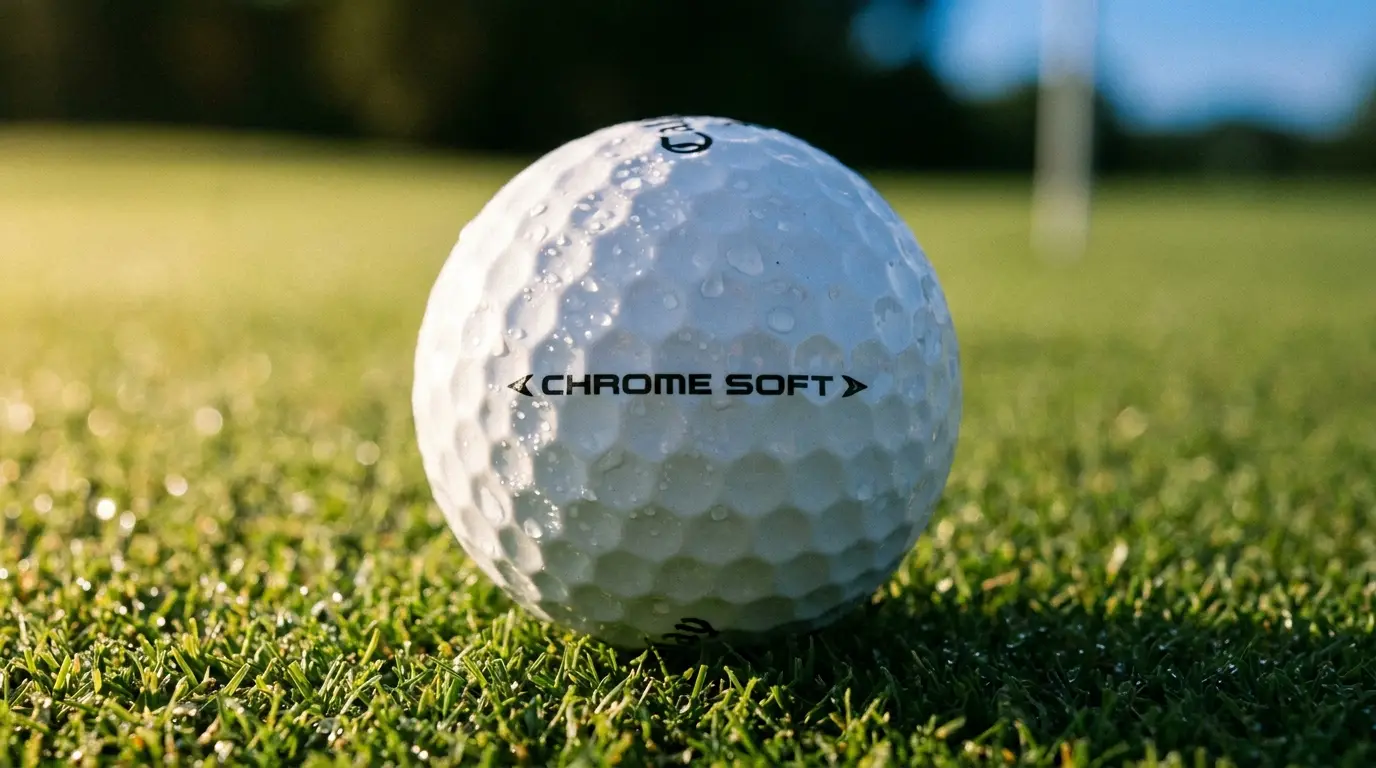
The Chrome Soft sits in Callaway’s premium lineup as the softer-feeling option below the Chrome Tour (~87) and well above the Supersoft (~38). The current generation rebuilt the core: Callaway calls it the Hyper Fast Soft Core, paired with a Tour Fast Mantle layer and a soft tour-urethane cover. The dimple pattern is the Seamless Tour Aero design, a 332-dimple package without the equatorial seam earlier generations carried.
Three things matter for fitting decisions, and the rest is marketing scaffolding:
- Compression is 72. Independent gauge readings put it in the 70–75 band — squarely mid-soft, well under the Pro V1 (87) and the TP5 (87), well above the Supersoft. That number tells you who the ball is for.
- The cover is urethane. That’s the same cover material used on the Pro V1, TP5, and Chrome Tour. Urethane delivers tour-level greenside spin — a real performance gap versus the Supersoft’s ionomer cover.
- Trajectory profile is high. MyGolfSpy’s ball test noted that the Chrome Soft and Chrome Tour “flew similarly high.” Golfalot’s review called it a touch higher than the Pro V1. If you already ballooned drives, that matters.
Who the Chrome Soft is built for
The fitting window is 90–105 mph driver swing speed. Inside that band, the 72-compression core fully activates at impact, the urethane cover returns greenside spin you can actually use, and the high-flight trajectory carries the ball where mid-handicap golfers tend to leave yards on the table.
Outside that band, the Chrome Soft gets worse, not better. Below 90 mph the core doesn’t fully compress — the Supersoft (~38) returns more ball speed for $27 less. Above 105 mph the core over-compresses and ball speed leaks — the Chrome Tour (~87) or Chrome Tour X (~98) holds firmness better. That’s the swing-speed-to-compression rule applied honestly, and it’s the reason the Chrome Soft is the wrong ball for both ends of the player spectrum.
If you score in the 80s, value short-game feel, and play in the 92–100 mph driver speed band, this is one of the right balls. If you live above 105 mph and chase every yard, look elsewhere in Callaway’s family.
How the Chrome Soft actually performs
Independent reviews agree on a tight cluster of findings. The summary version below uses real numbers and direct citations — no manufacturer claims.
Driver and full-swing performance
GolfWRX’s review found that the Chrome Soft “will create maximum distance off the tee for 99 percent of golfers” — meaning it isn’t a robot-test distance leader, but the practical distance for the typical amateur is a wash against any other premium ball. Plugged In Golf called it “the softest feeling tour-caliber ball” they’d played, and noted the driver impact “actually feels as hot and explosive as any other tour ball.” That’s the right read: soft does not equal slow at the 72-compression line, provided the player’s swing speed activates the core.
MyGolfSpy’s ball test summarized the Chrome Soft’s positioning bluntly: “for golfers who want soft urethane without completely giving up speed, Chrome Soft carved out a clear role.” MyGolfSpy’s Ball Lab teardown scored it 76 on a database average of 73 — average-plus, not class-leading, with no concentricity defects in their sample.
Greenside spin and feel
This is the strongest part of the ball. Multiple independent reviews call out tour-grade greenside spin from the urethane cover, and Golfalot’s testing measured slightly more chip spin than a Pro V1 on bump-and-runs — the ball stopped sooner than expected. Plugged In Golf described putter feel as “absolutely marshmallow-soft” and wedge feel as soft enough to need a session of distance recalibration.
Honest caveat: Golficity’s three-ball comparison against the Chrome Tour and Chrome Tour X found that greenside spin was “not as beneficial as Chrome Tour, Tour X.” The Chrome Soft delivers real tour-level spin around the greens. The firmer Chrome Tour variants deliver more of it. That’s the tradeoff for the softer feel.
Durability
Urethane wears faster than ionomer. Golfalot reported visible scuffs after one round on a par-3 course, with usable performance still intact across multiple rounds before greenside grip degraded. Plan for three to five rounds per ball before replacement. The Pro V1 and TP5 behave similarly — that’s a urethane-cover reality, not a Chrome Soft weakness.
Chrome Soft vs Supersoft
The cluster keyword. The honest answer is built on three variables: compression, cover, and swing speed.
| Spec | Chrome Soft | Supersoft |
|---|---|---|
| Compression | 72 | 38 |
| Cover | Urethane | Ionomer |
| Layers | 3-piece | 2-piece |
| Trajectory | High | High |
| Greenside spin | High (tour-grade) | Moderate |
| Best swing speed | 90–105 mph | Under 90 mph |
| Price per dozen | $54.99 | $27.99 |
The crossover sits near 85–90 mph driver swing speed. Below it, Out of Bounds Golf’s comparison is direct: “Slow swing speeds will likely get more distance with the Supersoft while fast swing speeds will get more distance with the Chrome Soft.” Above 90 mph, the Chrome Soft’s urethane cover returns greenside spin the Supersoft cannot match — and that’s where the $27 premium earns its keep.
A practical decision: if you score most of your strokes from inside 100 yards and swing 90 mph or faster, pay for the Chrome Soft. If you swing under 85 mph or you’re losing balls in the trees, the Supersoft is the smarter ball.
Chrome Tour vs Chrome Soft
The other half of the cluster. Both balls share Callaway’s Tour Aero design and tour-urethane cover. The differences are compression, layers, and flight window.
| Spec | Chrome Soft | Chrome Tour |
|---|---|---|
| Compression | 72 | 87 |
| Layers | 3-piece | 4-piece |
| Trajectory | High | Mid |
| Driver spin | Mid | Mid |
| Greenside spin | High | Higher |
| Cold-weather rated | Yes | No |
| Best swing speed | 90–105 mph | 90–105 mph |
| Price per dozen | $54.99 | $57.99 |
The Chrome Tour is Callaway’s direct Pro V1 competitor — same ~87 compression, four-piece architecture, mid-flight window. The Chrome Soft is a feel-first variant of the same idea, trading 15 compression points and one mantle layer for a softer impact and a higher trajectory.
Team Callaway lists Xander Schauffele, Sam Burns, Min Woo Lee, Chris Kirk, and Nicolai Hojgaard on its PGA Tour roster; available equipment-in-play data points toward the firmer Chrome Tour family rather than the standard Chrome Soft.
For the 90–105 mph amateur, the call comes down to launch profile. If you fight a low ball flight, the Chrome Soft’s higher trajectory adds carry. If you fight ballooning drives, the Chrome Tour’s flatter window is the smarter pick.
Chrome Soft vs Pro V1
The unspoken competitor for every premium ball. Golfalot’s head-to-head found the Chrome Soft “a touch harder than the Pro V1” off the wedge but with slightly more chip spin, and a “medium to high, a bit higher than the Pro V1” trajectory. Driver distance landed within a yard or two — within normal day-to-day strike variation.
The decision usually breaks on feel and trajectory:
- Pick the Chrome Soft if you want a noticeably softer impact, prefer a higher ball flight, or play meaningful cold-weather golf.
- Pick the Pro V1 if you want a flatter trajectory, a firmer click off the face, and a slightly tighter spread on full irons.
Both are premium tour-urethane balls in the 70–90 compression band. Neither is a wrong answer at 90–105 mph swing speed. The Chrome Soft is a few dollars cheaper per dozen.
The mistakes that cost strokes
- Playing the Chrome Soft under 85 mph. The 72-compression core needs swing speed to activate. Under 85, the Supersoft or Titleist TruFeel (50) usually plays longer for less money.
- Treating the Chrome Soft like the Chrome Tour in winter. The Chrome Soft handles sub-50°F conditions better than the firmer Chrome Tour — but both still pay the cold-air tax. Titleist’s lab data puts the distance loss at roughly 1.5% per 20°F drop.
- Expecting tour-pro-grade spin on partial wedges. It’s tour-grade for amateurs, but Golficity’s testing was clear that the Chrome Tour variants do more on partial spinners. If short game is your scoring engine, the Chrome Tour earns the upgrade.
- Buying it before measuring your swing speed. If your driver speed lives below 88 mph, this is the wrong premium ball — even if it’s the one your buddy plays.
Budget vs. premium: is the Chrome Soft worth $55?
The Chrome Soft sits at full premium pricing — $54.99 a dozen, the same neighborhood as Pro V1 and TP5. The question isn’t whether it’s a good ball. It is. The question is whether you score in a place where premium-tier greenside spin pays for itself.
If you shoot in the 80s or break 80 occasionally, your scoring engine runs through wedges and putting. A urethane cover ball earns the $25-per-dozen premium over an ionomer ball — and the Chrome Soft is one of the softest-feeling options in that tier. If you shoot 95+ and lose two balls a round in the trees, a dozen Chrome Softs is a $55 way to make that worse. The Kirkland Signature at $16.99 or the Supersoft at $27.99 will get you to the green at the same rate for less.
The fitting question isn’t “premium or value?” It’s “where do my next strokes come from?” If the answer is greenside, the Chrome Soft is on the short list. If the answer is keeping it in play, save the money.
The next step
Two minutes through the BallCaddie quiz gives the engine your swing speed, typical miss, greenside priority, and budget, then scores the full ball catalog against your profile. If your numbers land in the Chrome Soft’s window, it shows up. If they don’t, the engine picks a better-fitting ball at a better price — no affiliate tilt.
For deeper dives:
- How to choose the right golf ball for your swing speed — the parent fitting framework: which compression tier you belong in and why.
- Golf ball compression chart — every major ball’s measured compression on one calibrated gauge, including the Chrome Soft and its siblings.
- Urethane vs. ionomer golf balls — the cover-material upgrade question this review hinges on.
- Best golf ball for spin — the short list when greenside control is the priority.
- Best low-compression golf ball (2026) — the alternatives for swing speeds below the Chrome Soft’s window.
- Pro V1 vs Pro V1x — the Titleist parallel comparison; if you’re cross-shopping the Chrome Soft, you’re probably cross-shopping these.
- TP5 vs TP5x — the TaylorMade parallel; another mid-soft vs firmer-flagship comparison inside the same brand.
- Kirkland golf ball review — the value-tier benchmark every premium ball is measured against.
Key takeaways
- 72-compression, three-piece urethane built for 90–105 mph driver swing speed. Outside that band, Callaway’s other models fit better.
- Greenside spin is the strength — tour-grade for amateurs, slightly behind the Chrome Tour for partial-spinner connoisseurs.
- Trajectory runs high. A touch higher than the Pro V1. Adds carry for low-flight players; can balloon for high-flight players.
- Cold-weather suitable — the 72-compression core preserves more ball speed below 50°F than the firmer Chrome Tour.
- Tour pros play the firmer Chrome Tour family, not the standard Chrome Soft. The Chrome Soft is a premium amateur ball.
- $54.99 per dozen — fully priced. Worth it if greenside spin pays you back. Not worth it if you lose two balls per round.
Frequently asked questions
What swing speed is the Callaway Chrome Soft designed for?
The Chrome Soft is built around a 72 compression core and targets driver swing speeds between 90 and 105 mph. Below 90 mph, slower swings don’t fully activate the core and the Callaway Supersoft (~38 compression) usually produces more carry. Above 105 mph, faster swings over-compress the core and the firmer Chrome Tour (~87 compression) holds ball speed better. Inside that 90–105 mph band, the Chrome Soft sits in the heart of its design window.
Chrome Soft vs Supersoft — which one should I play?
The split is roughly 85–90 mph driver swing speed. Below that, the Callaway Supersoft’s ~38 compression and ionomer cover give more carry for less money ($27.99 vs $54.99). Above it, the Chrome Soft’s 72 compression core and urethane cover return better ball speed plus real greenside spin. Out of Bounds Golf put it cleanly: slow swings get more distance from the Supersoft, faster swings get more distance from the Chrome Soft.
Chrome Tour vs Chrome Soft — what’s the actual difference?
Compression and trajectory. The Chrome Tour is the firmer flagship at ~87 compression with a mid-flight window and four-piece construction — Callaway’s direct answer to the Pro V1. The Chrome Soft is 72 compression, three-piece, and flies noticeably higher. Both use a urethane cover, both sit at premium pricing ($54.99 vs $57.99), and both target the 90–105 mph driver speed range. Pick the Chrome Soft for feel and high launch; pick the Chrome Tour for a more penetrating trajectory and slightly more greenside spin.
Is the Chrome Soft as good as a Pro V1?
Off the tee for most amateurs, the two perform within a few yards of each other. The honest read from independent reviews is that the Chrome Soft flies a touch higher than the Pro V1 and feels noticeably softer at impact. Golfalot’s side-by-side noted slightly more chip spin from the Chrome Soft, while the Pro V1 produced a more penetrating ball flight. If you prioritize feel and high launch, the Chrome Soft wins. If you want a flatter window and a firmer click, the Pro V1 fits better.
How does the Chrome Soft hold up in cold weather?
Better than the Chrome Tour. The 72-compression core stays closer to its design firmness as temperatures drop, which preserves more ball speed than a firmer ball would. Titleist’s lab data puts the cold-weather penalty at roughly 1.5% per 20°F drop — about 3 yards on a 200-yard shot between 70°F and 50°F. The Chrome Soft is rated cold-weather suitable in BallCaddie’s catalog; the Chrome Tour is not.
Do any PGA Tour pros play the Callaway Chrome Soft?
Not in the standard version. Team Callaway players including Xander Schauffele, Sam Burns, Min Woo Lee, Chris Kirk, and Nicolai Hojgaard play the firmer Chrome Tour family. Three tour players — Max Greyserman, Marc Leishman, and Danny Lee — play the Chrome Soft X, which is a higher-compression variant. The standard Chrome Soft is built for amateurs who want tour-quality feel, not a tour stock ball.
How long does a Callaway Chrome Soft last?
Three to five rounds before the cover shows enough wear to matter for short-game spin. Independent reviews including Golfalot noted visible scuffs after a single round on a worn par-3 course, but performance held up across multiple rounds before greenside grip dropped off. Urethane covers always wear faster than ionomer. At $54.99 a dozen, expect a higher cost per round than a value-tier ball — that’s the tradeoff for the spin and feel.