🎯 New here? BallCaddie matches golfers to the right ball. → Take the 90-second quiz
Back to BlogCallaway Supersoft Review (2026): The 49-Compression Value Bestseller
Independent 2026 Callaway Supersoft review: 2-piece ionomer, ~49 compression, ~$25. Robot-test read, Chrome Soft and Soft Feel splits, plus who it fits.
Answer a few questions about your swing and BallCaddie matches you against a 70+ ball catalog.
Take the 90-second quizQuick answer
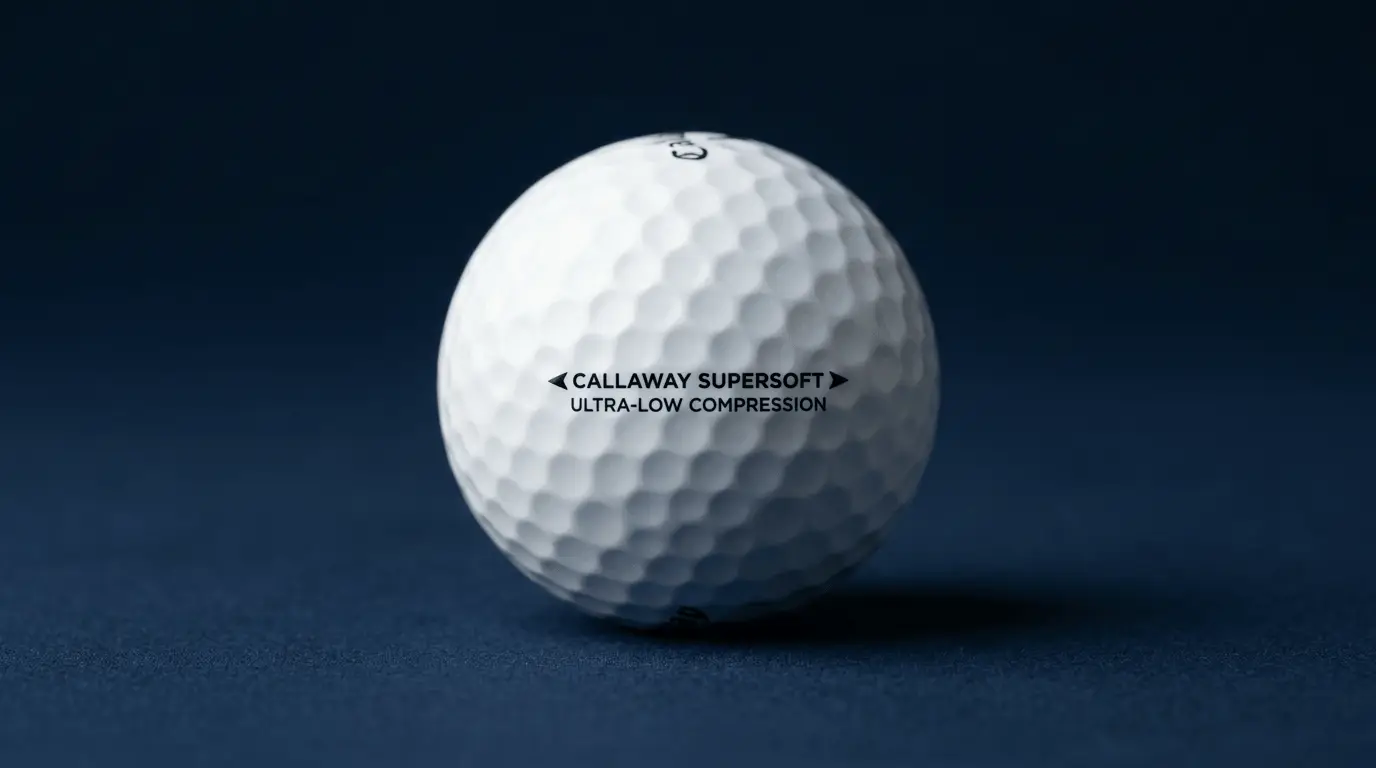
The Callaway Supersoft is a 2-piece ball with an ultra-soft core, Callaway’s hybrid ionomer cover, about 49 compression on MyGolfSpy’s 2026 gauge, and a street price around $25 a dozen. It fits driver swing speeds under 90 mph that want soft feel, low driver spin, and straight distance for value money. Around the green its ionomer cover runs out instead of checking. The best fit is a beginner or senior swinging under 90 mph.
Where the Supersoft sits among soft value balls
| Ball | Compression | Cover | Layers | Greenside spin | MSRP |
|---|---|---|---|---|---|
| Maxfli SoftFli | ~35 | Ionomer | 2 | Low | $19.99 |
| Wilson Duo Soft | ~37 | Ionomer | 2 | Low | $24.99 |
| Callaway Supersoft | ~38 | Ionomer | 2 | Low | $27.99 |
| Bridgestone e6 Soft | ~45 | Surlyn | 2 | Low | $23.99 |
| Titleist TruFeel | ~70 | Ionomer | 2 | Low | $24.99 |
| Srixon Soft Feel | ~58 | Ionomer | 2 | Moderate | $24.99 |
Compression and MSRP values come from the BallCaddie catalog. The table places the Supersoft at the soft end of the value rack — only the Maxfli SoftFli (~35) and Wilson Duo Soft (~37) sit softer, and all three cluster within a few compression points.
Callaway has marketed the Supersoft at 38 compression for a decade. Independent gauges read it firmer: MyGolfSpy’s Ball Lab measured a recent Supersoft to an average around 47, with individual balls ranging from the high-30s to 60 inside a single dozen. Manufacturer numbers and gauge-measured numbers don’t use the same scale, so both can be honest. The practical read is that “softest on the rack” is mostly marketing — the real spread among value soft balls is a handful of points, and the golf ball compression chart plots every model on one calibrated gauge.
Callaway Supersoft compression
Callaway markets the Supersoft at 38 compression, and the BallCaddie catalog lists 49 on MyGolfSpy’s 2026 gauge. MyGolfSpy’s Ball Lab gauge read a recent sample firmer — an average around 47, with balls ranging high-30s to 60 inside one dozen — and the two figures use different scales, so both can be right. Either way it sits at the soft end of the compression chart, built for driver speeds under about 95 mph.
What the Supersoft is
The Supersoft is the value anchor of Callaway’s ball line: two pieces, a soft high-energy core Callaway calls the Hyper Elastic SoftFast Core, and an ionomer cover. The current model is the 2025 Supersoft, launched in January 2025 alongside the updated ERC Soft and the Chrome Tour Triple Diamond.
Callaway brands the cover a Hybrid Cover — an ionomer blended with a Dow Paraloid impact modifier, the same material it moved the Supersoft and Callaway ERC Soft (~60) to in 2023. The point of the Paraloid additive is durability: it keeps the cover soft for feel while resisting the scuffs that used to mark older Supersofts after a few holes. The 332-dimple HEX Aerodynamics pattern is the other carryover, tuned for a high, low-drag flight that helps slower swings carry.
Listed at $27.99 in the BallCaddie catalog and typically $24.99–$26.99 at current retail, it sits firmly in the value tier, and the current model appears on the USGA conforming ball list for tournament play. Verify the exact colorway before a competition, since the list updates monthly.
Performance
The honest read of the Supersoft: it does the slow-swing job well and stops exactly where the price tag says it will.
Driver
Low spin and high launch are the Supersoft’s whole argument off the tee. The catalog tags it low-spin and high-trajectory, and that pairing strips side spin off a slower swing’s miss — the reason slicers tend to see straighter drives with it. Distance is where swing speed decides the verdict: Callaway designs the Supersoft for swings under 90 mph, and past about 90 mph the soft core starts to give carry back — over 100 mph that loss is enough to move you to a firmer ball, which is why fast-swing robot tests routinely rank the Supersoft among the shorter balls on the board. Under 90 mph that penalty disappears and the straightness carries the day.
Irons and approach
The high launch follows into the irons, where the soft core helps players who fight to get mid-irons airborne. Above 90 mph some golfers find the feel a touch mushy on crisp iron contact and step up to a firmer ball like the Titleist Velocity (~90) or Srixon Q-Star Ultispeed (~85). Below 90 mph the Supersoft’s launch and feel are the better match through the bag.
Greenside spin
Greenside spin is the Supersoft’s ceiling, and it’s low. The ionomer cover prioritizes durability and distance over wedge bite, so the ball runs out rather than checking. GolfSidekick’s testing frames it as a bump-and-run ball next to a urethane tour ball.
On a standard pitch it stops dependably; on a firm, fast green it gives up several yards of bite to a cast-urethane ball like the Callaway Chrome Soft (~77). If you score on spin from inside 100 yards, that gap is the whole argument for stepping up a tier — the trade-off is laid out in urethane vs. ionomer covers.
Putter feel
Off the putter the Supersoft is soft and quiet, the predictable result of a low-compression core under a thin ionomer cover. Reviewers reach for words like “spongy”; players who find firmer tour balls clicky tend to like the muted response, while some give up a little feedback on lag putts. It’s a feel preference more than a performance gap.
Supersoft vs Callaway Chrome Soft
The Callaway Chrome Soft (~77) is the ball Supersoft shoppers cross-shop most, and the two aren’t aimed at the same golfer. The Chrome Soft is a 3-piece urethane tour ball at $54.99; the Supersoft is a 2-piece ionomer value ball at $27.99. That’s roughly double the price for a urethane cover that grips the grooves and a firmer core built to compress at 85-105 mph.
Golf Monthly’s head-to-head lands where the construction says it should: the Chrome Soft checks and spins on approach and short-game shots where the Supersoft releases. Under about 90 mph with distance and straightness as the priority, the Supersoft is the smarter buy — you don’t generate enough clubhead speed to cash in everything a urethane ball offers. From 90-105 mph with a sharp short game, the Chrome Soft earns its premium. The Callaway Chrome Soft review covers that ball in full.
Supersoft vs the Srixon Soft Feel
Inside the value tier, the Srixon Soft Feel (~58) is the Supersoft’s most-compared rival, and the split is swing speed. The Supersoft is the softer ball (49 against 58) and the better answer under about 85 mph, where its ultra-low compression helps the slowest swings activate the core. The Soft Feel firms the formula up for the 88-95 mph player who wants soft feel without bleeding ball speed at the top of that range.
Price is close: the Soft Feel lists at $24.99 and the Supersoft sits within a few dollars of it, both 2-piece ionomer balls with low driver spin and a capped greenside ceiling. A slow swinger chasing maximum softness takes the Supersoft; a moderate swinger who wants a touch more ball speed takes the Soft Feel. The Srixon Soft Feel review and the best low-compression golf ball guide rank the rest of the soft field.
Supersoft Max: the oversized option
Callaway also sells the Supersoft Max, a larger-than-standard version of the same ball. An oversized ball can still be legal for tournament play — the Rules of Golf set a minimum diameter of 1.68 inches and a maximum weight, but no maximum size — as long as the specific model and colorway appears on the USGA conforming ball list. The Max runs even softer than the standard Supersoft and swaps the Paraloid hybrid cover for a tri-blend ionomer, aimed squarely at seniors, beginners, and anyone who struggles to get the ball airborne. If you want the softest, easiest-launching option and don’t need greenside bite, it’s worth a look; everyone else is better served by the standard Supersoft.
Swing-speed fit
The Supersoft’s window is slow-to-moderate — Callaway’s under-90-mph target, and the BallCaddie catalog maps it to swings under about 95 mph. The mechanics are in the swing-speed pillar at how to choose the right golf ball for your swing speed: a low-compression ball deforms fully for a slower swing and returns energy efficiently, while a too-firm ball never compresses and leaves the face slow. TrackMan’s amateur data puts the average male driver swing around 93-94 mph, near the top of the Supersoft’s range.
Above roughly 100 mph the math flips: a fast swing overcompresses the soft core and loses carry, so those players belong on a firmer multi-layer ball. The best golf ball for a slow swing speed guide is the better entry point if you’re well under 85 mph and want the full short list.
Who should play it
- Your driver swing speed is under about 90 mph and you want a ball that actually compresses.
- You’re a beginner or high handicapper who wants low driver spin to take a slice out of play.
- You play a lot of cold-weather or shoulder-season golf — the soft core stays pleasant to hit below 50°F, where a firm tour ball turns harsh.
- You want soft feel and durability for value money and don’t score on greenside spin.
Who should skip it
- You swing over 100 mph. You’ll overcompress the core and lose carry, so look at a firmer tour ball like the Callaway Chrome Tour (~94).
- You score on greenside spin from inside 100 yards. The ionomer cover caps wedge bite; a urethane ball like the Callaway Chrome Soft is the fix.
- You want the firm, penetrating flight of a tour ball. The Supersoft launches high and lands soft by design.
How BallCaddie decides when the Supersoft is the answer
The Ball Fitting Report breaks the estimated per-round cost of a mismatched ball into four places — short game, feel and consistency, ball flight, speed — with a figure and a mechanism for each. That breakdown is the Supersoft decision in miniature. When most of a sub-90-mph golfer’s estimate sits under feel and flight, a low-compression ball at a value price can deliver the scoring bump of a dozen costing twice as much; when most of it sits under the short game, the urethane cover is the part worth paying for. Budget is one of the scored inputs, and fit carries the most weight.
Six report sections are free after the 90-second quiz (first name and email before question 1). The seventh names your #1, #2, and #3 — $29, one time. The stroke figures are estimates based on published research, and results vary by player.
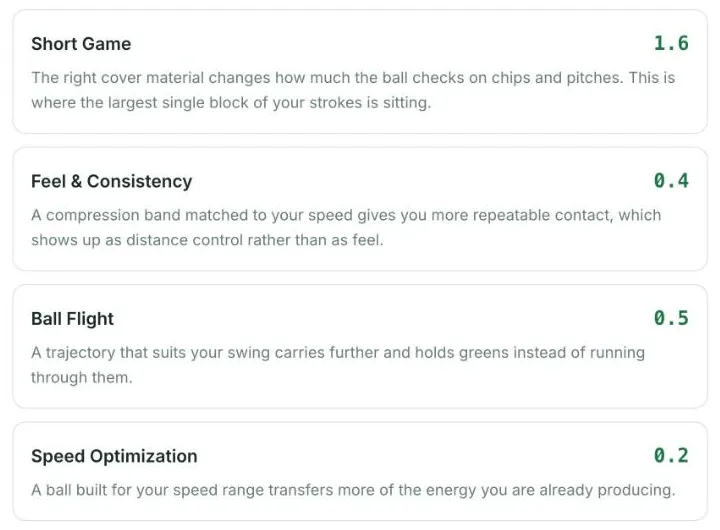
The strokes breakdown from a real report — a sample 12-handicap profile at 85–99 mph. See every section of the report.
The next step
The Supersoft earns a sleeve trial for any sub-90-mph golfer who wants real softness and durability without paying urethane prices. BallCaddie is brand-neutral and doesn’t sell balls, so the recommendation follows the fit, not a margin.
Ninety seconds through the BallCaddie fitting quiz scores the full catalog against your swing speed, miss pattern, greenside priority, and budget — and it’ll tell you when a value dozen is the right answer and when it isn’t.
For deeper dives on the inputs this review pulls from:
- How to choose the right golf ball for your swing speed - the swing-speed pillar mapping speed bands to compression and spin tiers, with the under-90-mph case the Supersoft is built for.
- Golf ball compression chart - the compression pillar plotting every ball on one calibrated gauge, including where the Supersoft’s marketed 38 lands against gauge-measured numbers.
- Best low-compression golf ball - the ranked soft-ball field where the Supersoft competes with the SoftFli, Soft Feel, and TruFeel.
- Best value golf ball in 2026 - value-tier picks at every swing speed, from ionomer two-piece balls to discount urethane.
- Best golf ball for a slow swing speed (under 85 mph) - the swing-speed entry point below 85 mph, where the Supersoft sits against the rest of the ultra-low-compression field.
- Srixon Soft Feel review (2026) - the closest value-tier rival at ~58 compression, and the swing-speed split that decides between them.
- Callaway Chrome Soft review - the urethane step up inside the Callaway line for players who score on greenside spin.
Key takeaways
- The Supersoft is a 2-piece ionomer value ball: ~49 compression on MyGolfSpy’s 2026 gauge (Callaway markets it at 38), listed at $26.99 in the BallCaddie catalog and typically lower at retail.
- It fits swings under about 90 mph. Low driver spin and high launch straighten out slower-swing misses and help the ball carry.
- Greenside spin is low. It runs out instead of checking, the ceiling for a 2-piece ionomer cover.
- Above 100 mph it overcompresses and gives up carry — step up to a firmer tour ball like the Chrome Tour.
- Cross-shop the Srixon Soft Feel (~58) at 88-95 mph and the urethane Callaway Chrome Soft (~77) if you score on wedge spin.
- The oversized Supersoft Max is the softer, easier-launching variant, and it still conforms for tournament play.
Stop guessing your golf ball
Take the 90-second fitting quiz · matched from a 70+ ball catalog · sign up to see your match
Take the quiz →Related posts
Independent 2026 Titleist TruFeel review: 2-piece ionomer, ~70 compression, $24.99. Who it fits, the Tour Soft and Velocity splits, and the greenside reality.
Independent 2026 Titleist Tour Soft review: 2-piece elastomer cover, ~88 catalog compression, $39.99 MSRP. MyGolfSpy data, lineup positioning, who plays it.
Independent Titleist Velocity review: 2-piece ionomer distance ball, $29.99, low spin, high launch. MyGolfSpy data, lineup fit, and who should play it.
Callaway Chrome Tour Triple Diamond review (2026): the low-spin tour ball for 105+ mph swings, the MyGolfSpy robot distance data, and who it actually fits.
Frequently asked questions
- What compression is the Callaway Supersoft?
- Callaway markets the Supersoft at 38 compression, and the BallCaddie catalog lists 49 on MyGolfSpy's 2026 gauge, which puts it at the soft end of the value rack. Independent gauges read it firmer — MyGolfSpy's Ball Lab measured a recent Supersoft to an average around 47, with individual balls ranging from the high-30s to 60 inside one dozen. The two numbers use different scales, so both can be right. Either way it's a genuinely soft, low-compression ball; the gap between it and rivals like the SoftFli or Soft Feel is only a handful of points.
- What swing speed is the Callaway Supersoft designed for?
- Callaway designs the Supersoft for driver swing speeds under 90 mph, and the BallCaddie catalog maps it to under about 95 mph. Its ultra-low-compression core returns clean energy for players who don't generate tour-level clubhead speed, and the high launch helps slower swings carry. Above roughly 100 mph you start to overcompress the core and lose carry, so faster swingers usually get more from a firmer multi-layer ball like the Callaway Chrome Tour (~94) or another tour model.
- Callaway Supersoft or Chrome Soft - which should I play?
- Play the Supersoft (~49) if your driver swing is under about 90 mph and you want soft feel, straight distance, and a value price around $25. Play the Chrome Soft (~77) if you swing 90-105 mph with a sharp short game and want the urethane cover's greenside bite, at roughly double the price. The Supersoft is a 2-piece ionomer ball that releases around the green; the Chrome Soft is a 3-piece urethane tour ball that checks and spins. Swing speed and short-game priority make the call.
- Does the Callaway Supersoft spin around the green?
- Greenside spin is low, the practical ceiling for a 2-piece ionomer ball. The Supersoft stops dependably on standard pitches but releases rather than checking on firm, fast greens, so it suits bump-and-run short game more than one-hop-stop wedge shots. The ionomer cover trades wedge bite for durability and distance. If you score on spin from inside 100 yards, step up to a urethane ball such as the Callaway Chrome Soft, which grips the grooves the Supersoft's cover can't.
- What is the Callaway Supersoft Max?
- The Supersoft Max is an oversized version of the standard Supersoft - a larger-than-normal ball aimed at seniors, beginners, and golfers who struggle to launch it. It runs even softer than the standard model and uses a tri-blend ionomer cover instead of the Paraloid hybrid. Despite the size, it can conform to the Rules of Golf: the USGA sets a minimum diameter of 1.68 inches and a maximum weight, but no maximum size, so a bigger ball is legal as long as the specific model appears on the USGA conforming ball list. Most players are better served by the standard Supersoft.
- Is the Callaway Supersoft good for beginners and cold weather?
- Yes on both. The Supersoft is one of the more sensible picks for beginners and high handicappers under 90 mph: low driver spin straightens a slice, the high launch gets the ball airborne, and the durable ionomer cover survives cart paths for plenty of rounds. The low-compression core also keeps a softer feel below 50°F than a firm tour ball, so it's a comfortable shoulder-season option; distance in the cold comes down to keeping the ball warm. The current Supersoft appears on the USGA conforming ball list for tournament play; verify the exact colorway before competing.
Stop guessing your golf ball
Take the 90-second fitting quiz · matched from a 70+ ball catalog · sign up to see your match
Take the quiz →