Pro V1 vs Pro V1x: Which Titleist Tour Ball Fits Your Game?
Titleist Pro V1 vs Pro V1x compared — compression, spin profile, trajectory, swing-speed fit, and tour usage. Which Titleist tour ball matches your game?
Quick answer
Both are $58/dozen, cast-urethane Titleist tour balls — driver performance is nearly identical. The Pro V1 (3-piece, compression ~87) flies on a mid, penetrating trajectory with softer feel — better for golfers who already generate enough spin or play in wind. The Pro V1x (4-piece dual-core, compression ~97) launches higher and spins more on irons and wedges — better for stopping power and getting the ball up. Tour-fitting data: even golfers under 95 mph are often fit into Pro V1x.
At a glance
| Pro V1 | Pro V1x | |
|---|---|---|
| Construction | 3-piece, single high-gradient core | 4-piece, dual-core (1.13” inner) |
| Compression | ~87 (softer) | ~97 (firmer) |
| Cover | Cast urethane elastomer | Cast urethane elastomer |
| Dimples | 388 tetrahedral | 348 tetrahedral |
| Trajectory | Mid, penetrating | High, peak farther downrange |
| Driver spin | Low | Low (≈ same as Pro V1) |
| Iron / wedge spin | High | Higher (up to +10% on full wedges) |
| Feel | Very soft, muted | Soft-firm, clicky feedback |
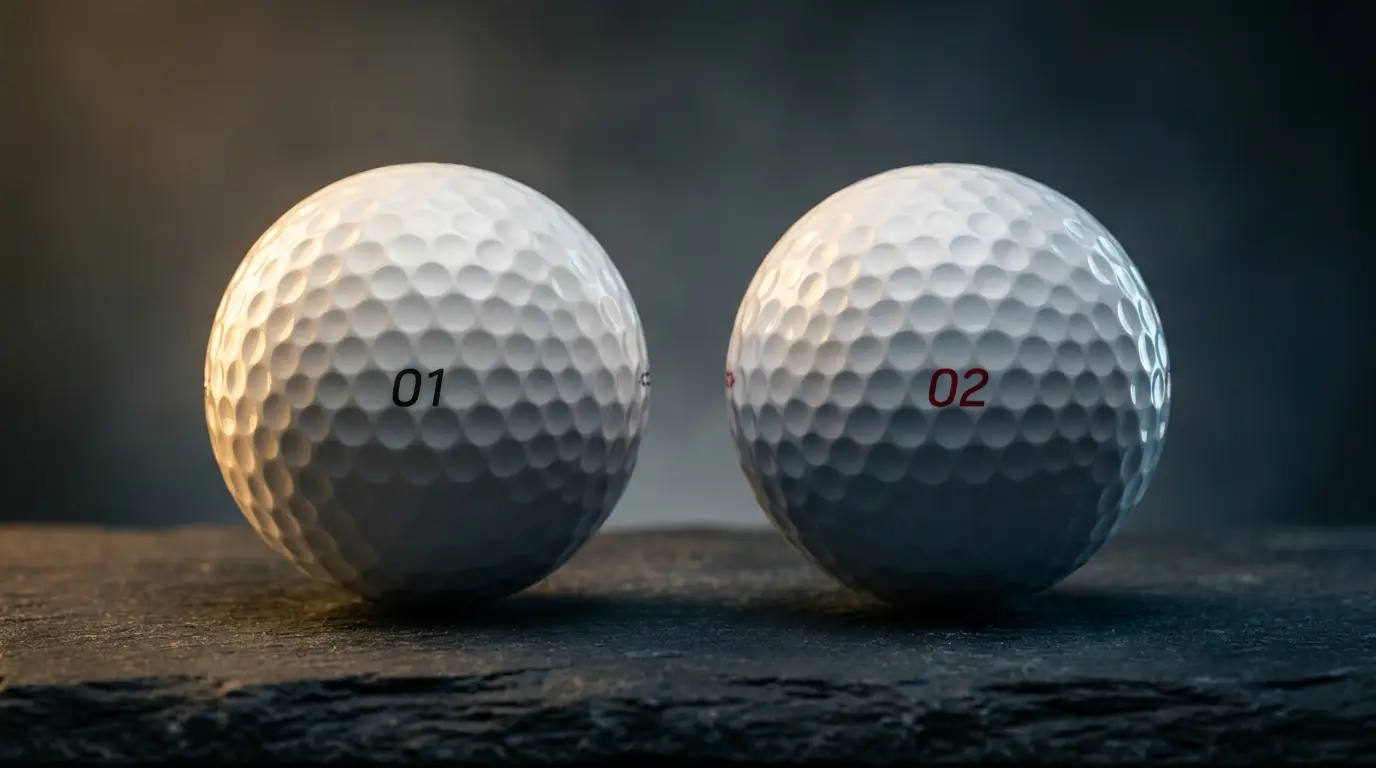
| Number color | Black | Red |
| MSRP | $58/dozen | $58/dozen |
Compression numbers come from BallCaddie’s catalog (Titleist Pro V1 and Titleist Pro V1x) and are corroborated by MyGolfSpy’s independent Ball Lab tests, which measured Pro V1x at an average of 96 on their gauge — “one of the firmer options on the market.” Dimple counts (388 vs 348) come from Titleist’s 2025 launch press release.
Why this comparison gets misread
Most golfers ask “which ball is better?” — but Pro V1 and Pro V1x are the same franchise built around two different launch-and-spin philosophies. They share the same cover, the same casing layer, the same price, and according to Titleist’s fitting database, nearly identical driver performance. The differences live in trajectory and short-game spin.
The swing-speed-only rule of thumb breaks down on Titleist’s own data. Fitting data summarized by GolfBalls.ca shows more golfers under 95 mph fit into Pro V1x than any other speed group. The honest decision rule is about your ball flight and short-game priorities, not your driver swing speed alone.
The construction difference
Pro V1 uses a 3-piece architecture: a single high-gradient core, a speed-amplifying high-flex casing layer, and a soft cast urethane cover. Pro V1x is 4-piece — same casing and cover, but with a dual-core design where a firmer outer core wraps a softer inner core. In the 2025 generation, Titleist expanded that inner core by 44%, from 1 inch to 1.13 inches in diameter.
The dual core lets Titleist manage ball speed and spin independently. Pro V1x’s firmer outer layer drives ball speed; the softer inner core keeps long-game spin in check. Pro V1 achieves the same low driver spin through a single high-gradient core whose firmness changes from inside to outside.
Cover material is identical, and Titleist states the two balls “have similar durability”.
Trajectory and flight
Pro V1 flies mid and penetrating — built for golfers who don’t need help getting the ball up. Pro V1x flies high with peak height farther downrange — built for maximum carry on long irons and a steeper angle of descent into the green.
In one independent driver test, Pro V1x’s peak height was about three feet higher than Pro V1’s. Both balls outperform competitors in crosswind, but Pro V1’s lower flight is the real wind ball — Pro V1x can balloon on exposed coastal layouts.
Driver spin vs iron spin (the “spin slope”)
Off the driver, the two are nearly identical. Titleist puts it bluntly: “Pro V1 and Pro V1x have very little difference off the tee.” Independent robot testing at 105+ mph reported driver spin differences under 1%.
Where they separate is iron and wedge spin. Pro V1x produces measurably more spin into the green — up to 10% more on full wedge shots in that same testing. Titleist calls this the “spin slope”: both balls keep long-game spin low, but Pro V1x’s slope climbs steeper as you move from driver to wedge.
Practical read: on a 30-yard chip, you won’t feel a difference. From 150 yards in with a 9-iron, Pro V1x will check up where Pro V1 might release a few feet farther.
Feel, sound, and putter response
Pro V1 is the softer, more muted ball. Pro V1x is firmer with a clickier sound off the putter face. Players who want feedback gravitate to Pro V1x; players who want a quieter impact prefer Pro V1.
Compression drives most of this — ~87 vs ~97. Both sit in the high-compression tier despite the spread between them; the golf ball compression chart places both above the firmness threshold most amateurs would call “soft.”
Swing-speed fit (where the conventional wisdom breaks)
The myth: Pro V1 for under 105 mph, Pro V1x for 105+. Testing data published by GolfBalls.ca suggests more golfers under 95 mph fit into Pro V1x than any other speed group. Their results across speeds:
| Driver swing speed | Tested behavior |
|---|---|
| ~85 mph | Pro V1x produced 100+ rpm more backspin than Pro V1 |
| ~98–99 mph | Pro V1 ≈ 148.8 mph ball speed, Pro V1x ≈ 146.8; spin Pro V1x ≈ 2,505 rpm vs Pro V1 ≈ 2,179 |
| 105+ mph | Driver spin difference < 1% — choice becomes feel and trajectory |
One reading: at slow swing speeds the firmer ball can spin more because it transfers more energy off the clubface; at elite speeds the spin gap collapses. Either way, the takeaway is the same — don’t pick by swing speed alone.
For deeper fitting, see how to choose a golf ball by swing speed, best golf ball for 100 mph, and best golf ball for 95 mph.
The Left Dot and Left Dash variants
Two specialty Pro V1 family members exist for fine-tuning within the lineup:
- Pro V1 Left Dot (~85 compression) — a Pro V1 with lower flight and lower long-game spin. Titleist confirms the high-gradient core developed for Left Dot is what now lives inside the standard 2025 Pro V1.
- Pro V1x Left Dash (~100 compression) — the firmest, fastest, lowest-spinning ball in the Titleist stable. Titleist’s product page describes it as 4-piece with a thicker casing layer and a different dimple-depth profile than standard Pro V1x.
If standard Pro V1x feels right but spin is high, Left Dash. If standard Pro V1 feels right but flight is high, Left Dot. Both ship in limited retail availability.
Tour usage
The two balls combined accounted for 26 of 46 PGA Tour wins in 2025 — Pro V1 with 14 wins (Scottie Scheffler the headline) and Pro V1x with 12 (Justin Thomas, Cameron Young). That split is the cleanest evidence that neither ball is universally “better” — two of the best players in the world pick different balls in the same family.
Mistakes and decision rules
- Don’t pick by swing speed alone. The over/under-105 rule is wrong as often as it’s right.
- Don’t switch mid-round. The two balls carry different yardages; pick one for 18.
- Don’t buy custom before testing both. Personalization locks you in. Play three rounds on each first.
- If you lose more than a sleeve per round, neither is the right call. See the Vice Pro Plus vs Pro V1 comparison or step back to a best value golf ball recommendation.
The fastest read: Pro V1x if you want help getting the ball up and maximum stopping power. Pro V1 if you already hit it high and want trajectory control in wind. Take the BallCaddie quiz (sign up to see your match) to see which ball fits your swing, or browse the catalog to compare specs across the urethane tier.
For deeper dives
- Golf ball compression chart — every ball’s compression on a single calibrated gauge.
- How to choose a golf ball by swing speed — the parent fitting pillar with example balls at each band.
- Pro V1 vs TP5 — the cross-brand tour-ball comparison.
- Vice Pro Plus vs Pro V1 — the value alternative at similar compression.
- Urethane vs ionomer covers — when the cover-material upgrade is worth the price jump.
Key takeaways
- Pro V1 = 3-piece, ~87 compression, mid trajectory, softer feel.
- Pro V1x = 4-piece dual-core, ~97 compression, high trajectory, firmer feel.
- Driver performance is nearly identical; iron and wedge spin separates them.
- Swing speed alone doesn’t pick the ball; trajectory preference and short-game priority do.
- Both retail at $58. Black numbers = Pro V1, red = Pro V1x.
Frequently asked questions
Is the Pro V1 or Pro V1x better?
Neither is universally better. Pro V1 is a 3-piece ball with softer compression (~87) and a mid, penetrating trajectory — better for golfers who already generate spin or play in wind. Pro V1x is a 4-piece dual-core ball with firmer compression (~97), higher launch, and more iron and wedge spin — better for stopping power, with driver performance nearly identical between the two. If you don’t know which camp fits, start with Pro V1.
What is the difference between Pro V1 and Pro V1x?
Construction differs (3-piece single-core vs 4-piece dual-core), as does compression (~87 vs ~97), trajectory (mid and penetrating vs high), and feel (softer and muted vs firmer and clickier). The biggest performance gap is iron and wedge spin — Pro V1x produces measurably more on full wedges. Driver spin is nearly identical between them.
What swing speed is the Pro V1x for?
Conventional wisdom says 105+ mph, but Titleist fitting data summarized by GolfBalls.ca indicates more golfers under 95 mph fit into Pro V1x than any other speed group. Swing speed alone doesn’t decide it. If you struggle to get the ball up or want maximum greenside spin, Pro V1x can help regardless of clubhead speed; if you already hit it high, Pro V1 controls trajectory better.
Does Pro V1x spin more than Pro V1?
On irons and wedges, yes — the dual-core construction generates more spin into the green, with up to 10% more on full wedges in independent testing. Off the driver, no — Titleist explicitly states there is “very little difference off the tee,” and robot testing reports differences under 1% at high swing speeds. Titleist calls the dynamic the “spin slope”: both balls keep driver spin low, but Pro V1x’s slope is steeper as you move toward the wedges.
Are Pro V1 and Pro V1x the same price?
Yes — both retail at $58 per dozen on the BallCaddie catalog. Custom personalization adds a small premium on either model. The two specialty variants — Pro V1 Left Dot ($57.99) and Pro V1x Left Dash ($58) — sit in the same price band and ship in limited retail availability. The visual tell: Pro V1 has black numbers, Pro V1x has red.
Should a high handicapper play Pro V1 or Pro V1x?
Both are USGA conforming and legal for any golfer. Handicap matters less than swing tendency: a high handicapper who hits it low benefits from Pro V1x’s higher launch, while one who already balloons drives benefits from Pro V1’s penetrating flight. If you lose more than a sleeve per round, a $20–$30 urethane like Kirkland Signature or Vice Pro is a smarter call than either Titleist.