🎯 New here? BallCaddie matches golfers to the right ball. → Take the 90-second quiz
Back to BlogSrixon Z-Star vs Pro V1: Which Tour Ball Wins on Value?
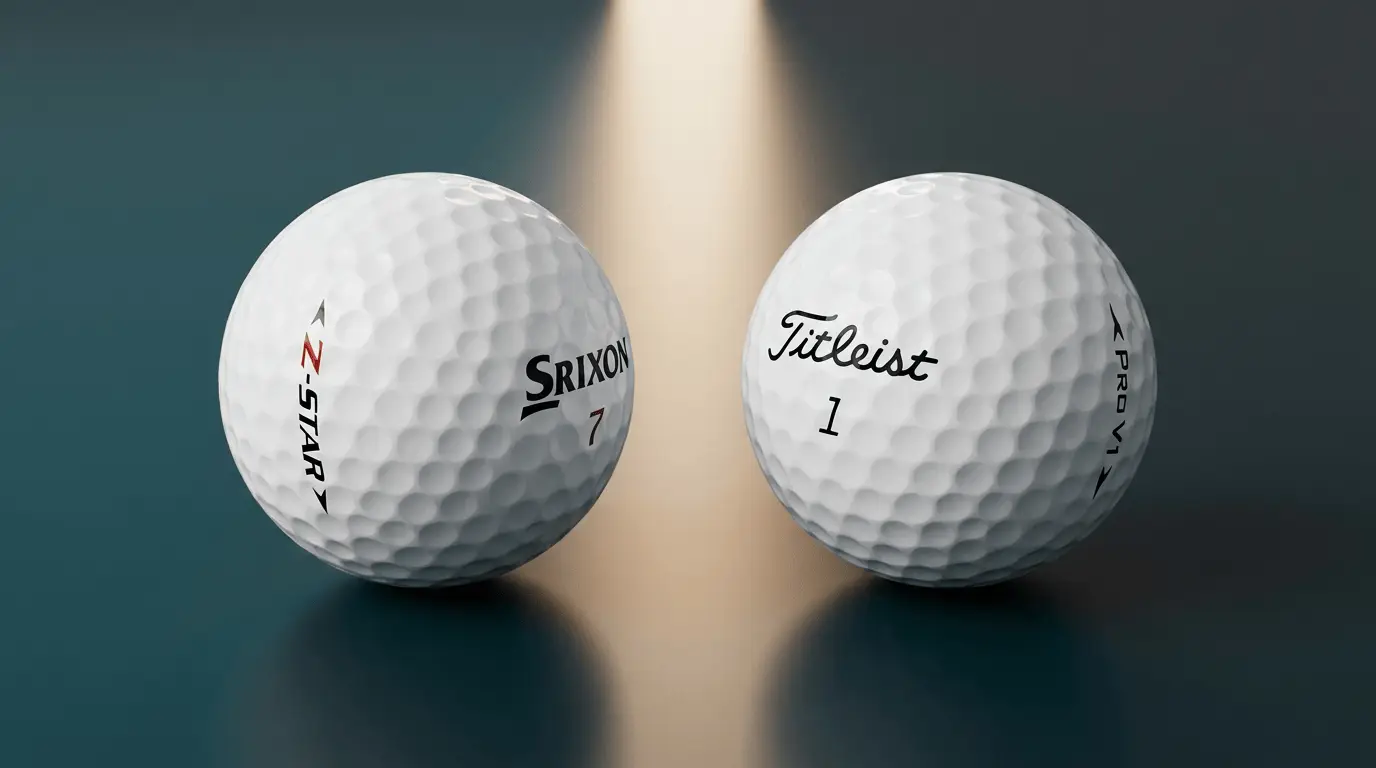
Srixon Z-Star vs Titleist Pro V1: 2026 robot-test numbers, specs, and the $3/dozen MSRP gap. Which tour ball fits your game and your wallet?
Answer a few questions about your swing and BallCaddie matches you against a 72-ball catalog.
Take the 90-second quizQuick answer
Both are 3-piece urethane tour balls, and MyGolfSpy’s 2026 robot test splits them by club. The Pro V1 (compression ~92, $57.99/dozen) was faster off the driver at all three swing speeds, the longest of 48 balls at the slow speed, and tighter left to right. The Z-Star (compression ~81, $54.99/dozen) spun about 430 rpm more on a 35-yard pitch. Pick the Pro V1 for the tee, the Z-Star for the short game and the price.
Head-to-head specs
| Spec | Srixon Z-Star (2025) | Titleist Pro V1 (2025) |
|---|---|---|
| MSRP per dozen | $54.99 | $57.99 |
| Promo floor | ~$36.66 (Buy 2, Get 1 Free) | ~$43.49 (spring Loyalty Rewarded, buy 3 get 1) |
| Construction | 3-piece | 3-piece |
| Cover | Urethane with biomass + Spin Skin+ (0.6 mm) | Cast urethane elastomer |
| Compression | ~81 | ~92 |
| Core | FastLayer DG Core 2.0 (gradient) | High-gradient core + high-flex casing |
| Dimples | 338 speed dimple pattern | 388 tetrahedral |
| Trajectory | Mid, penetrating | Mid, penetrating |
| Best swing speed | 90–105 mph | 90–105 mph |
Specs sourced from Srixon and the Titleist Media Center; compression is the gauge reading from the 2026 robot test (Srixon’s own figure for the Z-Star is 88).
2026 robot test, side by side
The 2026 robot test hit all 48 balls at three driver speeds (about 86, 102 and 116 mph), three 7-iron speeds, a full sand wedge and a 35-yard pitch. Rank out of 48 in brackets.
| Condition | Srixon Z-Star | Titleist Pro V1 |
|---|---|---|
| Driver ball speed, 116 mph | 168.0 mph (32nd) | 169.5 mph (10th) |
| Driver total distance, 116 mph | 314.8 yd (34th) | 317.0 yd (27th) |
| Driver ball speed, 102 mph | 148.8 mph (27th) | 149.8 mph (9th) |
| Driver total distance, 102 mph | 285.2 yd (36th) | 287.4 yd (21st) |
| Driver ball speed, 86 mph | 125.0 mph (29th) | 125.4 mph (10th) |
| Driver total distance, 86 mph | 227.4 yd (36th) | 232.9 yd (1st) |
| Driver spin, 102 mph | 2,804 rpm | 2,804 rpm |
| 7-iron spin, mid speed | 6,263 rpm | 6,141 rpm |
| Full sand wedge spin | 10,512 rpm | 10,632 rpm |
| 35-yard pitch spin | 5,871 rpm (4th) | 5,443 rpm (21st) |
The construction difference
On paper the two balls look close — three layers, urethane cover — though the Z-Star gauges about 11 points softer. The cores and covers are built differently.
Srixon’s Z-Star (~81) uses a FastLayer DG Core 2.0, a core that starts soft in the center and firms up toward the edge. Srixon says it softened the center of the core for this ninth generation to cut driver spin and add greenside spin. By Srixon’s own measure the 2025 Z-Star is an 88 compression, four points softer than the 2023 model.
Titleist’s Pro V1 (~92) pairs a reformulated high-gradient core with a speed-amplifying high-flex casing layer. Titleist credits the new core for the 2025 model’s added ball speed and iron and wedge spin, and the casing for keeping long-game spin low.
Both covers are urethane, but the formulations differ. Srixon’s 0.6 mm cover is made with a plant-derived biomass and gets a Spin Skin+ coating, a thin layer of urethane that adds friction on approach and greenside shots. Titleist uses a soft cast urethane elastomer. Those choices show up in the numbers below: the Pro V1’s core in ball speed, the Z-Star’s cover on short pitches.
Driver performance
The Pro V1 was the better driver ball in the 2026 test. Across the three driver speeds:
- Ball speed: the Pro V1 was faster at every speed, by about 0.5 to 1.5 mph, and ranked 9th or 10th of 48 against the Z-Star’s 27th to 32nd.
- Distance: the Pro V1 went farther at every speed, by about 2 to 6 yards. At the slow speed it was the longest ball in the entire test.
- Spin: a wash. Identical at the mid speed (2,804 rpm each) and within 35 rpm at the other two.
- Dispersion: the Pro V1’s shots spread less left to right at all three speeds.
Launch angles matched within 0.1 degrees, so the distance gap comes from ball speed. Both are still tour balls tuned for control, and the gaps are small. A 2-yard gap at 102 mph won’t change which club you hit next. A 6-yard gap at 86 mph is worth noticing if you swing slower.
Iron and wedge performance
The Z-Star’s edge is around the green. On the 35-yard pitch it spun 5,871 rpm, fourth of 48, against 5,443 rpm (21st) for the Pro V1, about 430 rpm more. Only three balls cleared 5,900 rpm, and the Z-Star sat just behind them. Srixon built the Spin Skin+ coating for this shot.
Off full swings the two are close:
- 7-iron spin: the Z-Star spun 122 rpm more at the mid speed and 154 more at the slow speed; at the fast speed they were even (6,523 vs 6,528 rpm).
- Full sand wedge, dry: the Pro V1 spun 120 rpm more (10,632 vs 10,512).
- Full sand wedge, wet: the Z-Star held on slightly better (10,436 vs 10,381 rpm).
- 7-iron distance: within about 2 yards at every speed, with no consistent winner.
The testers also named the Z-Star and Z-Star Diamond as the urethane balls that stood out for a flatter, lower-flying iron flight at the fast iron speed, which suits a player who fights a ballooning iron.
Feel, durability, and the everyday experience
The robot doesn’t measure durability, and we haven’t found a current head-to-head wear test of these two balls. Srixon says it built this generation’s cover and coating to last longer and to resist dirt and grime.
Feel is personal. On the same compression gauge the Z-Star is the softer ball (81 vs 92), so it will feel softer off the driver and irons. On the putter the difference is smaller and comes down to sound. If you’re already calibrated to the Pro V1, expect the Z-Star to take a few rounds to trust.
The price gap that defines the choice
MSRP gap: $3.00/dozen ($54.99 vs $57.99). During Srixon’s annual promo: about $21/dozen.
Srixon runs a Buy 2, Get 1 Free deal across its ball lineup, Z-Star included. In 2026 it ran May 21 to June 21, ending on Father’s Day, and a holiday version ran November 10 to December 31, 2025. Three dozen for the price of two drops the effective per-dozen cost to $36.66.
Titleist discounts the Pro V1 once a year. Its Loyalty Rewarded promo, usually in spring, gives you a fourth dozen free when you buy three, which works out to about $43.49 a dozen. The rest of the year retail prices sit at or near MSRP, and the only other discounts are retailers clearing last-generation balls.
Say you play eight dozen a season, a fair pace for a weekend golfer. Pro V1 at $57.99 × 8 = $464. Z-Star at the promo price × 8 = about $293. That’s about $171 a year, if you stock up once, for a ball that out-spins the Pro V1 on short pitches and gives up a few yards off the tee. Buy your Pro V1s during Loyalty Rewarded instead and the gap shrinks to about $55.
At MSRP, you’re choosing between Pro V1 driver speed and Z-Star pitch spin for $3. With both balls bought on promo the Z-Star still runs about $7 a dozen cheaper, and against a full-price Pro V1 it’s about $21.
Who should play which ball
Play the Z-Star if:
- Pitch and chip spin matter more to you than the last few yards off the tee
- You want a softer feel (~81 vs ~92 compression)
- You play firm greens that reward stopping power on short shots
- You’ll stock up during Srixon’s Buy 2, Get 1 Free deal
- Your irons fly too high and you want a flatter flight
Play the Pro V1 if:
- You want the most ball speed and distance off the tee
- You swing slower and want the longest ball in the 86 mph test
- You’re already calibrated to the Pro V1 and don’t want to relearn it
- You want the tighter left-to-right driver dispersion
- A $3–$21 a dozen gap won’t change what you buy
The alternative worth considering
If you’re at the higher end of the swing-speed range — say 105 mph and up — both companies have a firmer version of these balls aimed directly at you. The Srixon Z-Star XV (~96 compression, same $54.99 MSRP) is the high-speed Z-Star; the Titleist Pro V1x (~102 compression, 4-piece, $57.99) is the higher-launching, higher-spinning Titleist. The Pro V1x spun second-most of 48 on the 2026 test’s 35-yard pitch, so at that tier the Titleist wins the short game too. For the most spin in the Srixon family, the Z-Star Diamond (~93) led the test on the full wedge.
If price is the reason you’re looking at the Z-Star, the urethane Maxfli Tour ($39.99) was one of the 2026 test’s low-spin picks at the slow swing speed; see the best value golf ball rankings. The Kirkland Signature costs less again and is fine on full shots. Its greenside spin in the 2026 robot test was roughly ionomer level, well short of either tour ball.
The next step
Both balls fit a wide band of driver speeds, roughly 90 to 105 mph. If you haven’t checked your swing speed on a launch monitor in the last 12 months, a 30-minute session at any retailer’s fitting bay will tell you where you sit. The BallCaddie fitting quiz takes about 90 seconds and recommends across 72 balls — including the Z-Star, Pro V1, and every alternative mentioned here.
Related reads
- Pro V1 vs Pro V1x — the in-Titleist comparison most golfers run before adding Srixon to the mix
- Pro V1 vs TP5 — the TaylorMade comparison, useful if your shortlist already has three balls on it
- Best value golf ball — full rankings if the Z-Star price still feels high
- How to choose a golf ball by swing speed — the pillar guide; start here if you’re not certain about your speed tier
- Golf ball compression chart — where the Z-Star and Pro V1 land on the calibrated scale
Key takeaways
- Same construction, different price tier: Both balls are 3-piece cast-urethane tour balls. Z-Star is $54.99, Pro V1 is $57.99, with the Z-Star dropping to ~$36.66 during Srixon’s Buy 2, Get 1 Free deal and the Pro V1 to ~$43.49 during Titleist’s spring Loyalty Rewarded promo.
- Pro V1 wins off the tee: faster at all three driver speeds in the 2026 robot test, 2 to 6 yards longer, and the longest of 48 balls at the slow speed.
- Z-Star wins the short pitch: about 430 rpm more on a 35-yard pitch (4th of 48 vs 21st). Full-swing iron and wedge spin is close.
- The Z-Star is the softer ball (~81 vs ~92 on the same gauge); the Pro V1 was tighter left to right off the driver.
- Tour usage still favors Titleist by a wide margin, though Srixon’s staff includes Matsuyama and Lowry.
- Above 105 mph, look at the Z-Star XV or Pro V1x.
Sources
- MyGolfSpy, 2026 golf ball test
Stop guessing your golf ball
Take the 90-second fitting quiz · matched from a 72-ball catalog · sign up to see your match
Take the quiz →Related posts
Titleist AVX vs Pro V1: same-test robot spin and carry numbers, the 11-point compression gap, the $8 price difference, and which flight fits your game.
Independent Titleist Pro V1 review: 3-piece cast urethane at ~92 compression (independent gauge 92.5), mid-pack driver spin, and the swing speeds it fits.
Vice Pro Plus vs Pro V1: the Pro Plus is a firm 4-piece ball that plays closer to the Pro V1x. Compression, spin, price, and which swing speed each one fits.
Srixon's Golf Ball Fitting Quiz is free but only recommends Srixon balls and leans hard on swing speed. What it does well, and when a brand-neutral quiz wins.
Frequently asked questions
- Is the Srixon Z-Star better than the Pro V1?
- Neither wins everywhere. In MyGolfSpy's 2026 robot test, the Pro V1 was faster off the driver at all three swing speeds, went 2 to 6 yards farther, and was the longest of all 48 balls at the slow speed. The Z-Star spun about 430 rpm more on a 35-yard pitch, fourth of 48 against the Pro V1's 21st. Full-swing iron and wedge spin was close. Pick the Pro V1 for the tee, the Z-Star for short-game spin and the $3 lower price.
- What is the difference between the Srixon Z-Star and Pro V1?
- Five differences matter. Compression: the Z-Star gauges ~81 and the Pro V1 ~92, so the Z-Star feels softer. Cover: the Z-Star uses a 0.6 mm urethane made with biomass plus a Spin Skin+ coating; the Pro V1 uses a cast urethane elastomer. Core: the Z-Star's FastLayer DG Core 2.0 runs soft in the center and firm at the edge; the Pro V1's high-gradient core sits under a high-flex casing layer. Dimples: 338 on the Z-Star, 388 tetrahedral on the Pro V1. Price: $54.99 vs $57.99 per dozen MSRP.
- What swing speed is the Srixon Z-Star for?
- We fit the Z-Star at roughly 90–105 mph. In the 2026 robot test it wasn't a distance standout at any driver speed (27th to 32nd of 48 for ball speed), but its short-game spin held up: fourth of 48 on a 35-yard pitch. Above 105 mph, the firmer Z-Star XV (~96) and Pro V1x (~102) are the options. Below 90 mph, note that the Pro V1 was the longest ball in the whole test at the slow driver speed.
- Is the Srixon Z-Star cheaper than the Pro V1?
- Yes, by $3 per dozen at MSRP ($54.99 vs $57.99), and the gap widens during promos. Srixon runs a spring Buy 2, Get 1 Free deal on its whole ball lineup (May 21 to June 21 in 2026), plus a holiday run in late 2025, which drops the Z-Star to about $36.66 per dozen. Titleist's one regular promo is Loyalty Rewarded, a spring buy-3-dozen, get-1-free offer that works out to about $43.49 a dozen; the rest of the year the Pro V1 stays close to MSRP. Over a season of 8 dozen balls, the gap runs from about $24 at MSRP to about $171 if you buy Z-Stars on promo and Pro V1s at full price.
- Do PGA Tour players use the Srixon Z-Star?
- Yes. Hideki Matsuyama plays the Z-Star XV and has won the Masters and the FedEx St. Jude Championship on Srixon equipment. Shane Lowry, Keegan Bradley and Sepp Straka also play Z-Star models. Titleist still leads tour ball usage by a wide margin with the Pro V1 and Pro V1x.
- Is the Pro V1 worth the extra $3 over the Z-Star?
- If you want the most off the tee, yes: in the 2026 robot test it was faster than the Z-Star at every driver speed and 2 to 6 yards longer. If pitch-shot spin and total cost per round matter more, no: the Z-Star spun about 430 rpm more on a 35-yard pitch and drops to about $36.66 a dozen during Srixon's annual Buy 2, Get 1 Free deal. Full-swing iron and wedge spin is close enough to call even.
Stop guessing your golf ball
Take the 90-second fitting quiz · matched from a 72-ball catalog · sign up to see your match
Take the quiz →