TP5 vs TP5x: Which TaylorMade 5-Layer Tour Ball Fits Your Game?
TaylorMade TP5 vs TP5x compared — compression, spin profile, trajectory, swing-speed fit, and tour usage. Which 5-layer TaylorMade ball matches your game?
Quick answer
Both are $54.99/dozen, 5-layer cast-urethane TaylorMade tour balls with identical architecture and dimple pattern. The TP5 (compression 87) is softer, spins more on wedges, and reads more responsive on the putter face — better for 90–105 mph swings prioritizing greenside control. The TP5x (compression 97) is firmer, spins lower off the driver, and stretches carry distance most for 105+ mph swings chasing yards.
At a glance
| TP5 | TP5x | |
|---|---|---|
| Construction | 5-piece, Speed Wrapped Core | 5-piece, Speed Wrapped Core |
| Compression (BallCaddie catalog) | 87 | 97 |
| Cover | Cast urethane | Cast urethane |
| Trajectory | High, mid-spin descent | High, flatter and lower-spinning |
| Driver spin | Mid-low | Lowest in the TaylorMade tour line |
| Iron / wedge spin | Higher | Lower |
| Feel | Soft, lower-pitched thud | Firm, crisper click |
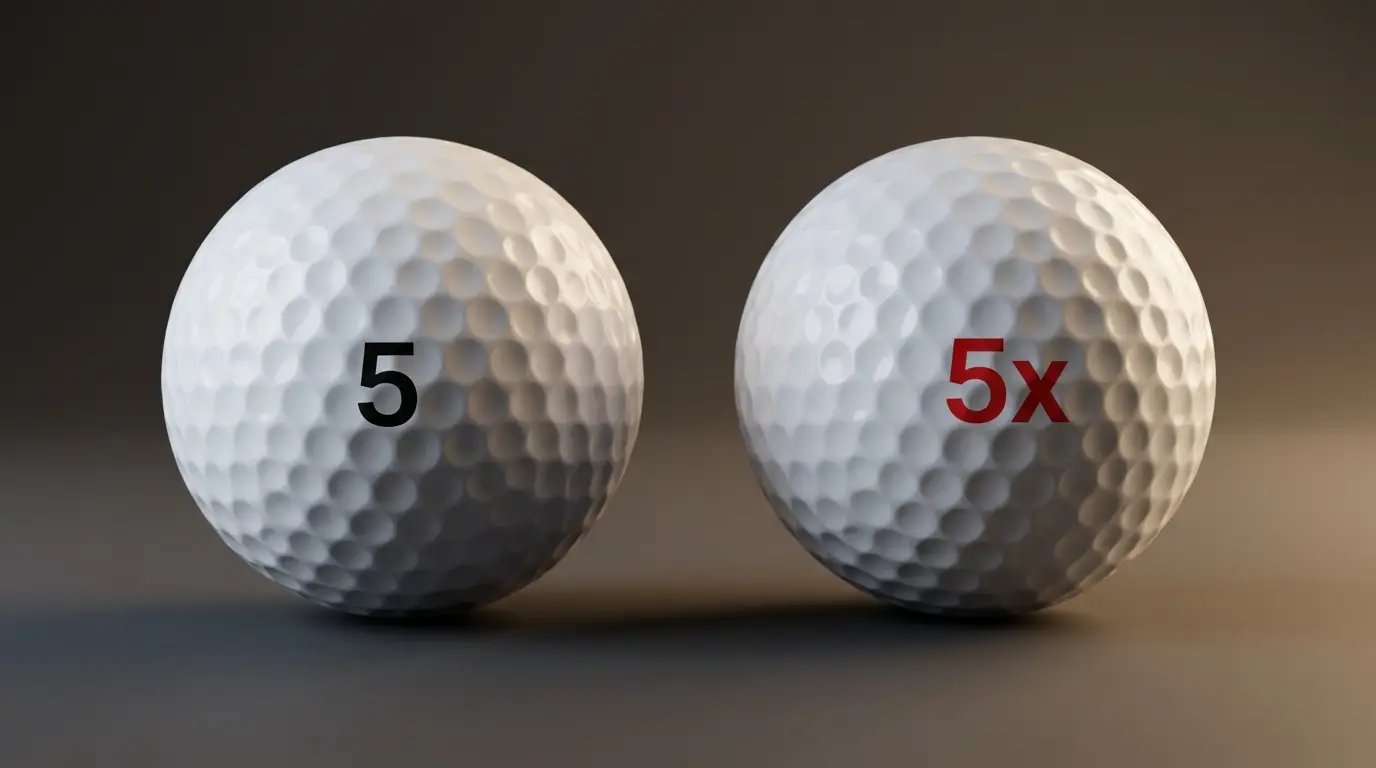
| Number color | Black | Red |
| MSRP | $54.99/dozen | $54.99/dozen |
Compression numbers above are the BallCaddie catalog’s source-of-truth values (TaylorMade TP5 and TaylorMade TP5x). MyGolfSpy’s independent Ball Lab measured TP5x at an average of 98 on its calibrated gauge — “one of the firmer options on the market” — putting it within a point of the catalog number.
Why this comparison gets misread
Most “TP5 vs TP5x” content treats them like two different balls. They’re closer to two tunings of the same ball. Both use the same 5-layer architecture — a layered core, a speed-mantle, and a cast-urethane cover — and the same Tour Flight Dimple Pattern. Both are priced identically.
The differences live in two places: core stiffness (which sets compression and feel) and how the layer progression separates driver spin from wedge spin. The decision rule isn’t “high handicap or low” or even “fast or slow swinger.” It’s whether you’d rather have softer feel and more wedge spin (TP5), or firmer feel and lower driver spin for distance (TP5x). The full fitting context lives in the golf ball compression chart and how to choose a golf ball by swing speed.
The construction (same skeleton, different stiffness)
TaylorMade’s five-layers deep-dive describes a layered core — a soft inner section followed by progressively stiffer mantle layers — wrapped in a speed-mantle and a cast-urethane cover. The architecture is identical between the two balls; only the durometer and density of each layer change.
The 2024 generation introduced the Speed Wrapped Core, described by MyGolfSpy as a material-density change that decouples sound and feel from compression. The practical effect: the new TP5 reads softer in feel than the prior generation despite holding nominally the same compression. The cover is identical between the two — the wedge-spin gap shows up because TP5’s softer core lets the urethane stay engaged with the grooves longer at low impact speeds.
Compression and feel
The 10-point catalog spread between TP5 (87) and TP5x (97) puts both balls in the high-compression tier but at meaningfully different positions within it. Golf Insider UK reports the same gap on its own gauge (87 vs ~98). For where these compressions sit relative to the rest of the urethane tier, see the golf ball compression chart — TP5 lines up next to the Titleist Pro V1, and TP5x sits next to the Pro V1x.
PluggedIn Golf describes TP5 as “soft and responsive” — a lower-pitched thud on the putter. TP5x produces a crisper, higher-pitched click closer to the Pro V1. Most reviewers can identify the two by sound alone within a single putt.
Driver spin and total distance
The cleanest measurable gap between the two balls is driver spin. PluggedIn Golf measured TP5x running roughly 150 RPM lower than TP5 with a low-spin player, with the gap widening for high-spin swings. MyGolfSpy’s TP5 vs TP5x buyer’s guide shows the distance gap widening with clubhead speed: 2–4 yards at 95 mph, 6 yards at 105 mph, 8–12 yards at 110+ mph. The Speed-Layer architecture is engineered exactly for this — at high impact loads the soft inner core engages, depressing spin; at low loads only the outer layers respond.
If you’re under 95 mph, the driver gap won’t be the deciding factor. If you’re over 105 mph, it usually is.
Iron and wedge spin (the TP5’s case)
Run the comparison the other direction and TP5 wins — by a wider margin. PluggedIn Golf measured TP5x roughly 7% lower on iron spin in its review, and BallCaddie’s catalog reflects the same dynamic: TP5 is tagged spinCategory: high while TP5x is spinCategory: mid. The on-course translation matters: a full sand wedge that one-hops and stops with a TP5 will release noticeably more with a TP5x on the same firmness. For a player who scores from inside 100 yards, TP5 buys back real shots; for a player who plays for the middle of the green and prizes distance off the tee, TP5x’s slightly lower wedge spin is a fair trade.
This is the spin-slope dynamic, similar to what shows up in the Pro V1 vs Pro V1x comparison — both balls in a family share low driver spin, but the wedge-spin slope climbs steeper on the softer-core option.
Trajectory and wind
TaylorMade classifies both balls as high-launch in its lineup, with TP5x slightly flatter and more piercing in mid-flight. In a crosswind, the lower-spin TP5x is the more wind-stable ball; TP5’s higher wedge spin can balloon shots into a stiff headwind on partial swings. Neither ball is the right pick below 50°F — both are stamped coldWeatherSuitable: false in the BallCaddie catalog.
Swing-speed fit
The clean read by speed band:
| Driver swing speed | Recommendation |
|---|---|
| Under 90 mph | Neither — drop to a mid- or low-compression option in the compression chart |
| 90–100 mph | TP5 (firmness, feel, and wedge spin all cooperate; distance gap to TP5x is small at this speed) |
| 100–110 mph | Either — choose by feel and short-game priority |
| Over 110 mph | TP5x (lower driver spin helps high-spin swingers most; the distance edge is real at this speed) |
For more granular fitting, see best golf ball for 95 mph or best golf ball for 100 mph. The pillar guide how to choose a golf ball by swing speed has the same logic applied across all bands and brands.
Tour usage and the McIlroy switch
Per the PGA Tour’s equipment report, Rory McIlroy switched from TP5x to TP5 about a month before the 2026 Masters. McIlroy historically runs above-average driver spin. The 2024 TP5’s softer core gave him slightly more wedge and approach spin without sacrificing meaningful driver ball speed — exactly the trade his game needed. The switch is the cleanest evidence that “fastest swinger plays the firmest ball” is a rule of thumb, not a law.
Mistakes and decision rules
- Don’t pick by swing speed alone. McIlroy’s switch — at 115+ mph — makes the point. Trajectory preference and short-game priority matter as much.
- Don’t switch mid-round. TP5 and TP5x carry different distances, especially on full irons. Pick one for 18.
- Don’t read TaylorMade’s “half club longer” claim as TP5x vs TP5. The original announcement compares the 2024 TP5x to the 2021 TP5x — a generation-over-generation gain, not a TP5x-vs-TP5 advantage.
- If you lose more than a sleeve a round, neither is the right call. Step back to a best value golf ball recommendation or the Vice Pro Plus vs Pro V1 comparison for a $30-tier urethane alternative.
The fastest read: TP5 if you score with your wedges. TP5x if you score with your driver. Take the BallCaddie quiz (sign up to see your match) for a fitting that weights swing speed, short-game priority, and feel together — or browse the catalog to compare TP5/TP5x against the rest of the urethane tier.
For deeper dives
- Pro V1 vs Pro V1x — the Titleist parallel to this comparison, with similar spin-slope dynamics.
- Pro V1 vs TP5 — the cross-brand version, comparing 3-piece Titleist to 5-piece TaylorMade.
- Golf ball compression chart — every ball’s measured compression on a single calibrated gauge.
- How to choose a golf ball by swing speed — the parent fitting pillar.
- Urethane vs ionomer covers — when the cover-material upgrade is worth the price jump.
Key takeaways
- Same 5-layer construction, same urethane cover, same $54.99 catalog price.
- TP5 = compression 87, softer feel, higher wedge spin.
- TP5x = compression 97, firmer feel, lower driver spin, longer carry at high swing speeds.
- Under 90 mph, neither is the right fit; over 110 mph, TP5x’s distance edge is real.
- Number color is the visual tell — TP5 black, TP5x red.
Frequently asked questions
Is the TP5 or TP5x better?
Neither is universally better. TP5 is the softer 5-layer ball (compression 87) with higher wedge spin — better for golfers in the 90–105 mph driver-speed band who want greenside stopping power. TP5x (compression 97) has lower driver spin and a flatter, more penetrating flight — better for swing speeds above 105 mph chasing maximum carry. Both share the same 5-layer construction, the same cast-urethane cover, and the same dimple pattern.
What is the difference between TP5 and TP5x?
Construction is identical — both are 5-layer balls with a Speed Wrapped Core and a cast-urethane cover. The differences are compression (TP5 87 vs TP5x 97), driver spin (TP5x measurably lower per PluggedIn Golf and MyGolfSpy testing), wedge spin (TP5 noticeably higher), and feel (TP5 reads softer, TP5x clickier). The number color is the visual tell — TP5 black, TP5x red.
What swing speed is the TP5x for?
TaylorMade markets TP5x to faster swingers, and independent robot testing from MyGolfSpy supports it: the TP5x’s distance edge over TP5 grows with clubhead speed. Below 100 mph the gap is small enough that feel preference is a better tiebreaker. Below 90 mph, neither ball is the right fit — TaylorMade’s Tour Response or another mid-compression option suits that band better than either premium 5-layer model.
Does TP5 spin more than TP5x?
On wedges and short irons, yes — independent testing from PluggedIn Golf measures TP5x roughly 7% lower on iron spin, and BallCaddie’s catalog tags TP5 as high-spin and TP5x as mid-spin. Off the driver, TP5x is the lower-spin option. The on-course read: a TP5 wedge that holds the green will release more with TP5x. Both balls produce above-average wedge spin for the urethane tier — TP5x is the lower-spin option within the tour tier, not a low-spin ball outright.
Are TP5 and TP5x the same price?
Yes — both list at $54.99 per dozen on the BallCaddie catalog, with personalization adding a small premium. The pix variants (with the high-contrast ClearPath Alignment graphics) and yellow versions carry the same per-dozen price as the standard white. Street prices on the prior generation typically drop once the new generation ships, so checking secondary retailers can save real money on a previous-year sleeve.
Why did Rory McIlroy switch from TP5x to TP5?
Per the PGA Tour’s equipment report, McIlroy tested both before the 2026 Masters and found the new Speed Wrapped Core in the 2024 TP5 held driver ball speed close to the TP5x while adding spin on partial wedges and approach shots — exactly the trade he wanted. McIlroy historically generates above-average driver spin already, so giving back lower spin in exchange for greenside control was a net gain for his game. It’s a one-player example, not a universal recommendation.