Inside Your Ball Fitting Report — what’s free and what $29 unlocks
Last updated: August 28, 2026 · BallCaddie — independent, brand-neutral ball fitting.
Your Ball Fitting Report is one document with seven sections. Six of them are free once you finish the quiz. The seventh is sealed. The split follows one rule: the free sections describe the golfer, and the paid section is the answer. This page walks through all seven with screenshots from a real report, so you know exactly what you get before you give us an email address.
The one thing that stays sealed
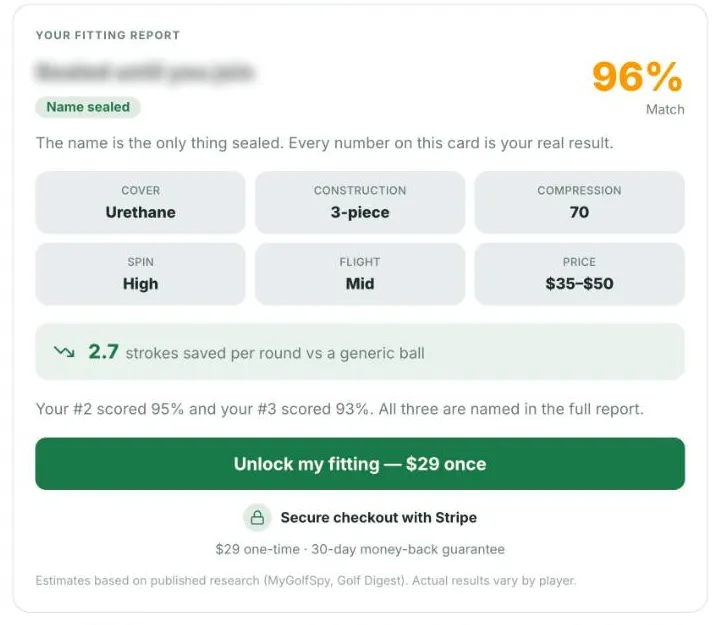
The match card is the first thing you see at the top of the report. The match percentage is real. The cover, construction, compression, spin, flight, and price band are real. The scores for your #2 and #3 are real. The ball’s name is the only thing withheld — you are reading the full case for a conclusion and deciding whether the conclusion is worth $29.
The seven sections, one at a time
Sections 1–6 open as soon as the quiz is done. Section 7 is the Full Unlock.
Section 1 — Your swing, read back to you
Free after the quizIn one line: Every answer you gave, on one page, in the units a fitter would use.
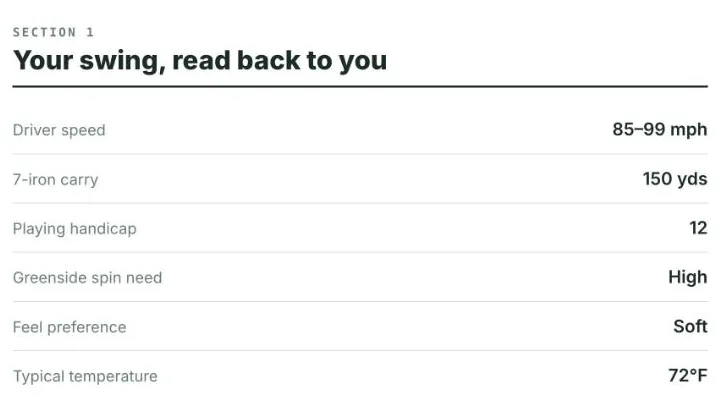
The report opens by showing you what it thinks it heard. Driver speed band, 7-iron carry, playing handicap, greenside spin need, feel preference, and the temperature you usually play in. It's deliberately boring, and it's the section people re-read most — because if the fitting is wrong, it is almost always wrong here, and one edited answer fixes the whole report.
Section 2 — The specs your game needs
Free after the quizIn one line: Compression, cover, spin, and flight — as requirements, before any ball is named.
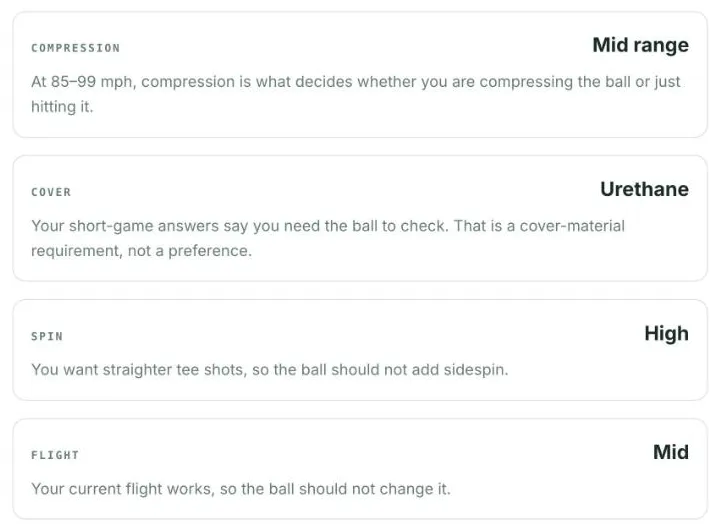
This is the section that turns answers into a spec sheet. It states the compression band, cover material, spin profile, and flight window your game calls for, and it gives the reason for each one in a sentence. The compression line says what it changes for you, which is mostly feel and driver spin. A urethane cover is a requirement that falls out of your short-game answers, not a preference. Read this section and you could shop for yourself without us.
Section 3 — Where your strokes are leaking
Free after the quizIn one line: The ball’s effect on your score, broken into the four places it shows up.
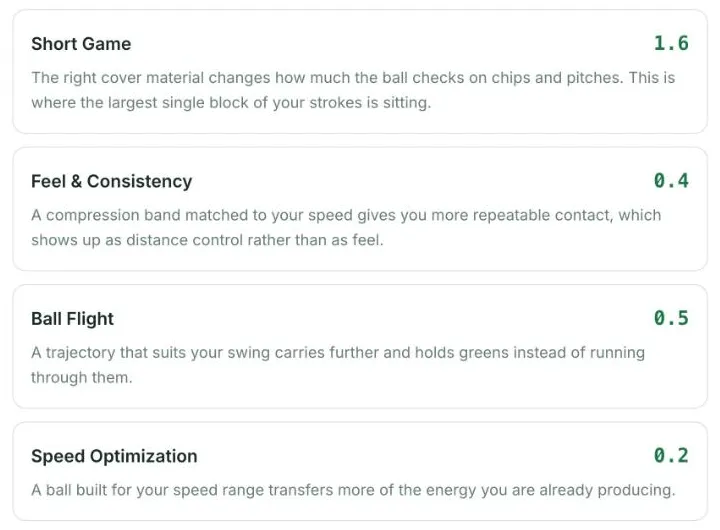
Short game, feel and consistency, ball flight, and speed optimization — each with an estimated stroke figure and an explanation of the mechanism behind it. For the sample profile the largest single block sits in the short game, which is exactly why cover material outranks compression for that golfer. The figures are estimates based on published research, not measurements of your rounds, and results vary by player.
Section 4 — How the catalog scored for you
Free after the quizIn one line: How much of the shelf your fitting eliminated — as a count, not a leaderboard.
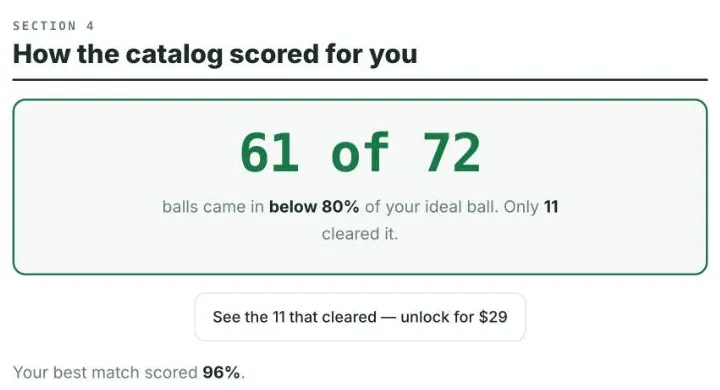
Every ball in the catalog is scored against the spec in Section 2, and this section reports the result as a number: for the sample profile, 61 of 72 balls came in below 80% of the ideal, and 11 cleared. That count is the honest part of the free report. It tells you how narrow the real shortlist is without handing over the shortlist, and it is the clearest evidence that "any premium ball is fine" is not true for a specific golfer.
Section 5 — How to test any ball yourself
Free after the quizIn one line: The protocol — so the report survives a catalog change, a new release, or our disappearing.
A sleeve, not a dozen. Play the same two holes with your current ball and the candidate — one shot each, alternating, so course and conditions match. Judge it on chips and pitches first, since cover material shows up around the green long before it shows up off the tee. Ignore driver distance on a single round; wind and turf swing it more than the ball does. And re-test when the temperature drops below 55°F, because compression behaves differently in the cold. This section is written so it works on a ball we have never heard of, which is the point of putting it in the free half.
Section 6 — What to ignore in ball marketing
Free after the quizIn one line: The five claims on the box that tell you nothing about your fit.
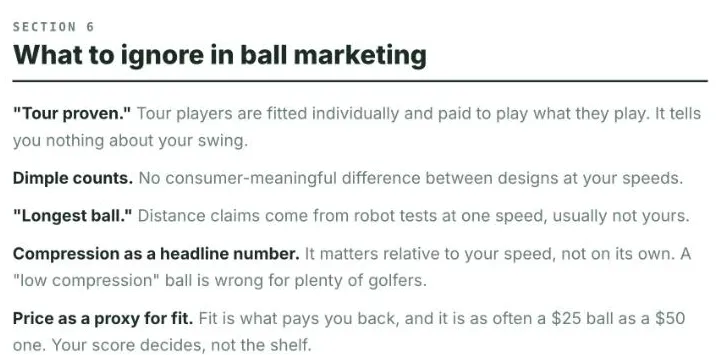
"Tour proven" describes a paid contract and an individual fitting, not your swing. Dimple counts have no consumer-meaningful difference between designs at amateur speeds. "Longest ball" comes from a robot test at one speed, usually not yours. Compression as a headline number is meaningless without a speed to compare it to — plenty of golfers are wrong for a "low compression" ball. And price is not a proxy for fit: a $25 ball beats a $50 one often enough that the shelf position tells you nothing.
Section 7 — Your Match
Full Unlock — $29 onceIn one line: The answer: your #1 ball by name, plus #2 and #3, the near-misses, and a buy plan.
Sections 1 through 6 describe the golfer. Section 7 is the answer, and it is the only part behind the $29. It names your #1 ball and gives the reasoning — which of your spec requirements it satisfies and which it trades away — then names your #2 and #3 so you have real alternatives when a model is out of stock or on sale. It lists the near-misses, the balls that failed on one axis and why, so you can tell whether a friend’s recommendation is close or nowhere near. And it ends with a buy plan: which to sleeve-test first, and in what order.
The three things a ball fitting is actually deciding
Every line in Section 2 traces back to one of three relationships. Once you can see them, the rest of the report reads as arithmetic rather than opinion.
Compression ↔ swing speed
Every swing compresses the core, even a slow one. Compression mostly sets feel and driver spin, and firmer balls tend to be a little faster off the driver. That is why Section 2 states a compression band and not a compression number.
Spin ↔ your miss
A tee ball that peels off the planet wants less driver spin. Approach shots that land and keep running want more of it. The spin line in your spec is set by the miss you described, not by which spin sounds better.
Cover material ↔ scoring shots
Urethane grips the face and checks; ionomer is durable and cheap but releases. Which one you need depends on where your strokes are leaking — which is why Section 3 sits between the spec and the answer.
Where the numbers come from
BallCaddie does not run a hitting robot, and the report never pretends otherwise. It draws on two separate bodies of data and keeps them separate:
- Independent robot-test data. Measured performance comes from organizations that do run the robots — MyGolfSpy and Golf Digest ball tests. That is where distance, spin, and consistency behavior comes from, and it is why the catalog’s compression figures are gauge readings rather than marketing numbers.
- Manufacturer spec sheets. Construction facts — cover material, layer count, dimple design, stated compression, price — come straight from the manufacturers. Facts about what a ball is, never claims about how well it performs.
- USGA conformance. Every ball in the catalog is checked against the USGA conforming list, so a fitting can never point you at a ball you cannot put in play.
What that buys you and what it does not: the report is a fitting built from what you know about your own game, scored against measured data on the balls. It isn't a launch monitor session, and it doesn't claim to be one. A fitter watching your actual ball flight is measuring something this cannot see.
What it costs, and what it is next to
The quiz takes about 90 seconds and is free, and so is the report it builds. Naming your #1 ball is the one paid part, and we'd rather say so here than surprise you at the end.
Section 7 is $29, one time, and it never renews. That payment also opens Caddie Mode on-course A/B testing, My Bag, unlimited re-fits, Settle the Debate, and saved fittings. If you would rather pay monthly, BallCaddie Pro is $4.99/month for the same feature set.
For scale, not for a superiority claim: a dozen premium golf balls runs about $55, so a wrong ball costs roughly twice the report. Club Champion charges $175 for a single-club fitting — a club fitting, a different thing entirely, listed here only because it's the number most golfers have in their heads when they hear the word "fitting". Our fitting tool comparison lays out what every option measures and what it costs.
Frequently asked questions
Is the Ball Fitting Report free?
Six of its seven sections are. The quiz takes about 90 seconds and is free. Sections 1 through 6 open with no payment: your swing read back to you, the compression, cover, spin and flight your game needs, where your strokes are leaking, how many balls in the catalog cleared your bar, how to test any ball yourself, and what to ignore in ball marketing. Section 7, "Your top 3, by name", is the one that names balls, and it is sealed until you unlock it.
What does the $29 Full Unlock include?
The Full Unlock is $29 one-time and never renews. It opens Section 7, "Your top 3, by name": the #1 ball for your profile by name, plus your #2 and #3 with the reasoning behind each, the near-misses that just failed to clear, and a buy plan for testing them. It also opens Caddie Mode on-course A/B testing, My Bag, unlimited re-fits, Settle the Debate, and saved fittings. BallCaddie Pro at $4.99/month is the same feature set on monthly billing if you would rather not pay once.
Do I need a launch monitor to get a Ball Fitting Report?
No. The quiz asks for things you already know — a driver-speed range, your usual 7-iron carry, your handicap, whether you need the ball to check around the green, your feel preference, and the temperature you usually play in. If you do have launch monitor numbers you can enter them and the fitting gets sharper, but nothing in the report requires them. That is the trade being made: a launch monitor session at a fitter measures your ball flight directly, and this reads your answers instead.
Why is the ball name sealed in the free report?
Because the name is the answer and everything before it is the reasoning. Sections 1 through 6 describe the golfer — your speed band, the specs that follow from it, where your strokes are going, how the catalog sorted, how to test, what to ignore. Section 7 is the conclusion those six sections build to. Every number on the sealed match card is your real result — the match percentage, the compression, the cover, the construction, the price band — the name is the only thing withheld. You can read the whole case for free and decide whether the conclusion is worth $29.
What data is the fitting based on?
Two sources, kept separate. Independent robot-test data — MyGolfSpy and Golf Digest ball tests — supplies measured performance, because those organizations run the hitting robots and BallCaddie does not. Manufacturer spec sheets supply the construction facts: compression, cover material, layer count, dimple design, and price. USGA conformance is checked so nothing in the catalog is a non-conforming ball. BallCaddie takes no affiliate money from ball manufacturers, and the stroke figures in Section 3 are estimates based on published research, not measurements of your own play — results vary by player.
Related BallCaddie pages
- Ball Catalog — every ball the report scores against.
- Smart Buy Plan — the sleeve-first protocol behind Section 5.
- Compare Fitting Tools — what each fitting option measures and costs.
- Pricing — the $29 Full Unlock and the monthly alternative.