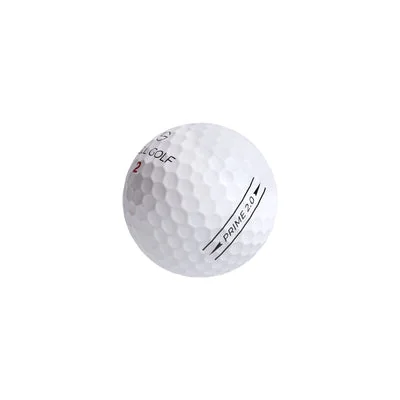
Snell Prime 2.0 Golf ball compression, specs & review
The Snell Prime 2.0 is a 82-compression, 2-piece golf ball with a urethane cover, mid spin and a high flight. The Snell Prime 2.0 is a rare two-piece urethane (soft, grippy XV3 cover) value ball fit for low-to-mid swing speeds (7-iron carries of 125 yards or less). In Today's Golfer's 2024 robot test its wedge spin landed within 74 rpm of a Pro V1, and within 133 rpm on an iron. MyGolfSpy has not robot-tested it; its only article on the ball is disclosed partner content.
Is 82 compression right for your swing? The quiz checks your swing speed and feel against every ball in our catalog, this one included.
Take the quiz →What do these specs mean?
Compression
How soft the ball feels. Lower numbers (70–80) compress easier and help slower swings get distance. Higher (90+) rewards faster swings.
Cover
Surlyn is tough and cheap — great for distance and durability. Urethane is softer and grips wedges for more spin around the green.
Layers
2-piece: simple, long, straight. 3-piece and 4-piece add layers for more feel and spin control on approach shots.
Trajectory
How high the ball flies. Low = flatter flight with more roll. High = peaks up and lands soft. Mid = balanced.
Spin
Low spin = straighter shots, less curve, more roll. High spin = more control and stopping power on the green (but also magnifies slices/hooks).
Tier
Price bucket. Value = budget-friendly distance balls. Mid = solid all-around. Premium = tour-level spin and feel, costs more per dozen.
Best For
Try a sleeve first — ~$5 for 3 balls before committing to a dozen.
What golfers told our quiz
16% of the 2,698 golfers who finished our quiz say their drives fly low, like a line drive. The Snell Prime 2.0 is rated high-flight, which is aimed at that.
Take the 90-second quiz to see which balls fit your swing.
Self-reported answers from 2,698 finished quizzes, as of Oct 4, 2026.
The Snell Prime 2.0 is a rare two-piece urethane (soft, grippy XV3 cover) value ball fit for low-to-mid swing speeds (7-iron carries of 125 yards or less). In Today’s Golfer’s 2024 robot test its wedge spin landed within 74 rpm of a Pro V1, and within 133 rpm on an iron. MyGolfSpy has not robot-tested it; its only article on the ball is disclosed partner content.
Who It’s For
The Snell Prime 2.0 is built for slower-to-moderate swing speeds — Snell fits it to players whose 7-iron carry is around 125 yards or less. It suits golfers who prioritize moderate swing speed, slow swing speed, greenside control, great value. It is a rare thing: a genuine urethane ball at a value price. MyGolfSpy has not tested it; the independent numbers we have come from Today’s Golfer’s 2024 robot test. In the Snell lineup, the Prime 2.0 sits firmer than the Snell Get Sum and softer than the Snell PR3.
Feel
With the soft XV3 urethane cover over a two-piece build, feel is soft and controlled off the face without going mushy on full shots.
Spin Profile
Driver spin stays sensible for slower swings, so drives hold their line. Around the green the XV3 urethane cover bites: in Today’s Golfer’s 2024 robot test wedge spin landed within 74 rpm of a Pro V1, and within 133 rpm on an iron, which is remarkable for the price.
Trajectory & Construction
A high launcher, which is what the slower swings Snell fits it to (a 7-iron carry of 125 yards or less) need to keep the ball carrying. Two pieces only, but the cover is urethane (Snell’s XV3), a rare combination for a $19 ball; two-piece balls are almost always ionomer. Performs well in cooler temperatures.
Price & Value
At $18.99 per dozen (direct-to-consumer, no retail markup), the Prime 2.0 delivers premium materials at a meaningful discount to the big brands.
Buy it if
- You want real urethane greenside spin without paying tour-ball prices.
- Your 7-iron carry is around 125 yards or less.
- Greenside control matters more to you than the last few yards off the tee.
Similar Balls
- Snell Get Sum — softer, ionomer-covered sibling
- Vice Tour — 3-piece urethane value ball
- Maxfli Tour — urethane, mid-compression value tour ball
- Kirkland Signature V3 — 3-piece urethane, Costco value
Frequently Asked Questions
What is the compression of the Snell Prime 2.0 golf ball?
The Snell Prime 2.0 has a compression of about 82, which puts it in the mid-compression range. At 82 it is a mid-compression ball, soft enough for the slower-to-moderate swings Snell recommends it for without going mushy on full shots. It is one of several specs the BallCaddie fitting quiz weighs against your swing speed, usual miss, feel preference and budget.
Who should play the Snell Prime 2.0?
The Snell Prime 2.0 is built for slower-to-moderate swing speeds — Snell fits it to players whose 7-iron carry is around 125 yards or less. It suits golfers who prioritize moderate swing speed, slow swing speed, greenside control, great value.
What swing speed is the Snell Prime 2.0 designed for?
Snell aims it at slower-to-moderate swings — roughly a 125-yard 7-iron carry or less — where a value urethane ball gives up little to a premium tour ball.
Does the Snell Prime 2.0 have high greenside spin?
Close to it. In Today’s Golfer’s 2024 robot test its wedge spin landed within 74 rpm of a Pro V1. MyGolfSpy has not tested it, so that is one independent robot test, not a consensus.
Is the Snell Prime 2.0 good in cold weather?
Yes. Of the three Snell urethane balls we list, the Prime 2.0 is the softest and the only one we flag as cold-weather suitable.
How much does the Snell Prime 2.0 cost?
MSRP is $18.99 per dozen.
Read more about the Snell Prime 2.0
Compare every current Snell golf ball by swing speed, spin, and price: the PR4 for 110+ mph swings, and where the 2026 robot test left the PR3.
Yes, between holes, under Rule 6.3a. Mid-hole only when a Rule allows it. What a found Supersoft costs a Pro V1 player, in 2026 robot-test spin numbers.
Tell the ball from the swing: wedges that release, drivers that balloon, slices, hard feel. Each sign gets a ball-or-swing call and a 2-minute test.
Yes. In 2026 robot testing at 86 mph the Pro V1 was the longest of 48 balls. What an 85 mph swing pays for it, and where our fitting engine draws the line.
Usually no. Of 2,800 fittings, 1,127 were 16+ handicap, and only 7% got a Pro V1 or V1x as their #1 ball. Swing speed and short game decide it, not handicap.
A 9-hole, two-sleeve protocol for testing golf balls on the course: which two balls to buy, how to alternate them, what to write down, how to read the result.
Similar Balls
Balls with comparable specs