🎯 New here? BallCaddie matches golfers to the right ball. → Take the 90-second quiz
Back to BlogHow to Test Golf Balls on the Course Without Buying a Dozen
A 9-hole, two-sleeve protocol for testing golf balls on the course: which two balls to buy, how to alternate them, what to write down, how to read the result.
Answer a few questions about your swing and BallCaddie matches you against a 72-ball catalog.
Take the 90-second quizHow to test golf balls on the course
Buy one sleeve each of two balls, mark them, and play 9 holes alternating by hole: Ball A on the odd holes, Ball B on the even holes, same tee and target line. Judge them at the green first (putts, chips, how an approach lands), then off the tee. Write 6 things down per hole on the card below. One written 9-hole round beats five rounds of memory, and it costs about $25 to $30 in sleeves instead of $110 in dozens.
The method is older than the product. Gene Parente, who founded Golf Laboratories and runs the robot that most ball tests use, told GOLF.com in 2024 to “go buy a sleeve of two to three different types of balls” and “start short and work your way back,” because the 40-yard wedge shot is the shot that decides whether a tour player keeps a ball. Titleist’s own fitters say the same thing: they “start at the green and work back to the tee.” What’s missing from both is the part in between: how to run that test on a public course with a group behind you and no launch monitor.
Why the range can’t run this test
Range balls answer the wrong question. They are a different model from anything you’d buy, they come off a mat, and they land on a flat field where no one can see whether a wedge shot checked or released. The two things that separate a $20 ball from a $55 ball both happen on grass you can’t see from a range bay.
In MyGolfSpy’s 2026 robot test of 48 balls, urethane covers averaged roughly 1,250 rpm more spin than ionomer on a 35-yard pitch and about 2,600 rpm more on a full wedge (its follow-up cover-material breakdown, which groups the balls differently, puts those gaps nearer 1,900 and 3,300). Off the driver at 86 mph, 11 yards of total distance covered the entire 48-ball field, and the firmest balls led the ball-speed chart. So a range session with a driver measures a question the whole field answers within 11 yards and skips the 2,600-rpm one. The course does both, and the short game is the half you’re paying for. Our urethane vs ionomer post has the cover numbers in full.
Pick two balls from a spec range
Testing a Pro V1 against a Chrome Soft tells you which of two tour balls you prefer, and leaves open whether a tour ball is the right tier for your swing in the first place. Start one level up: get a compression and cover range for your game, then pick two balls inside it that differ in the one variable you want to settle.
The BallCaddie fitting quiz returns that range in about 90 seconds, along with how many of the 72 catalog balls it ruled out. The quiz and the six-section report are free; naming your #1 ball is the paid part. The range is all this test needs, and it’s in the report.
Three ways to pick the pair, in order of how often they’re the right call:
- Your current ball vs the cheapest ball inside your range. The most common pairing. Of the 2,794 golfers who have taken the BallCaddie quiz as of October 24, 2026, 49% say they don’t care about feel, which removes the main reason to pay more than the range requires. (Self-reported answers, not measured results.)
- The cheapest ball in your range vs the priciest. This settles whether the cover upgrade is worth it to you. Below is what that pair usually looks like.
- Two balls at the same price, different flight. For golfers whose miss is the problem: one low-launch and one high-launch ball from the same tier.
The pair most golfers end up testing
Costco shoppers compare these three more than any other trio, and the trio covers both ends of the cover question. Specs are from the BallCaddie catalog; the spin notes are from the 2026 robot test.
| Callaway Supersoft (~49) | Kirkland Signature V3.0 (~95) | Titleist Pro V1 (~92) | |
|---|---|---|---|
| Cover | Ionomer | Urethane | Urethane |
| Compression (catalog) | ~49 | ~95 | ~92 |
| Driver spin tendency | Low | Mid | Mid, high around the green |
| Reference price per dozen | $26.99 | About $15 to $20 | $57.99 |
| What the on-course test shows | Chips release; soft off the putter | Chips check more than the Supersoft, less than the Pro V1 (the yellow checks more than the white) | Chips check and stop quickest of the three |
| The shot that decides it | A 40-yard pitch to a firm green | Same | Same |
If the Supersoft and the Pro V1 land the same way on your 40-yard pitch, the test is over and you’ve saved $31 a dozen. If the Pro V1 stops two paces shorter, you’ve found the one number that justifies the price, and you can go looking for a cheaper urethane ball that does the same thing. Our Kirkland review has the full robot numbers on that middle column.
Which two balls to test, by your miss and speed
BallCaddie’s fitting read on the pair to put in your sleeves, built from the catalog’s spin and flight fields. The right-hand ball in each cell is the one that attacks the miss; the left-hand ball is the control. Swing-speed bands are driver clubhead speed.
| Your miss | Under 85 mph | 85–95 mph | 95–105 mph | 105+ mph |
|---|---|---|---|---|
| Slice or fade that costs distance | Srixon Soft Feel (~58) vs Bridgestone e12 Straight (~66) | Titleist TruFeel (~70) vs Titleist AVX (~81) | TaylorMade Tour Response (~74) vs Snell PR4 (~91) | Titleist Pro V1 (~92) vs Titleist Pro V1x Left Dash (~105) |
| Driver balloons | Callaway Supersoft (~49) vs Bridgestone e12 Speed (~80) | Srixon Ultispeed (~85) vs Titleist AVX (~81) | Titleist Pro V1 (~92) vs Titleist AVX (~81) | Bridgestone Tour B X (~100) vs Titleist Pro V1x Left Dash (~105) |
| Flies low, lands hot | Callaway Supersoft (~49) vs Wilson Duo Soft (~37) | Titleist TruFeel (~70) vs Snell Prime 2.0 (~82) | Titleist Pro V1 (~92) vs Titleist Pro V1x (~102) | Callaway Chrome Tour (~94) vs Titleist Pro V1x (~102) |
| Straight, but approaches won’t hold | Srixon Soft Feel (~58) vs Srixon Q-Star Tour (~70) | Titleist Tour Soft (~88) vs Srixon Z-Star (~81) | Kirkland Signature V3.0 (~95) vs Maxfli Tour (~94) | Bridgestone Tour B X (~100) vs Srixon Z-Star XV (~96) |
Two cautions on that table. The slow-swing column pairs soft balls on purpose, but a slow swing does not rule out a firm ball: in the 2026 robot test, firmer balls were as fast or faster off the driver at every speed tested, so if you like a firm feel, test one. The miss column describes a ball-flight tendency. A ball with less driver spin shortens a slice and leaves the swing path exactly where it was. The swing-speed fitting guide explains the tiers behind the columns.
The 9-hole rotation
Alternating by hole is the whole trick. Playing one ball for 9 holes and the other for the next 9 (the method Titleist suggests) works on a quiet day, but on most courses the back nine has different wind, firmer greens by afternoon, and a tired swing. Alternating puts both balls in the same conditions within 15 minutes of each other.
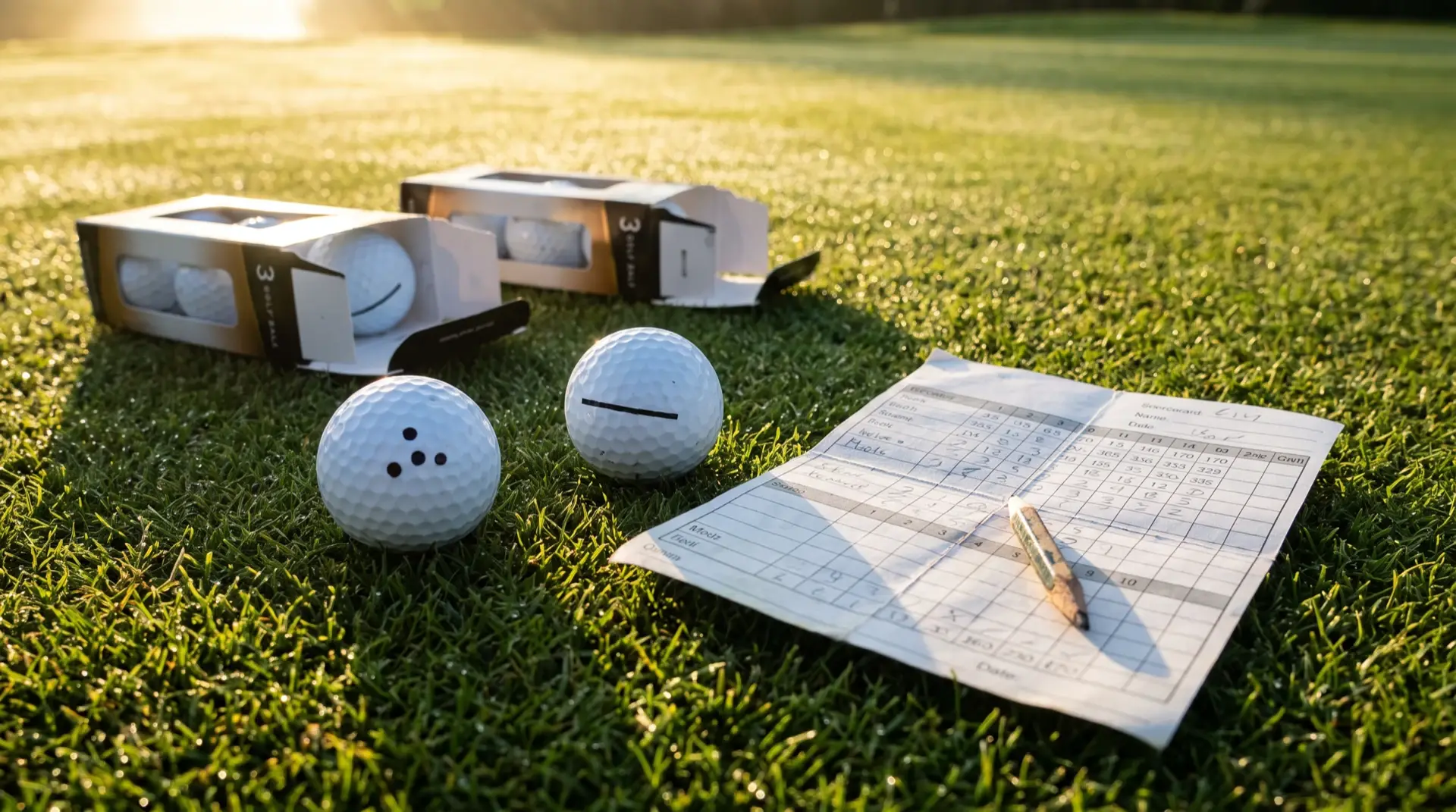
- Mark the balls before you leave the house. Three dots on Ball A, one line on Ball B, in a color you can see on the green. The Rules recommend an identifying mark on your ball (Rule 6.3a), and you’ll need one to tell the two apart on every green.
- Ten minutes on the practice green first. Ten putts from 6 feet and ten from 25 feet with each ball. Write down one word for feel off the putter and whether the long putts came up short or long relative to your gamer. Then ten chips from 15 yards: did each one check or release?
- Ball A on odd holes, Ball B on even holes. Same tee box, same target line, same club you would have hit anyway. You can change balls between holes under the Rules (Rule 6.3a, and the USGA’s plain-English version is “you may change balls under any relief Rule or between the play of two holes”). Finish each hole with the ball you teed off with.
- Don’t chase a bad swing. If you top a drive on hole 4, write “mishit” and move on. One bad swing per ball per nine is normal; the sheet averages it out. Three bad swings in a row ends the test for today. The ball had nothing to do with it.
- Note the one-ball rule if you’re in a competition. The USGA’s One Ball Rule is an optional condition a committee can adopt; when it’s in effect you must finish the round with the brand and model you started with. It is not in effect for a casual round, so the alternating test is legal on any ordinary day.
What to write down
Six things per hole, one line each. A pencil on the back of the scorecard is enough; the table below is the card.
| Per hole | Write | What it tells you |
|---|---|---|
| Driver | Fairway / left / right, and how far off | Spin and launch fit. A ball that misses farther on the same swing is spinning more. |
| Approach | Carry vs what you expected: short, on, long | Compression fit. Two or three yards short on every approach is a tier problem. |
| Green reaction | Released / checked / spun back | Cover. This row alone decides whether urethane is worth paying for. |
| Chip | Checked or released; one word for feel | Cover and your lie. Match this against the practice-green row. |
| Putt | Soft / firm; short / long on the lag | Feel. Rarely a reason to switch on its own. |
| Confidence | One word | The row you’ll remember in July. |
Skip yardages you’d have to guess. If you carry a GPS watch, write the approach carry; if not, “short / on / long” is more honest than an invented number. The protocol trades lab precision for the weather, turf and nerves a launch monitor can’t reproduce.
How to read the sheet
Add up the rows where one ball won clearly. Then apply four rules, in this order.
- If only putter and chip feel differ, keep the cheaper ball. Feel is yours to prefer, and it doesn’t change where the ball finishes. Half of our quiz takers say they don’t care about feel at all.
- If green reaction differs, the cover is worth paying for. A ball that checks on your approaches and chips when the other one releases is giving you back the 2,600-plus rpm the robot measured. That is the one result that justifies a price jump, and it’s also the result that tells you to look for a cheaper urethane ball with the same behavior.
- If driver dispersion differs by more than a fairway width, recheck your tier before buying either. A big driver gap on the same swing means one ball is well off your compression or spin range. Re-run the quiz with your real carry number, then test again inside the new range.
- A draw means keep your current ball. Two balls that land the same way on 9 holes are the same ball for your game. Buy the cheaper one, or keep the one you already have a box of. A tie still counts as a result.
Of the 2,794 quiz takers above, 34% call tee shots their weakest area and 21% say the short game, yet the robot data puts the biggest ball-to-ball gap at the wedge. The sheet is built to make you look at the rows you’d otherwise skip. Our strokes-saved audit explains how the engine turns those rows into a per-round number.
Then buy the dozen
Only now. Buy the winner as a dozen; a mixed bag of whatever is on sale resets the test. The Smart Buy Plan is this sequence written as a checklist: sleeve, 9 holes, dozen. If you bought the sleeves at a pro shop, two sleeves of a premium ball run about $25 to $30; a dozen of each would have been around $110. That’s the saving.
If you’d rather log the shots in an app than on a card, Caddie Mode runs the same idea in three missions: a putter click test, a 40-yard check, and an on-course protocol you can run over 3 holes or a full 18, then scores the two balls for you. It’s part of the $29 one-time purchase that also names your #1 ball. The paper version works without it; the Caddie Missions page has the details.
When to run the test again
The fit changes when your inputs change. Run the 9 holes again when any of these happen:
- New driver or irons. A driver that adds 3 mph can move you into a tier where a firmer ball stops costing carry.
- First cold month. At a typical playing temperature of 55°F or below, the quiz drops the catalog balls flagged as poor in cold and adds a cold-weather pick; our cold-weather guide has the yardage numbers.
- Your carry drops 10 yards and stays there. Age, injury, or a changed swing. The ball that fit at 95 mph is a different question at 85.
- A re-fit changes your range. BallCaddie stamps every fitting with the engine version it ran on, and past results stay frozen, so a spring fitting and an October re-fit can disagree and both be right for their date. When the range moves, the sleeve test is how you check it on grass.
For the old-ball question, the one about the sleeve that sat in your trunk since 2021, the test is different and so is the answer: see Do golf balls go bad?.
For deeper dives
- How to choose a golf ball for your swing speed — the tiers behind the spec range, and how to estimate your speed without a launch monitor.
- Golf ball compression chart — every catalog ball’s measured compression on one gauge, for picking the two sleeves.
- Soft vs hard golf balls — the robot numbers on what compression does and doesn’t change at each swing speed.
- Urethane vs ionomer — the cover gap that the green-reaction row is measuring.
- The 2026 MyGolfSpy ball test — the lab version of this test, and the seven findings worth knowing before you buy sleeves.
Sources
Stop guessing your golf ball
Take the 90-second fitting quiz · matched from a 72-ball catalog · sign up to see your match
Take the quiz →Related posts
At 100 mph almost any compression works: in 2026 robot testing 47 of 48 balls finished within 8.3 yards off the driver. Picks by spin, flight and feel.
What golf ball should I use? Your swing speed, short game, and budget decide it. Match yourself to one of five player profiles and get the balls that fit.
The longest ball travels farther offline for the same mistake. The robot data on golf ball dispersion, and the straightest picks at every swing speed.
The 10 best golf balls of 2026, ranked by player type — tour, value, slow-swing, and budget picks matched to your swing speed with lab-measured data.
How to test golf balls on the course with two sleeves
Pick two candidates from a spec range
Take the free BallCaddie fitting quiz to get a compression and cover range, then buy one sleeve each of two balls inside that range at different prices. Your current ball can be one of the two.
Mark them and start at the practice green
Put a different dot pattern on each ball. Hit 10 putts and 10 chips with each before the round. Write down feel off the putter and whether the chip checked or released.
Alternate by hole for 9 holes
Ball A on odd holes, Ball B on even holes, same tee and target line. Play every shot with that hole's ball, including putts.
Log 6 things per hole
Driver miss direction, approach carry vs expected, green reaction (released, checked, spun back), chip feel, putter feel, and a one-word confidence note.
Read the sheet, then buy the dozen
If only feel differs, keep the cheaper ball. If green reaction differs, the cover is worth paying for. If driver dispersion differs by a fairway width, recheck your swing-speed tier before buying anything.
Frequently asked questions
- How do you grade golf balls?
- That question usually means used-ball grades, which describe cover condition rather than performance: sellers sort recovered balls from mint down to practice grade by scuffs, discoloration and logos. Grading says nothing about whether a model fits your swing, which is what the on-course test above settles. Our used golf balls guide covers the grades, what recycled and refurbished mean, and what a scuffed cover costs in spin.
- Can I test golf balls on a simulator or launch monitor instead of the course?
- A launch monitor measures the part of the test the course can't: your driver speed, launch and spin to within a few hundred rpm. It cannot measure how a ball lands on your greens, how a chip checks on your turf, or how it feels off your putter, and those are where a urethane and an ionomer ball differ most. Use the monitor to set the spec range, and the course to pick the ball.
- How do I test whether an old golf ball is still good?
- That is a different test. Bounce it next to a new ball from waist height, look for cover cuts and dull paint, and read our guide on whether golf balls go bad for the shelf-life numbers. A ball that has sat in a garage for five years is usually fine, and even a modern urethane ball pulled from a pond after a year gave up only about a yard in the test that guide cites. Cover cuts and a faded, chalky paint layer are what retire a ball.
Stop guessing your golf ball
Take the 90-second fitting quiz · matched from a 72-ball catalog · sign up to see your match
Take the quiz →