🎯 New here? BallCaddie matches golfers to the right ball. → Take the 90-second quiz
Back to BlogDo Golf Balls Go Bad? How Long a Golf Ball Actually Lasts
Modern golf balls don't expire on a shelf. Heat, freezing, and cover damage do real harm. The storage data, the 21-yard freezer test, and when to retire a ball.
Answer a few questions about your swing and BallCaddie matches you against a 70+ ball catalog.
Take the 90-second quizQuick answer
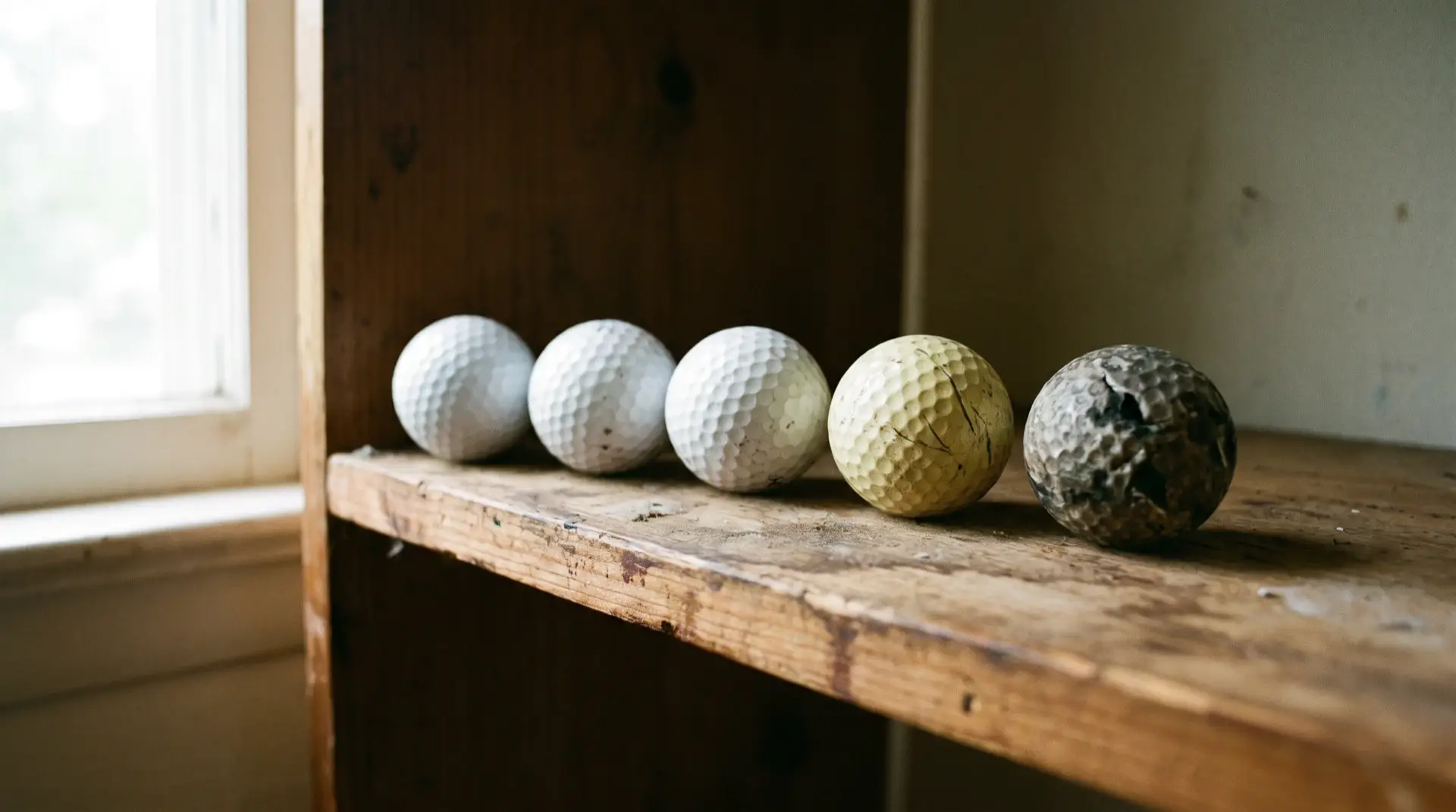
Modern golf balls don’t have a meaningful expiration date. Titleist’s own guidance is five years or more for balls stored indoors at room temperature, and the solid-core construction used since the early 2000s doesn’t dry out the way wound balata did. The thing that ends a ball is a cut or scuffed cover, and the thing that costs you yards on the day is playing it cold. The calendar barely registers.
What actually ages a golf ball
| Condition | What it does | Reversible? | Verdict |
|---|---|---|---|
| 5+ years in a closet | Nothing measurable | n/a | Play them |
| Winter in a cold garage | Firmer, slower, lower launch while cold | Yes, warms back | Warm before play |
| Summer in a car trunk | ~1 yard in robot testing; long-term cycling untested | Mostly | Manufacturers say don’t |
| 6–12 months in a pond | ~1 yard on modern urethane balls | n/a | Fine if the cover is intact |
| Scuff you can feel with a fingernail | Disrupted dimple pattern, unpredictable flight | No | Retire to the shag bag |
| Cut or crack in the cover | Erratic flight, spin loss | No | Retire immediately |
The wound-ball hangover
The “golf balls go bad” idea is a leftover from a construction that stopped being sold about 25 years ago. Balata and wound balls were built from thin rubber thread wrapped under tension around a liquid or rubber center, and that tension relaxed over time whether you played the ball or not. Titleist’s own staff make this distinction repeatedly on Team Titleist: the rubber wrappings in the pre-solid-core generation could genuinely deteriorate, while a 2-piece or multi-layer solid-core ball stored at room temperature holds its performance almost indefinitely.
Every ball in BallCaddie’s catalog uses a solid core. The Titleist Pro V1 (~92), the Kirkland Signature V3 (~95), and the Callaway Supersoft (~49) are all built on molded rubber that has nothing to unwind. Your grandfather’s advice about old balls going dead was correct for his golf balls.
What the shelf-life numbers are
Titleist publishes the clearest number of any manufacturer: balls kept away from excessive heat and stored in normal indoor conditions “can be safely stored for five years or even more.” The same Team Titleist threads consistently frame the risk as storage conditions rather than age, though the more expansive “virtually unlimited” claims circulating there come from forum members, not Titleist R&D. The five-year figure is the number with a company name behind it.
No manufacturer prints an expiration date on the box, and there’s no published lab study establishing a hard cutoff for solid-core balls. That absence is itself informative: if a dozen premium balls measurably died at year 4, the ball companies selling replacement dozens would have every commercial reason to say so.
A practical read: a sealed dozen you bought in 2020 and left in a bedroom closet will play like a 2020 dozen. What it won’t do is match a 2026 model, because the aerodynamics and cover chemistry moved on in the intervening six years. That gap is a product generation, measurable the day the dozen was sealed.
Heat, cold, and why your trunk is the problem
Temperature is the storage variable people worry about most, and the two directions behave nothing alike.
Cold is temporary, and expensive while it lasts. MyGolfSpy ran room-temperature, heat-soaked, and freezer-chilled balls through a robot at fixed driver speed. After about 6 hours in a freezer, measured compression moved only 2 to 3 points — the core wasn’t being harmed. The performance numbers were another story: frozen balls launched lower, spun roughly 500 rpm more, lost more than 6 mph of ball speed, and gave up over 21 yards of carry and total distance. Let the same ball return to room temperature and it goes back to normal. The cost lands on the shots you hit while it was cold, and stops there.
Heat is less dramatic than its reputation. MyGolfSpy’s heat-soaked balls came out about 1 yard different on carry, and the compression change they measured at roughly 115°F normalized once the balls came off the heat. On the published evidence, an afternoon in a warm car is close to a non-event.
The honest caveat: no public robot test covers what actually worries people, which is a full summer of daily 100°F-plus cycling in a trunk. Titleist’s guidance is to store indoors year-round and specifically to avoid a car trunk in sweltering or freezing conditions, and a manufacturer telling you not to do something with its own product is worth following even when the lab data stops short of proving harm. Treat it as cheap insurance rather than a documented failure mode.
Separate from ball temperature, cold air itself costs distance regardless of how you store things. Titleist’s lab rule of thumb is about 1.5% of distance per 20°F drop, which works out to roughly 3 yards on a 200-yard shot between 70°F and 50°F. Denser cold air does that to a warm ball out of a warm pocket.
If you play through winter, the catalog’s coldWeatherSuitable flag is a shortcut: the low-compression value balls like the Srixon Soft Feel (~58), Titleist TruFeel (~70), and Bridgestone e6 Soft (~45) carry it, while the firm premium models don’t. The compression chart has the full picture. The tier-firmer rule of thumb you’ll hear for winter doesn’t survive the measurement above: compression moved 2 to 3 points in a freezer, and a tier is 20 points. What the flag marks is feel, and a 102-compression Pro V1x does turn harsh in February. The yards come off when the ball itself goes cold, so keep a spare warm in your pocket whichever model you carry.
Water: mostly a myth on modern balls
A peer-reviewed study in the Golf Science Journal submerged Titleist Pro V1s in real golf ponds for up to 12 months and found no significant loss in total distance, estimating the practical effect at about 1 yard. Solid cores and cast urethane covers resist water ingress well enough that a year underwater is close to a non-event, and the same study found no relationship between cover staining and performance. An algae ring tells you a ball sat in a pond for a while and nothing more.
The used golf balls guide works through the buying side of this in full, including the recycled-versus-refurbished split that costs more distance than any pond ever will.
Water sitting on the cover during play is a different and much larger effect. MyGolfSpy’s wet-versus-dry robot testing found every ball launched higher and spun less when the cover was sprayed, with the worst performers losing more than 55% of their spin and 4 to 5 yards of carry. Wiping your ball on the towel before a wedge shot in the rain is worth more than any storage decision in this post.
Scuffs, cuts, and when to retire a ball
Cover damage is the failure mode that ends most golf balls, and the threshold is easy to test: drag a fingernail across the surface. If your nail catches in a cut or gouge, the dimple pattern is disrupted and flight becomes unpredictable. Retire it to the practice bag. A faint scuff or marker line you can’t feel is cosmetic.
For usable life on an undamaged ball, National Club Golfer puts the realistic figure at around seven rounds before wear starts to show on a urethane cover. Most amateurs never get there. You’ll lose the ball, or scuff it on a cart path, well before 126 holes of accumulated wear changes anything you can measure.
Tour players work to a standard that has nothing to do with durability. Reporting on tour ball-changing habits puts the typical swap at every five or six holes, and caddies at that level are chasing the last fraction of a percent of cover consistency at 120 mph, not replacing a worn-out ball. Copying that habit at a $57.99 MSRP is an expensive way to buy nothing.
One rule constraint worth knowing. Under Rule 4.2c(2), you may lift and inspect a ball if you reasonably believe it became damaged during the hole, but the USGA and R&A only let you substitute if “it can be clearly seen that the original ball is cut or cracked and this damage happened during the hole being played — but not if it is only scratched or scraped or its paint is only damaged or discoloured.” A scuffed ball finishes the hole. Swap it on the next tee.
The mistakes that cost real strokes
- Storing a dozen in the trunk all season. The single worst thing on this list, and the most common. Twenty seconds of moving the box into a closet protects the whole dozen.
- Throwing out yellowed balls. Discoloration on a modern urethane cover is a cosmetic reaction, unrelated to core performance. The colored-ball data says the same thing about cover tint generally: it doesn’t move spin or distance.
- Playing a scuffed premium ball to “get your money’s worth.” A cut Pro V1 flies worse than an intact Kirkland Signature V3 that costs about $15 a dozen. Sunk cost isn’t a fitting input.
- Buying a closeout dozen from four model years ago and expecting current performance. The ball is intact and playing exactly as designed, to a 2022 design brief. Judge it on what it was, and price it accordingly.
- Chasing a new ball every few holes because pros do. Their reason is cover consistency at tour clubhead speeds. Yours would be habit.
What this means for what you buy
Long shelf life changes the value math on bulk buying. If a ball you’ve been fit to goes on sale at 30% off, buying 4 or 5 dozen is a good decision, because those balls will play the same in 2030 as they do today. The value-tier analysis applies the same logic to price-per-round.
The one caveat is fit. Stockpiling five years of a ball only pays off if it’s still the right ball for you, and swing speed drifts — usually downward with age, sometimes upward after a swing change. Buy deep on a ball you’ve already validated. Buy a single dozen of anything you’re testing.
Cover material also changes how you should think about wear. Urethane grips the face for greenside spin and scuffs more readily than the harder ionomer and surlyn covers on value balls, which is part of why a $22 ionomer ball can outlast a $58 urethane one in raw rounds played. The urethane vs. ionomer breakdown covers when that trade is worth making.
The next step
Fit costs strokes at a scale storage never reaches. If you’re not sure the dozen in your closet was the right purchase to begin with, run your numbers through the BallCaddie fitting quiz — swing speed, typical miss, greenside priority, and budget, scored against the whole ball catalog. It takes 90 seconds, and you’ll sign up to see your match. No affiliate tilt: it’ll tell you when the $20 dozen is the honest answer.
For deeper dives on the topics this guide touches:
- Golf ball compression chart — every ball’s measured compression on a single calibrated gauge, and why cold barely moves those numbers even as it costs yards.
- Used golf balls: recycled vs refurbished — the grading scale, the robot data putting Mint recycled balls within 2 yards of new, and why refurbished balls are the ones to avoid.
- Urethane vs. ionomer covers — the durability and spin trade between the two cover families, and when the price jump earns its keep.
- How to choose a golf ball for your swing speed — the fitting framework, including what happens when winter layers drop your swing speed a band.
- Best value golf ball in 2026 — price-per-round math across the value tier, where buying deep on a sale makes the most sense.
Key takeaways
- Unopened balls stored indoors don’t meaningfully age. Titleist’s published guidance is 5 years or more; the real-world ceiling is longer.
- Solid cores killed the expiration problem. Wound balata balls did go dead on the shelf. Nothing sold today is built that way.
- Cold costs yards while the ball is cold. Freezer-chilled balls lost 21+ yards in MyGolfSpy’s robot test with compression moving only 2–3 points, so the penalty is thermal rather than structural. Heat measured far milder, about 1 yard.
- Water barely matters on modern balls. Twelve months in a pond cost Pro V1s about 1 yard in peer-reviewed testing. Water on the cover during play costs far more.
- Cover damage is what ends a ball. Fingernail catches in a cut, the ball is done. Yellowing and light scuffs are cosmetic.
- Rule 4.2c(2) only allows a mid-hole swap for a cut or cracked ball, never for scuffs or paint wear.
Stop guessing your golf ball
Take the 90-second fitting quiz · matched from a 70+ ball catalog · sign up to see your match
Take the quiz →Related posts
Warm water, mild dish soap, a soft brush. The robot data on what mud and scuffs actually cost you, the Rules on cleaning mid-round, and the methods to skip.
Cut a golf ball open and you find a rubber core, up to 3 mantle layers and a urethane or ionomer cover. What each part does and how many pieces you need.
Where pro shops, leagues, and bulk buyers get golf balls cheapest: Vice and Snell volume tiers, used 5-dozen lots, Costco, and logo minimums, per ball.
The big number under the brand is your play number and nothing more. What 1-4, 00, three-digit stamps and the old 90/100 compression numbers actually mean.
Frequently asked questions
- Do golf balls go bad if you never use them?
- Not in any way you'll notice. Modern golf balls use a solid rubber core instead of the wound rubber thread used before the early 2000s, and solid cores don't dry out or relax on a shelf. Titleist's published guidance is that its balls can be safely stored for five years or more under normal indoor conditions, and staff comments on Team Titleist go further, describing room-temperature shelf life as effectively unlimited. Storage conditions matter far more than the calendar.
- How long do golf balls last once you start playing them?
- National Club Golfer puts realistic usable life at around seven rounds for a modern urethane ball before wear becomes noticeable, assuming you don't cut it first. In practice most amateurs lose a ball long before they wear one out. Tour players operate on a completely different standard, swapping balls roughly every five or six holes to keep the cover pristine rather than because the ball has stopped working.
- Is it bad to leave golf balls in your car?
- It's the worst common storage spot, mostly because of cold. A trunk swings from below freezing in winter to far above room temperature in summer, and MyGolfSpy's robot testing measured balls taken straight from a freezer losing more than 6 mph of ball speed and over 21 yards of carry and total distance. Most of that cold penalty is temporary and disappears once the ball warms back up, but the repeated heat-cold cycling is what Titleist specifically advises against for long-term storage.
- Do golf balls lose distance after sitting in water?
- Modern premium balls barely do. A peer-reviewed study in the Golf Science Journal submerged Titleist Pro V1s in golf ponds for up to 12 months and found no significant total-distance loss, estimating the real-world effect at roughly 1 yard. The waterlogged reputation comes from older constructions: the same paper cites earlier testing where six months underwater cost about 9 yards of carry on 2-piece balls and about 17 yards on 3-piece balls. On a recovered ball, a cut cover is a bigger problem than time in the pond.
- When should you throw away a golf ball?
- Retire it when you can catch a fingernail in a cut or gouge, when the cover has a scuff big enough to disrupt the dimple pattern, or when it's visibly out of round. Yellowing and paint wear on their own are cosmetic on a modern urethane ball. Under Rule 4.2c(2) you may only substitute a ball mid-hole if it's clearly cut or cracked, so a scuffed ball has to finish the hole regardless of how it looks.
- Does cold weather permanently ruin a golf ball?
- No. Cold makes a ball play firmer and slower while it's cold, then it recovers as it warms. MyGolfSpy found that six hours in a freezer moved measured compression by only 2 to 3 points, so the core isn't being damaged, but those same balls launched lower, spun about 500 rpm more, and lost over 21 yards. Separately, Titleist's lab guidance puts the air-temperature effect at about 1.5% of distance per 20°F drop, which is roughly 3 yards on a 200-yard shot.
- Are old golf balls still legal to play?
- A ball is conforming if its model appears on the USGA and R&A conforming ball list in effect for the competition you're playing, so a dozen from 2015 is fine for everyday golf and for any competition using the current list. The one change on the horizon is the distance rollback: the R&A's June 2026 Notice to Manufacturers confirmed a single implementation date of 1 January 2030 for the updated Overall Distance Standard testing, replacing the earlier phased 2028-and-2030 plan. Nothing in your closet is affected before then.
Stop guessing your golf ball
Take the 90-second fitting quiz · matched from a 70+ ball catalog · sign up to see your match
Take the quiz →