🎯 New here? BallCaddie matches golfers to the right ball. → Take the 90-second quiz
Back to BlogHow to Clean Golf Balls (and When Cleaning Won't Save One)
Warm water, mild dish soap, a soft brush. The robot data on what mud and scuffs actually cost you, the Rules on cleaning mid-round, and the methods to skip.
Answer a few questions about your swing and BallCaddie matches you against a 70+ ball catalog.
Take the 90-second quizQuick answer
Soak golf balls in warm water with a few drops of mild dish soap for 15 to 20 minutes, scrub the dimples with a soft toothbrush, rinse, and towel dry. Skip bleach, ammonia, and melamine sponges — we could find no ball maker that endorses any of them. Cleaning removes mud, which mostly costs you direction. It does nothing for a scuff, which cost 40-plus yards of carry in robot testing.
What’s on your ball, and whether cleaning fixes it
Every number below comes from MyGolfSpy’s robot test of mud and cover damage, run inside their annual ball-test rig.
| What’s on the cover | Measured cost | Does cleaning fix it? |
|---|---|---|
| Mud on one side | Spin axis tilted ~6.5°, shot finished 7 yards offline (8-iron) | Yes |
| Paint blemish or hairline scratch | None measured | Nothing to fix |
| Light scuff (cart path, tree) | 8+ yards offline, peak height well below normal | No |
| Moderate scuff | Carry fell to 205 yards, 40+ yards short; 45+ yards offline | No |
| Both sides scuffed | 13 yards offline, 200-yard carry, flight described as unstable | No |
| A quarter of the dimples sanded off | ~50° spin axis, 57 yards offline, sub-200 carry | No |
Two categories, two different problems. Mud is temporary and washes off. A scuff is permanent, and the ball belongs in the shag bag. One caveat on the mud row: MyGolfSpy applied a realistic smear rather than a packed coating, and noted that stickier mud clinging through impact would do more.
Why dirt in a dimple matters at all
A dimple is about 0.010 inches deep — roughly a quarter of a millimetre — according to ball designer Dean Snell’s published design notes. That’s the whole aerodynamic structure. Designers adjust that depth in hundredths of an inch to move a ball’s flight window, which we covered in detail in how many dimples are on a golf ball.
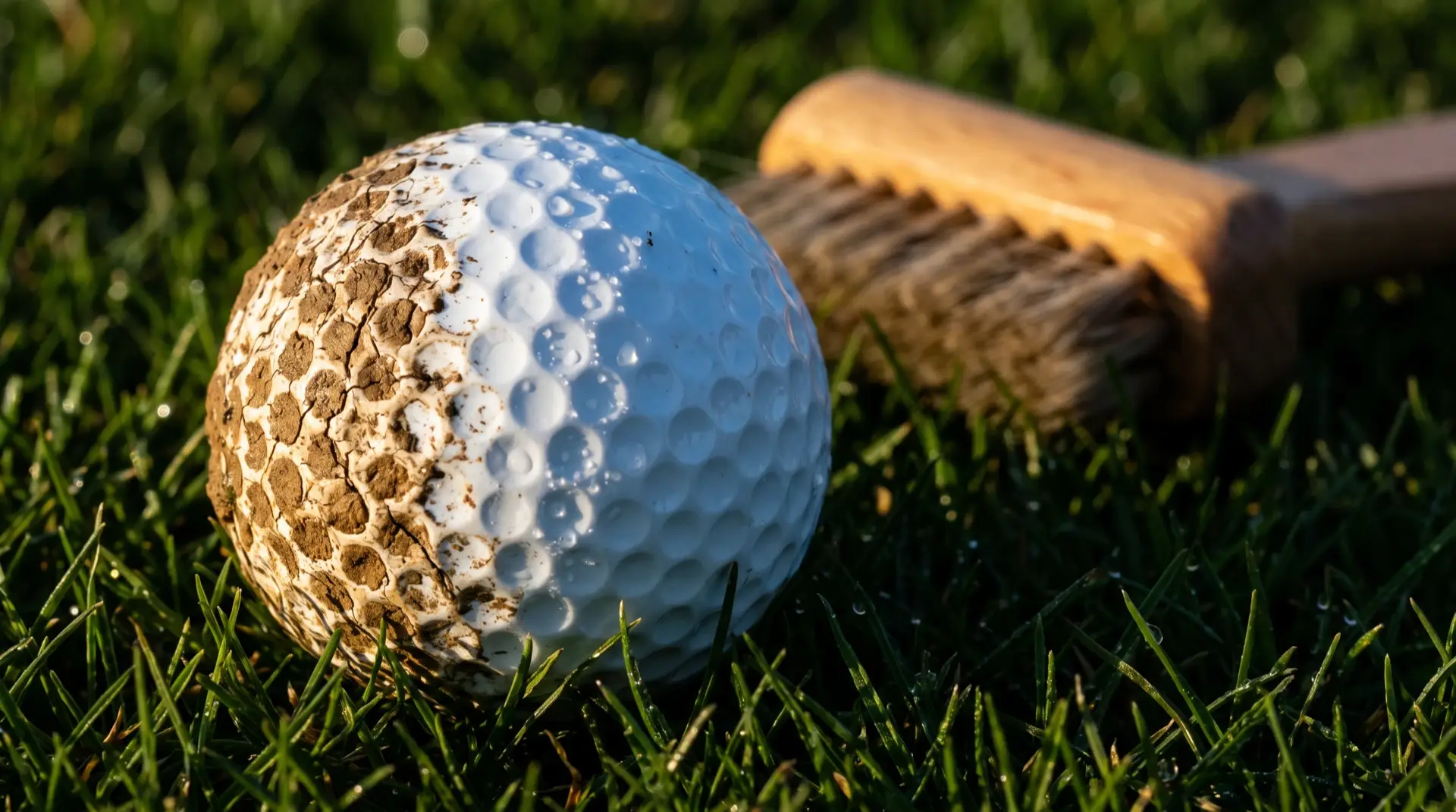
Mud fills a 0.010-inch cavity without trying. Once part of the surface is smooth and the rest is dimpled, the airflow separates from the ball earlier on one side than the other. That asymmetry tilts the spin axis, and a tilted spin axis is what curvature is.
Which direction? Away from the dirt. MyGolfSpy found the ball moves opposite the mud or the scrape, every time. Mud on the right side sends it left.
How to clean golf balls at home
The whole procedure is five steps and one bucket.
- Sort first. Run a fingernail over each cover. Anything you can catch a nail in is cover damage, and no amount of soap changes that. Pull those out now.
- Soak in warm water with a few drops of mild dish soap. Give it 15 to 20 minutes as a rule of thumb — long enough that dried mud lets go on its own, which is the point, since softened mud brushes off with almost no pressure on the cover.
- Brush the dimples with a soft toothbrush or nail brush, in small circles. The dimples are the only part that matters aerodynamically, and they’re also where dirt hides.
- Rinse and towel dry. Soap film left on a ball attracts dust in a bag pocket.
- Re-soak anything stubborn rather than reaching for something stronger. See the next section for why.
That’s it. A dozen balls is a soak plus a few minutes of brushing, most of it unattended.
What not to use, and why the internet is wrong about this
Search for golf ball cleaning and you’ll find confident recommendations for vinegar, ammonia, undiluted bleach, OxiClean, dishwashers, washing machines, and melamine foam sponges. We went looking for the source of any of it.
We came up empty. Titleist publishes a full Learning Lab entry on cover materials, explaining that premium balls use a urethane elastomer while value models use ionomer blends, but it says nothing about cleaning and lists no approved solvent. Searching the major ball makers’ own sites turned up no ball-care procedure anywhere. Every chemical recipe we could find online cites another blog post rather than a test or a manufacturer.
That matters because of what you’re cleaning. A golf ball’s outer surface is paint plus a clearcoat over the cover, and both are softer than the cover beneath them. Melamine foam — the material in a Magic Eraser — is a very fine abrasive, which is exactly why it lifts marks off walls. Pointing an abrasive at a printed logo and a clearcoat has an obvious failure mode.
Warm soapy water removes everything the aggressive methods claim to remove. Anything stronger is an unsourced gamble on a ball that costs between $2 and $4. Take a second soak instead.
Cleaning your ball during a round: the actual Rules
This is where golfers lose strokes they didn’t know were available to lose.
On the putting green, clean it whenever you like. Rule 13.1b says a ball on the putting green may be lifted and cleaned, as long as you mark the spot first and replace it on that spot.
Everywhere else, it depends on why you lifted it. Rule 14.1c says a ball lifted from anywhere other than the green may always be cleaned, with four exceptions:
| You lifted the ball… | Cleaning allowed? |
|---|---|
| To see if it’s cut or cracked | No |
| To identify it | Only as much as identification requires |
| Because it interferes with another player | No |
| To see if it lies where relief is allowed | No, unless you then take relief under a Rule |
Break one of those and it’s one penalty stroke, plus you must replace the ball. The identification exception is the one that catches people: you’re allowed to wipe off just enough mud to read your mark, and no more. Putting a distinctive mark on your ball before the round keeps that window small, which is one of the practical arguments in what the numbers on a golf ball mean.
Preferred lies changes everything. When a course plays the model local rule for preferred lies, it’s literally named lift, clean and place — cleaning is built into the procedure. Wet-season golf is the one time you can wash a mud ball in the fairway without thinking about it.
The mud ball problem nobody can fix
Sitting in a fairway with mud on your ball and no local rule in effect, you have to play it. So how bad is it?
Less bad than the panic suggests, and less predictable than the confidence suggests.
MyGolfSpy’s mud test used a mid-speed 8-iron at a 100 mph driver equivalent, with a realistic smear rather than a packed-on coating. Ball speed, launch angle, and spin were only marginally affected, because most of the mud leaves the ball at impact. The damage showed up in the spin axis: nearly 6.5 degrees of tilt, and 7 yards offline. Meaningful on a tight pin, survivable on a wide fairway.
A separate Trackman session run by GOLF Top 100 Teacher Joe Plecker with a Division I player found the position of the mud is what decides the outcome. Mud on the surface, away from the strike, produced a shot that landed well short of the player’s normal 182-yard 7-iron carry at roughly normal height. Mud between the clubface and the ball did the opposite: the same 7-iron carried 190 yards with dramatically reduced spin and a knuckling flight that wouldn’t stop.
And a caution on all of it. When instructor Andrew Rice ran his own TrackMan mud-ball test years earlier, he called the results inconclusive, reporting that the ball could curve either direction regardless of where the mud sat. Mud isn’t a calculation. Aim for the fat side of the green and accept the variance.
When cleaning won’t help: retiring a ball
The threshold is tactile, and MyGolfSpy states it cleanly: small paint blemishes and very minor surface scratches are likely no big deal, but if the damage is easily felt, it will very likely hurt performance.
Their driver data at 100 mph shows why. A light scuff — the kind you get bouncing one off a cart path — flew more than 8 yards offline with a peak height well below normal. A moderate scuff, which most golfers would already replace, dropped carry to 205 yards against an undamaged average more than 40 yards higher, tilted the spin axis past 35 degrees, and finished over 45 yards from the target. Sanding off a quarter of the dimples produced a 57-yard duck hook.
The Rules draw the line in the same place, roughly. Under Rule 4.2c, you may substitute another ball mid-hole only if it’s clearly cut or cracked, “but not if it is only scratched or scraped or its paint is only damaged or discoloured.” A scuffed ball has to finish the hole. It doesn’t have to start the next one.
For the full picture on how age, heat, and water treat a ball, see do golf balls go bad, and for what a cleaned-up recovered ball is actually worth, recycled vs refurbished used golf balls.
Cover material changes how often you’re doing this
Titleist’s own material page is blunt about the trade: ionomer blends are “harder, more durable plastics like Surlyn,” and ionomer covers are more durable, while urethane buys soft feel, short-game spin, and shot-shape control.
Practically, that means a urethane tour ball reaches the throw-it-out threshold sooner than an ionomer value ball hit into the same tree.
| Cover | Example balls | Durability |
|---|---|---|
| Urethane | Titleist Pro V1 (~92), Callaway Chrome Tour (~94), TaylorMade TP5 (~93), Titleist AVX (~81) | Scuffs more readily; retire sooner |
| Ionomer | Titleist Velocity (~90), Srixon Soft Feel (~58), Titleist TruFeel (~70), Callaway Supersoft (~49) | Harder cover; survives cart paths better |
At $57.99 for a dozen Pro V1s, retiring a scuffed ball costs about $4.83. At about $15 a dozen for the urethane Kirkland Signature V3 (~95), it costs $1.25 — one of the underrated arguments for value urethane if you play a course with a lot of trees and cart path. The cover-material trade-off in full is in urethane vs ionomer golf balls.
Find the ball that fits before you worry about washing it
Cleaning protects the ball you’re playing. It doesn’t help if that ball was the wrong fit to begin with. BallCaddie’s 90-second fitting quiz scores the full catalog against your swing speed, spin needs, feel preference, and budget, and sign-in is required to see your match. You can also browse the catalog by cover material if durability is what you’re optimizing for.
For deeper dives
- Golf ball compression chart — the cover and construction pillar this post sits under, with every catalog ball ranked by measured compression.
- How to choose the right golf ball for your swing speed — the fitting pillar: matching compression tiers to driver speed.
- Do golf balls go bad? — storage, heat, freezing, and the shelf life of an unopened sleeve.
- Used golf balls: recycled vs refurbished — what a cleaned recovered ball is really worth, and the pond study that debunks waterlogging.
- Urethane vs ionomer golf balls — the durability and spin trade-off behind the table above.
- How many dimples are on a golf ball? — the 0.010-inch depth that mud fills, and why the count matters less than the geometry.
Key takeaways
- Warm water, mild dish soap, 15 to 20 minute soak, soft brush. That’s the whole method, and it removes everything removable.
- We found no ball maker that publishes a cleaning procedure or an approved solvent. Every bleach, ammonia, and Magic Eraser recipe we could trace cites another blog. Re-soak instead.
- Mud shows up mainly as curvature. Roughly 6.5° of spin-axis tilt and 7 yards offline in MyGolfSpy’s robot test, curving away from the dirty side, with ball speed and spin barely moved. Mud caught between the face and the ball is a separate problem, and that one does change distance.
- On the green you can always clean. Off it, four exceptions apply under Rule 14.1c, at one penalty stroke each.
- A scuff you can feel is a dead ball. A light one flew 8+ yards offline; a moderate one cost 40-plus yards of carry and finished 45 yards off target. Retire it.
- Urethane scuffs sooner than ionomer, so tour balls hit the retirement threshold faster — worth pricing in if your course eats golf balls.
Stop guessing your golf ball
Take the 90-second fitting quiz · matched from a 70+ ball catalog · sign up to see your match
Take the quiz →Related posts
Cut a golf ball open and you find a rubber core, up to 3 mantle layers and a urethane or ionomer cover. What each part does and how many pieces you need.
Where pro shops, leagues, and bulk buyers get golf balls cheapest: Vice and Snell volume tiers, used 5-dozen lots, Costco, and logo minimums, per ball.
MyGolfSpy put 48 balls through a robot at three swing speeds. The findings that actually change which ball you should play, and the ones that don't.
The most expensive golf balls of 2026, from $58 Pro V1 tour balls to the $249 Attomax and $70,000 gold collectibles — and what the price actually buys.
Frequently asked questions
- What is the best way to clean golf balls?
- Warm water, a few drops of mild dish soap, a 15 to 20 minute soak, then a soft toothbrush worked into the dimples, followed by a rinse and a towel dry. The soak does most of the work, which keeps abrasive scrubbing off the cover. That sequence removes everything cleaning can remove: mud, grass stain, pond silt, and most surface grime. It cannot restore paint, fill a gouge, or reshape a dimple that a cart path flattened.
- Does a dirty golf ball actually affect your shot?
- Yes, and mostly as curvature. MyGolfSpy's robot testing put mud on one side of a ball and hit it with a mid-speed 8-iron: the spin axis tilted nearly 6.5 degrees and the shot finished 7 yards offline, curving away from the muddy side. Ball speed, launch angle, and spin barely moved, because most of the mud leaves the ball at impact. Mud trapped between the clubface and the ball behaves differently, killing spin and making carry unpredictable.
- Can I clean my golf ball during a round?
- On the putting green, always. Rule 13.1b lets you mark, lift, and clean a ball on the green with no restriction. Anywhere else, Rule 14.1c says a lifted ball may be cleaned except in four situations: when you lift it to check whether it is cut or cracked, to identify it (where you may clean only as much as identification requires), because it interferes with another player, or to see whether it lies where relief is allowed and you then don't take relief. Cleaning when you shouldn't costs one penalty stroke.
- Can you use vinegar, bleach, or ammonia to clean golf balls?
- We could find no ball maker that endorses any of them. Titleist publishes detailed material science on its urethane elastomer and ionomer covers but no cleaning procedure and no approved-solvent list, and a search of the other major makers' sites turned up nothing either. Every vinegar, ammonia, oxygen-bleach, and dishwasher recipe we could trace cites another blog rather than a maker or a test. Warm soapy water removes essentially everything those methods claim to remove, so the extra risk to the paint and clearcoat buys nothing.
- Will a Magic Eraser damage a golf ball?
- Probably, and there's no upside. Melamine foam works by acting as an extremely fine abrasive, which is why it lifts marks off painted walls. A golf ball's outer surface is paint plus a clearcoat sitting over the cover, all of it softer than the dimple geometry underneath. Nobody has published a controlled test on golf balls specifically, so treat it as an unnecessary gamble on a $2 to $4 ball that soap already cleans.
- When should you throw a golf ball away instead of cleaning it?
- When the damage is tactile. MyGolfSpy's rule of thumb is that small paint blemishes and very minor scratches don't matter, but anything you can feel with a fingernail very likely will. Their robot data backs it up: a light cart-path scuff pushed a driver 8-plus yards offline, and a moderate scuff dropped carry to 205 yards, more than 40 yards short of the undamaged average, while finishing over 45 yards off line. Cleaning does nothing for any of it.
- Do urethane golf balls get dirtier than ionomer ones?
- They scuff more readily, which is different from getting dirtier. Titleist describes its premium urethane elastomer cover as soft yet tough, and its ionomer blends as harder, more durable plastics, stating plainly that ionomer covers are more durable. A urethane ball trades some of that toughness for greenside spin and feel. Both clean the same way; the urethane ball reaches the throw-it-out threshold sooner, which is a running cost of playing a tour ball that rarely gets priced in.
Stop guessing your golf ball
Take the 90-second fitting quiz · matched from a 70+ ball catalog · sign up to see your match
Take the quiz →