🎯 New here? BallCaddie matches golfers to the right ball. → Take the 90-second quiz
Back to BlogUsed Golf Balls: Are They Worth It? Recycled vs Refurbished (2026)
Used golf balls can save 50%, but recycled and refurbished play very differently. The robot-test data, grading scale, and when a lake ball is worth teeing up.
Answer a few questions about your swing and BallCaddie matches you against a 72-ball catalog.
Take the 90-second quizQuick answer
Recycled golf balls (recovered, cleaned, and graded, with the original cover intact) flew within about 2 yards of new in the seller’s robot test and cost 30 to 50% less. Refurbished balls (stripped, repainted, and re-stamped) lost 3 to 13 yards off the driver in a robot test and vary from ball to ball. Buy Mint or Near-Mint recycled premium balls, like a used Pro V1. Skip anything labeled refinished.
Used golf ball grades at a glance
| Grade | What it means | Price vs $57.99 new Pro V1 | Best for |
|---|---|---|---|
| Mint (5A) | Original cover, like-new look and feel, logos or pen marks possible | $34.99–$39.99 (30–40% off) | Tournament and regular play |
| Near-Mint (4A) | Played a few holes, slight blemishes, no cuts | $24.99–$26.99 | Regular play, best value |
| Good (3A) | Visible scuffs and discoloration, free of cuts | $17.99–$18.99 | Casual rounds, beginners |
| Practice grade (name varies by seller) | Major blemishes, may be cut or out-of-round | Varies by seller | Practice only |
| Refinished / Refurbished | Stripped, repainted, re-stamped to look new | $26.99 at LostGolfBalls | Skip for real play |
Prices are per dozen for the current (2025) Pro V1 at LostGolfBalls, Golf Ball Planet, and Found Golf Balls, checked October 3, 2026. Older model years run cheaper.
Recycled and refurbished are two different products
Read the label first. You’ll know from it whether a used ball is worth playing.
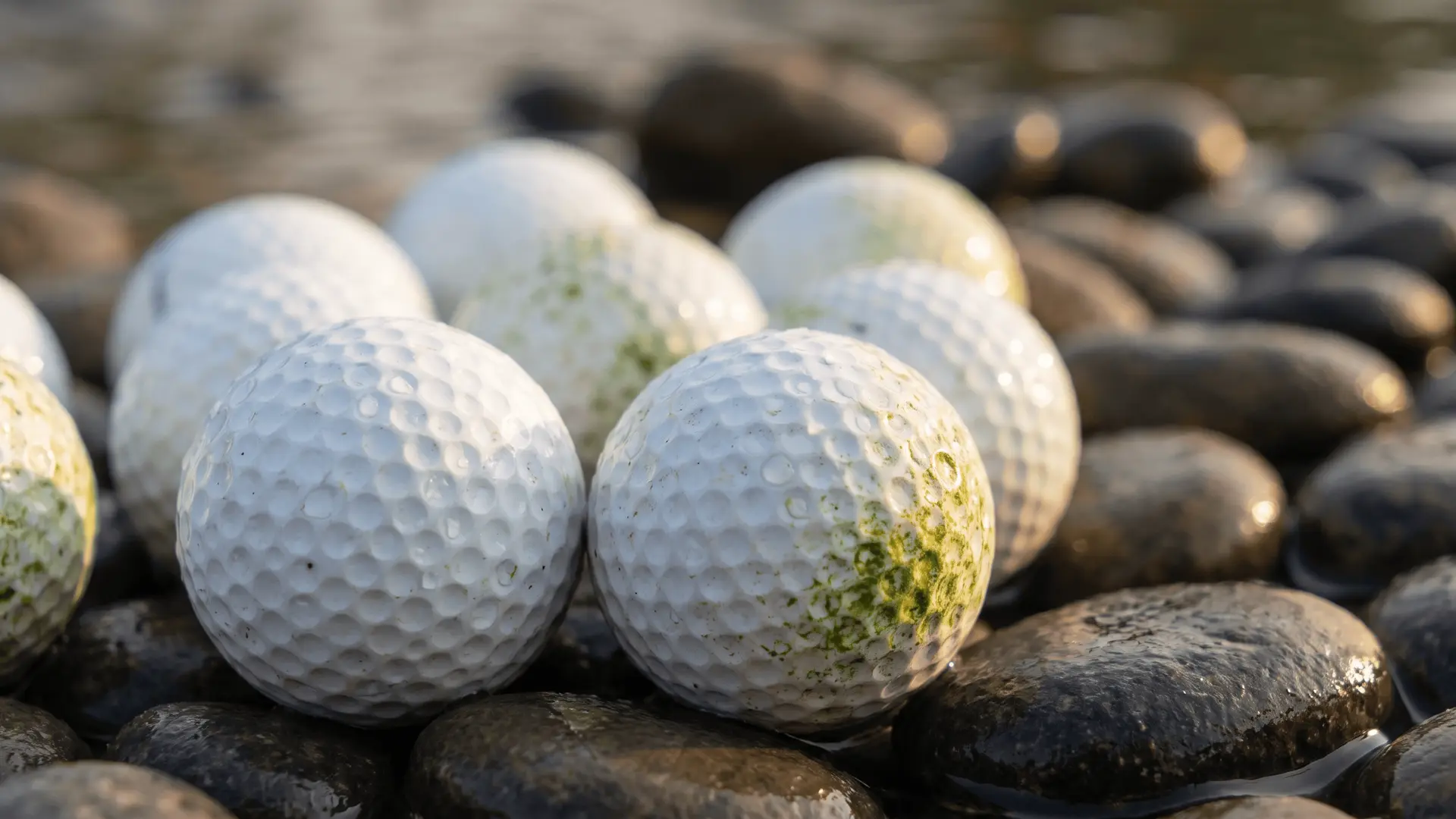
Recycled balls (also sold as used or lake balls) get recovered from course ponds and rough, washed, inspected, and sorted by model and condition. The cover, core, and factory stamps stay exactly as they left the plant. Cleaning and grading are the only things that happen to them.
Refurbished balls (sold as refinished) start as beat-up used balls, then get stripped, repainted with fresh white coating, re-stamped with the model logo, and clear-coated. They look new on the shelf. Underneath the paint, the cover may be scuffed or cut, and the added coating changes the ball’s weight and dimple shape. LostGolfBalls’ grading scale says refinished balls carry, by law, a small “Refinished” mark on one pole. That stamp is the quickest way to spot one. The Federal Trade Commission order behind the practice also lets a seller put the disclosure on the packaging if that tells the buyer clearly, so read the box as well as the ball.
Why the construction matters ties back to how a golf ball is built: the cover and core do the work, so anything that alters them alters the ball.
The waterlogging myth, and what the data shows
Modern premium balls barely lose anything to water. Researchers submerged new Titleist Pro V1 (~92) balls in golf-course ponds for up to 12 months and measured them against dry-stored controls in a peer-reviewed study in the International Journal of Golf Science. They found no significant loss in total distance or carry dispersion. The non-significant trend they did see was worth about 1 yard (roughly 0.5%). The balls yellowed with time, and the yellowing showed no relationship with performance.
The waterlogged-lake-ball reputation came from real testing on 1990s balls. Farricker’s 1996 experiment found Surlyn-covered 2-piece balls lost about 9 yards of carry and balata-covered 3-piece balls about 17 yards after six months underwater. Balata is gone from the premium shelf.
Golf forums and seller blogs still repeat bigger figures, like “5 to 10 yards after a week, 20 to 30 yards after three months.” We couldn’t trace those numbers to a published test. The one controlled study on a modern urethane tour ball used the Pro V1, and its authors expect similar-construction balls like a TaylorMade TP5 (~93) or Callaway Chrome Soft (~77) to hold up the same way, though no published study has put those in a pond for a year. On a recent tour ball, time in the water costs you close to nothing. A cut cover costs you a lot, and no amount of drying fixes that.
Do recycled balls play like new?
For the average golfer, yes. LostGolfBalls ran its own robot test comparing brand-new balls to its Mint (5A) recycled stock. New balls averaged just over 211 yards off the driver; the recycled Mint balls averaged just under 210. With a 7-iron, new balls flew 155 yards and recycled Mint 153. Both gaps are about 2 yards or less, inside the shot-to-shot noise any golfer produces. It’s the seller’s own test, so weigh it that way, but the numbers line up with the pond study. See the full LostGolfBalls robot-test writeup.
LostGolfBalls reported spin and launch angle as “extremely similar” too. A Mint recycled ball keeps the original urethane cover, so greenside spin should behave like the new version. You’re buying urethane greenside spin at 30 to 50 percent off, as long as the cover is intact.
Why refurbished balls come up short
Paint is the problem. In its 2021 robot test, MyGolfSpy ran Reload-brand refinished Pro V1s against new 2021 Titleist Pro V1s at three swing speeds. The refinished balls measured heavier, larger, and firmer, yet flew slower and shorter at every speed:
| Club / swing speed | New Pro V1 | Refinished Reload | Loss |
|---|---|---|---|
| Driver, fast | 326.8 yd | 313.7 yd | ~13 yd |
| Driver, mid | 280.6 yd | 273.0 yd | ~7.6 yd |
| Driver, slow | 232.1 yd | 229.1 yd | ~3 yd |
| 8-iron, fast | 200.4 yd | 192.2 yd | ~8 yd |
| 8-iron, mid | 174.6 yd | 169.3 yd | ~5.3 yd |
The extra coating leaves the dimples shallower with rounder edges, so the ball no longer flies the way Titleist designed it. Ball speed fell 2.7 mph at the fast driver speed. The boxes mixed 2015 and 2017 Pro V1s, and compression across 24 balls ran from 93 to 126. Whatever cut or scuff the donor ball had gets painted over, so damage often hides under that clean white coat. It’s one brand in one test, and the testers allowed that other refinishers may do better work.
What you save, and which grade to buy
The more balls you lose, the more you save buying used. A new dozen Titleist Pro V1 (~92) is $57.99. On October 3, 2026, Mint (5A) recycled 2025 Pro V1s were $34.99 at LostGolfBalls and Golf Ball Planet and $39.99 at Found Golf Balls. Golf Ball Planet’s 100-ball mixed-year Pro V1 pack in Mint works out to about $23.50 a dozen. Lose 2 balls a round over a dozen rounds a month, and Mint at $34.99 saves you about $46 monthly, with a robot-tested gap of about 2 yards. Grade names shift by seller: Golf Ball Planet calls the tiers Mint, Grade A, and Grade B, and LostGolfBalls and Found Golf Balls sell a Pristine tier above Mint at $44.99 to $49.99, which hands back most of the savings.
For rounds that count, buy Mint (5A) or Near-Mint (4A) recycled. Both keep the original cover; Near-Mint wears its history in a few light scuffs. Drop to Good (3A) for casual golf, or if you’re a beginner losing a sleeve a round. Two cases beat a used premium ball outright, and they’re different cases. If your short game doesn’t use greenside spin, a new value ball like the Srixon Soft Feel (~58) suits you better than a mint Pro V1, because you’d be paying for tour spin you don’t use. If you swing hard and lose a lot of balls, the urethane Kirkland Signature (~95) runs about $15 a dozen in the Costco warehouse ($29.99 for two dozen) and about $20 shipped from Costco.com ($39.99 for two dozen) (see the full Kirkland review). Used wins when you specifically want a tour ball you’d otherwise skip on price.
Are used balls legal?
Yes. The Rules of Golf never require a new ball, and the USGA conforming ball list covers the ball model, whatever its age. A used, unaltered Pro V1 is the same conforming model it was in the sleeve. Everyday scuffs and pond yellowing don’t change its status.
Refinished balls have their own ruling. Under Interpretation 4.2a(1)/2, you may play a refurbished ball unless there’s strong evidence it no longer conforms. Once the Committee adopts the List of Conforming Golf Balls as a Local Rule, a refurbished ball must not be used, even if its markings appear on the List. The evidence isn’t kind, either: in the 2021 robot test above, 23 of the 24 refinished balls weighed more than the USGA’s 1.62-ounce limit. For any competition, stick to new or recycled balls.
When to retire a ball: cosmetic vs structural
Dimples steer the airflow, so check whether the damage reaches them. Light scuffs, faint marker dots, and yellowing are surface-only and fly true. The International Journal of Golf Science pond study found no relationship between discoloration and distance or dispersion.
Pull a ball from your gamer rotation once the damage turns structural: a cut or gouge you can catch with a fingernail, a deep cart-path scrape that flattens a patch of dimples, or a wobble that means the cover has gone out of round. Those change how air separates across the cover and can tilt the spin axis, sending shots knuckling or curving in ways you can’t predict. Demote them to the shag bag.
How to inspect a used ball before you tee it up
The check takes about 30 seconds.
- Check both poles for a “Refinished” stamp. The big recyclers print it on every refinished ball. If it’s there, the ball has been repainted, so send it to practice.
- Run a fingernail across the cover. A cut or gouge you can feel disrupts flight, so retire it. Marks you can’t catch with a nail are cosmetic and fine to play.
- Roll it and read the color. A wobble on a flat surface means the cover is out of round. Heavy yellowing by itself is only cosmetic on a modern urethane ball, but paired with any cut, the ball belongs in the shag bag.
The mistakes that cost the most
- Buying refinished for the like-new look. The fresh paint hides a scuffed donor ball and cost 3 to 13 yards off the driver in robot testing. Read the pole for the “Refinished” stamp.
- Playing a cut ball to save a buck. Cover damage is the one condition that wrecks flight and spin. A $0.50 ball that dives into the trees costs you a stroke and the ball.
- Assuming lake balls are dead. Pro V1s pulled from a pond after 12 months underwater tested the same as dry ones. Check the cover for cuts and play it.
- Overpaying for Mint when Near-Mint will do. The grading gap between 5A and 4A is cosmetic. If you’re going to lose it in a hazard anyway, buy the grade down.
The next step
Buying used cuts the price of whatever model you pick, and a cut-rate dozen of the wrong ball is a worse deal than a fair-price dozen of the right one. The BallCaddie fitting quiz takes 90 seconds and scores the 72 balls in the catalog against your swing speed, typical miss, and short-game priority. Your fitting report is free; your #1 ball is paid. Then shop that model used.
Related guides:
- Golf ball compression chart — every ball’s measured compression on one gauge, and how cover and core construction affect performance, water resistance included.
- Best value golf ball in 2026 — the new-ball value picks at every swing speed, including the cheapest urethane on the market.
- Costco Kirkland Signature review — the cast-urethane Costco ball that often beats buying a used Pro V1 outright.
- Titleist Pro V1 review (2026) — the tour benchmark most people shop used, with the Ball Lab compression read and the honest gap to the Kirkland.
- Urethane vs. ionomer covers — why the cover you’re preserving in a recycled ball is the whole reason to buy premium.
- Golf ball fitting: how it works — the four inputs that decide your ball, so you buy the right model used instead of the cheapest one.
Key takeaways
- Recycled is the one to buy. Mint recycled balls flew within about 2 yards of new in LostGolfBalls’ robot test; Reload refinished balls lost 3 to 13 yards off the driver in a 2021 robot test.
- Pond time barely hurts a modern tour ball. The International Journal of Golf Science study found no significant loss on Pro V1s submerged up to a year. Cut covers kill balls.
- Buy Mint (5A) or Near-Mint (4A) recycled for rounds that count; both keep the original cover at 30 to 50 percent off.
- Used balls are legal. The conforming list is model-based, so an unaltered used ball conforms. Refinished balls are banned wherever the conforming-list Local Rule is in play.
- Used only wins on tour balls. Below 85 mph or at a high loss rate, a new Kirkland at about $15 to $20 a dozen or a value ball often beats a used premium ball on price and fit.
Sources
- MyGolfSpy, Lab: Reload Pro V1 refinished golf balls
- Federal Trade Commission, Metropolitan Golf Ball, Inc. order
- The R&A, Rules of Golf, Rule 4
Stop guessing your golf ball
Take the 90-second fitting quiz · matched from a 72-ball catalog · sign up to see your match
Take the quiz →Related posts
Where pro shops, leagues, and bulk buyers get golf balls cheapest: Vice and Snell volume tiers, used 5-dozen lots, Costco, and logo minimums, per ball.
Modern golf balls don't expire on a shelf. Heat, freezing, and cover damage do real harm. The storage data, the 21-yard freezer test, and when to retire a ball.
Compression sets feel, driver spin and a little speed. 2026 robot numbers for 48 balls, plus the box number for 12 of them against what a gauge read.
Yes, between holes, under Rule 6.3a. Mid-hole only when a Rule allows it. What a found Supersoft costs a Pro V1 player, in 2026 robot-test spin numbers.
How to inspect a used golf ball before you play it
Check both poles for a Refinished stamp
Refinished balls sold by the big recyclers carry a small 'Refinished' or 'Refurbished' mark on one pole. If it's there, the ball has been repainted over a worn donor ball. Set it aside for practice.
Run a fingernail across the cover
Drag a fingernail over the surface. A cut or gouge you can catch with your nail disrupts the dimple pattern and flight, so retire that ball to practice. Faint marker lines or light scuffs you can't feel are cosmetic and fine to play.
Roll it and read the color
Roll the ball on a flat surface to spot a wobble that signals an out-of-round cover. Heavy yellowing on its own is only cosmetic on a modern urethane ball, but paired with any cut, the ball belongs in the shag bag.
Frequently asked questions
- Are used golf balls as good as new ones?
- High-grade recycled balls come very close. In LostGolfBalls' robot testing, Mint (5A) recycled balls flew within about 2 yards of brand-new balls off both the driver and a 7-iron, and a peer-reviewed study in the International Journal of Golf Science found Titleist Pro V1s submerged for up to a year showed no significant distance or dispersion loss. Refurbished balls are the exception. MyGolfSpy's 2021 robot test measured one refinished brand 3 to 13 yards shorter than a new Pro V1 off the driver. Buy recycled Mint or Near-Mint and most golfers won't see a difference from new.
- What's the difference between recycled and refurbished golf balls?
- Recycled (or 'used' or 'lake') balls are recovered from courses, washed, and graded, with their original cover, core, and stamps untouched. Refurbished (or 'refinished') balls are stripped, repainted, and re-stamped to look new, which adds weight, fills dimples, and disrupts the aerodynamics. Robot testing shows recycled Mint balls play like new while refurbished balls fly shorter and vary more from ball to ball. LostGolfBalls says its refinished balls carry, by law, a small 'Refinished' stamp on one pole. Read the grade label before you buy.
- Do lake balls lose distance from being in the water?
- For modern urethane tour balls, barely. A peer-reviewed study in the International Journal of Golf Science submerged Titleist Pro V1s in golf ponds for up to 12 months and found no significant loss in distance or dispersion, only cosmetic yellowing. The old 'waterlogged' reputation comes from a 1996 experiment on older balls, where Surlyn-covered 2-piece balls lost about 9 yards of carry and balata-covered 3-piece balls about 17 after six months underwater. The study's authors point to the modern ionomer casing and urethane cover as the likely reason newer balls hold up. The bigger risk in a recovered ball is a cut cover.
- Are used or refurbished golf balls legal in tournaments?
- Used balls, yes. The Rules of Golf don't require a new ball, and the USGA conforming ball list covers the ball model whatever its age, so a used, unaltered Pro V1 conforms. Normal scuffs and discoloration don't change that. Refurbished balls have their own ruling, Interpretation 4.2a(1)/2. You may play one unless there's strong evidence it no longer conforms, but once the Committee adopts the List of Conforming Golf Balls as a Local Rule, a refurbished ball must not be used, even if its markings appear on the List. For competition, use new or recycled balls.
- How much do used Pro V1 golf balls cost?
- A new dozen Pro V1 runs $57.99. Mint recycled current-model Pro V1s sold for $34.99 a dozen at LostGolfBalls and Golf Ball Planet and $39.99 at Found Golf Balls when we checked on October 3, 2026, roughly 30 to 40 percent off. Near-Mint ran $24.99 to $26.99, and older model years and mixed-year bulk packs dip into the low $20s per dozen for Mint. A golfer who goes through 2 dozen a month saves about $46 by switching from new to Mint recycled, with under 2 yards of robot-tested difference.
- What golf ball grade should I buy?
- For rounds that matter, buy Mint (5A) or Near-Mint (4A) recycled balls. Both keep the original cover, and Near-Mint is the better value if you can live with a slightly worn look. Good (3A) balls suit casual rounds and beginners who lose several balls per round. Keep practice grades (the name varies by seller) for the range and short-game work, since they may include cut or out-of-round balls. Skip the Refinished grade for real play, however new it looks.
Stop guessing your golf ball
Take the 90-second fitting quiz · matched from a 72-ball catalog · sign up to see your match
Take the quiz →