🎯 New here? BallCaddie matches golfers to the right ball. → Take the 90-second quiz
Back to BlogDoes Golf Ball Compression Matter? What the Number Tells You, and What It Doesn't
Compression sets feel, driver spin and a little speed. 2026 robot numbers for 48 balls, plus the box number for 12 of them against what a gauge read.
Answer a few questions about your swing and BallCaddie matches you against a 72-ball catalog.
Take the 90-second quizDoes golf ball compression matter?
Yes, for three things: how the ball feels, how much it spins off the driver, and how much ball speed a fast swing gets out of it. In MyGolfSpy’s 2026 robot test of 48 balls, the 10 firmest were 0.9 mph faster off the driver than the 10 softest at 86 mph and 3.4 mph faster at 116. Compression has almost no link to greenside spin, which the cover sets, and the number on one brand’s box can sit 13 points from what a gauge reads. Pick compression for feel and flight. Pick the cover for your short game.
We ran a straight-line fit on the per-ball numbers the 2026 test published, checked the printed compression of 12 balls against the gauge, and wrote down how many points compression is worth inside BallCaddie’s fitting engine.
What the number measures, and who checks it
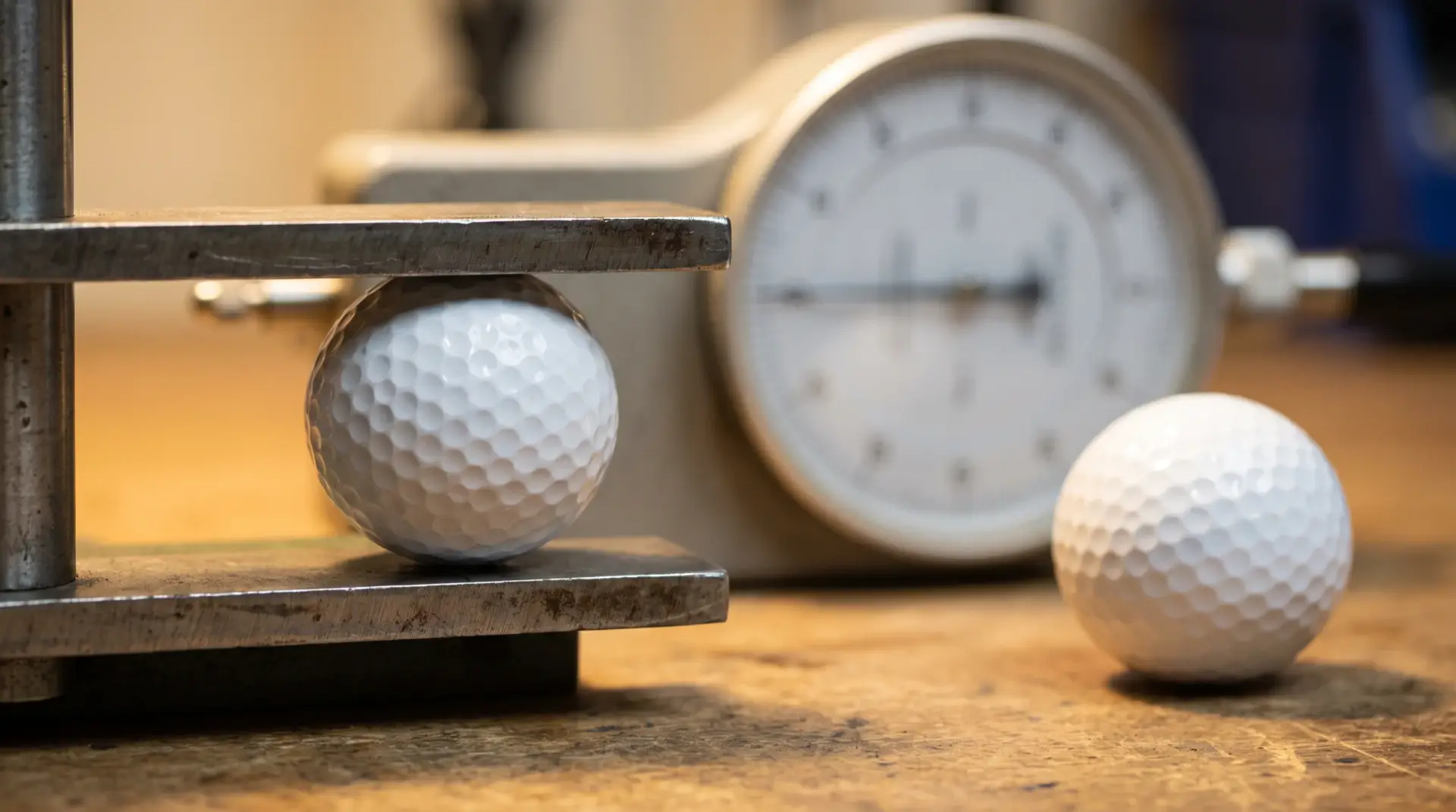
Compression is how much a ball squashes under a set load. A higher number is a firmer ball.
No rule covers it. The USGA’s Equipment Rules regulate a ball’s weight, size, spherical symmetry, initial velocity and overall distance, and compression isn’t on the list. Each maker and each lab reads it on its own machine.
Dean Snell, who designed balls for Titleist and TaylorMade before starting his own brand, explains the problem in Snell’s compression accuracy post from July 2026. The traditional Atti gauge presses a ball about a tenth of an inch and reads the result off a spring. Other machines press farther or at a different rate, and in his words, “When the deflection or test method changes, the number can change too.”
So a compression number is comparable only with other balls read on the same gauge. The compression chart uses one gauge’s readings for that reason.
The number on the box against the gauge
The table sets 12 balls whose makers print a compression number next to the gauge reading from the 2026 robot test. We read every maker number off the brand’s own page on November 9, 2026; Maxfli’s comes from the Golf Galaxy listing, since Golf Galaxy’s parent owns the brand.
| Ball | Maker says | 2026 test gauge | Gap |
|---|---|---|---|
| Vice Tour | 85 | 98 | +13 |
| Snell PR3 | 80–85 | 93 | +8 to +13 |
| Srixon Z-Star | 88 | 81 | −7 |
| Srixon Z-Star Diamond | 100 | 93 | −7 |
| Srixon Z-Star XV | 102 | 96 | −6 |
| Srixon Q-Star Tour | 74 | 70 | −4 |
| Vice Pro Air | 75 | 72 | −3 |
| Vice Pro Plus | 100 | 97 | −3 |
| Maxfli Tour X | 100 | 102 | +2 |
| Vice Pro | 90 | 89 | −1 |
| Srixon Soft Feel | 58 | 58 | 0 |
| Srixon Q-Star Ultispeed | 85 | 85 | 0 |
| Titleist Pro V1 | none printed | 92 | n/a |
| Callaway Chrome Tour | none printed | 94 | n/a |
The gap has no fixed direction. Srixon’s three tour balls gauged 6 to 7 points under their labels while its two ionomer balls matched to the point. Vice’s ionomer Tour gauged 13 over. No conversion factor turns one brand’s scale into another’s.
A label can reverse the order inside one brand. Vice lists the Tour (85) as softer than the Pro (90); the gauge put the Tour 9 points firmer. Snell lists the PR3 below the PR4’s 85–90; the gauge read the PR3 at 93 and the Snell PR4 at 91.
Even one publisher’s numbers move. The 2026 test dashboard lists the Bridgestone Tour B RXS at 72, and the same publisher’s September write-up of that test lists it at 65. Different samples, sessions or gauges give different readings of one model.
Read compression as a band about 10 points wide. A 3-point difference between two balls is no bigger than the gap between label and gauge on 8 of the 12 balls above. Snell’s post says the same from the maker’s side: “a small difference in compression does not automatically mean a meaningful difference in performance.”
What compression changes, shot by shot
We compared the 10 firmest balls in the test (98 to 105 on its gauge, all urethane) with the 10 softest (49 to 74, 6 of them ionomer). The last column is R², the share of the ball-to-ball variance across all 48 balls that a straight-line fit on compression accounts for. The fit is BallCaddie’s arithmetic on the test’s published numbers, and it measures association: the firm group is all urethane, so cover and construction ride along with compression.
| Shot | 10 firmest vs 10 softest | Variance compression accounts for (R²) |
|---|---|---|
| Driver ball speed, 86 mph | +0.9 mph | 47% |
| Driver ball speed, 102 mph | +2.3 mph | 77% |
| Driver ball speed, 116 mph | +3.4 mph | 83% |
| Driver carry, 86 mph | +4.2 yards | 32% |
| Driver carry, 102 mph | +5.2 yards | 33% |
| Driver carry, 116 mph | +10.4 yards | 50% |
| Driver total distance, 86 mph | +0.3 yards | 0% |
| Driver total distance, 102 mph | +1.7 yards | 1% |
| Driver total distance, 116 mph | +7.2 yards | 31% |
| Driver spin, 86 mph | +429 rpm | 75% |
| Driver spin, 116 mph | +322 rpm | 71% |
| 7-iron carry, slowest speed | −1.1 yards | 11% |
| 35-yard pitch spin, urethane balls only | n/a | 2% |
Driver speed: firm is faster, and the gap grows with your swing
Every 10 points of compression was worth about 0.2 mph of ball speed at 86 mph, 0.6 mph at 102 and 0.85 mph at 116. The five slowest balls at 86 mph all gauged 72 or softer. No speed in the test made a soft ball the fast one off the driver.
MyGolfSpy’s own September analysis of this data found the same pattern: compression explained roughly 88% of how each ball’s speed changed as the driver got faster, in a straight line with no threshold, and cover material and layer count added nothing once compression was known. There’s no swing speed where a ball “starts to compress.”
Carry against total: where slow swings get their yards back
Firm balls carried farther at every speed. They also rolled less: at 86 mph the firm group’s roll (total minus carry) was about 4 yards shorter, and its extra 430 rpm of driver spin is the likely reason. The two cancel at that speed. The firm group finished 0.3 yards ahead in total distance, and compression accounts for 0% of the total-distance variance.
The five longest balls in total distance at 86 mph were the Pro V1 (~92), Titleist Tour Soft (~88), Mizuno Pro S (~96), Titleist TruFeel (~70) and Callaway Chrome Soft (~77), all inside one yard, from 70 compression to 96. Total distance here is carry plus roll as the test reports it, and your own roll depends on how firm your fairways are.
For a swing under 90 mph, that makes compression a carry-or-roll choice. If you need carry to clear bunkers and water, the firm group averaged about 4 yards more of it. If your fairways run, the soft group got those yards back on the ground.
At 116 mph roll gives back only 3 of the yards. The firm group was 10.4 yards longer in the air and 7.2 longer in total. Above 100 mph the soft group was the shorter group, with exceptions: the TaylorMade Tour Response (~74) finished third of 48 in total distance at 116 mph. The soft vs hard comparison covers it ball by ball.
Driver spin: the steadiest effect in the data
Compression accounts for about three-quarters of the driver-spin variance at every speed. At 86 mph each 10 points added roughly 128 rpm, and the field ran from 2,456 rpm for the Callaway Supersoft (~49) to 3,367 for the Vice Pro Plus (~97).
Lower spin means a lower, flatter drive. With the same face and path it also curves a little less, since curve comes from tilted spin. A soft ball’s case is less spin and a softer feel, for a small carry cost at slow speeds. The low spin ranking lists every ball by driver spin.
Irons and wedges: a small soft edge, then the cover takes over
Off the slowest 7-iron in the test, the 10 softest balls carried 1.1 yards farther than the 10 firmest. The whole field’s ball speed sat within 1.3 mph on that shot, so the edge is small.
Around the green, compression and spin are close to unrelated. On the 35-yard pitch the 38 urethane balls averaged 5,382 rpm and the 10 ionomer balls 4,118, a gap of about 1,260 rpm between the two cover groups. Inside urethane, compression accounts for 2% of the variance: the Q-Star Tour (~70) spun 5,702 rpm, the Pro V1 (~92) 5,443 and the Snell PR3 (~93) 4,184.
A soft ionomer ball feels soft and spins little on a pitch. The Supersoft’s 4,002 rpm ranked 47th of 48. If you want soft feel and wedge spin together, you want a soft urethane ball, and the urethane vs ionomer explainer covers the price of that.
Feel is the reason most golfers should care
Titleist has said for years that compression is a feel choice. A Titleist staff reply on its Team Titleist forum in December 2013 put it this way: “While there is no performance benefit to choosing a specific compression, many golfers (regardless of swing speed) do have feel preferences.”
The robot measured a speed effect that Titleist’s line leaves out, and it’s large only for fast swings. For everyone else the cost is about 4 yards of carry and next to nothing in total distance.
Golfers do have the preference. Of the 3,920 golfers who had taken the BallCaddie quiz as of November 9, 2026, 37% say they prefer a soft feel and 47% say they don’t care about feel. Among the 958 who swing under 85 mph, 40% prefer a soft feel and 69% say more distance off the tee is what they want most. Those are self-reported answers.
At that speed the two wants barely collide. The soft group gave up about 4 yards of carry and nothing measurable in total distance, so a slow swinger who likes a soft ball is trading very little for it.
How much compression counts in a BallCaddie fit
BallCaddie’s fitting engine reads compression as three bands: low (66 and under), mid (67 to 89) and high (90 and up).
Compression is worth up to 15 points per ball. Feel is worth up to 30, the cover up to 20 and flight up to 20. Before adjustments, a ball in the band you match scores 15, one band away scores 9, two bands away scores 4.
The engine picks the band from your feel answer and adjusts it for your speed:
- “Soft” makes the low band the match. At 110 mph and up every band scores the full 15, because at that speed a 100-compression tour ball already feels soft.
- “Firm” makes the high band the match. Under 85 mph the mid band becomes the match, the high band scores 9 and the low band 4.
- “Don’t care” makes the mid band the match, and at 85 mph and up the high band scores full marks too.
- 55°F or colder is the biggest compression swing in the engine: a ball with the catalog’s cold-weather flag gains up to 5 points and one without it loses up to 12. The cold-weather post has the reasoning.
- Three smaller rules sit on top, all capped at 15. A golfer with a handicap of 8 or better who swings under 85 mph gets up to 6 extra points on a high-band urethane ball. A soft putter-feel answer adds 1 point to the low band, and naming putting as your weakest area adds 2.
The table near the top is why the engine uses bands. Of the 12 balls with a printed number, 9 land in the same band whether you use the label or the gauge. Two change band on a real disagreement (the Vice Tour and the Snell PR3), and the Vice Pro crosses the 90 line on a single point, 90 against 89. A fit keyed to exact numbers would shift on 10 of the 12.
Your miss, your speed, which band
Rows are the misses golfers describe in the quiz. This is BallCaddie’s fitting read of the robot numbers and the catalog’s spin and flight fields; driver numbers are at 86, 102 and 116 mph for the three columns.
| Your miss | Under 85 mph | 85 to 99 mph | 100 mph and up |
|---|---|---|---|
| Fade or slice, or a drive that balloons | Low or mid band for the least driver spin: Supersoft, 2,456 rpm; Tour Response, 2,795 with a urethane cover | Mid band: Tour Response, 2,492 rpm; Tour B RXS (~72), 2,563; Chrome Soft, 2,588 | Stay in the high band and take its low-spin end: Callaway Chrome Tour Triple Diamond (~101), 2,315 rpm; Bridgestone Tour B X (~100), 2,346 |
| Drive flies low and comes up short on carry | Firmer than the box suggests: Callaway Chrome Tour X (~99), 200.3 yards of carry; Tour Soft, 199.0 | Chrome Tour X, 260.1 yards; Wilson Staff Model X (~102), 260.1 | Titleist Pro V1x (~102), 292.8 yards; Maxfli Tour X, 291.9 |
| Straight off the tee, wedges won’t stop | Pick on cover, urethane in the band you like the feel of: Q-Star Tour, 5,702 rpm on the pitch; Tour B RXS, 5,848 | Z-Star, 5,871; Titleist AVX (~81), 5,773 | Chrome Tour X, 5,992; Pro V1x, 5,967 |
| Ball feels like a rock | Low band: Soft Feel or TaylorMade SpeedSoft (~50); the mid-band Q-Star Tour if you want wedge spin with it | Chrome Soft or Tour Response | Z-Star or AVX, and expect to pay in carry: the AVX flew 277.7 yards at 116 mph against the Pro V1x’s 292.8 |
The slice row trims a curve by a few hundred rpm of spin, which is a small help, and the straightest golf ball post puts a number on how small.
Four myths, each with its number
“A slow swing can’t compress a firm ball.” At 86 mph the 10 firmest balls were 0.9 mph faster than the 10 softest, and the five slowest balls in the field were all soft. The 85 mph Pro V1 post works through what a tour ball costs and gains at that speed.
“A soft ball goes farther for a slow swing.” The 10 softest carried 4.2 yards shorter off the driver than the 10 firmest and finished 0.3 yards behind in total, which is a tie. Off a slow 7-iron they were 1.1 yards longer.
“Soft balls spin more around the green.” Cover material sets pitch spin. The ionomer balls averaged about 1,260 rpm less than the urethane balls, and every ball under 67 compression in the BallCaddie catalog has an ionomer cover (Surlyn is an ionomer).
“A 90 is a 90.” The Vice Tour is an 85 on its own page and a 98 on the test gauge. Compare balls on one gauge or by band.
Choosing in three steps
- Cover first. If your wedges need to stop, buy urethane. The urethane balls averaged about 1,260 rpm more pitch spin in the test.
- Band second, by feel. Low, mid or high, whichever you like at impact. At 102 mph the two ends of the test finished 1.7 yards apart in total distance.
- Speed third. At 100 mph and up, lean firm. The softer feel cost the soft group about 2 yards of total distance at 102 mph and 7 at 116.
Then confirm it on grass. The two-sleeve test settles a choice between two bands in one round.
The BallCaddie fitting quiz asks your swing speed, feel preference, miss and short game, and scores all 72 balls in the catalog with the weights above. The quiz and the fitting report are free. Naming your #1 ball is the $29 part.
For deeper dives
- Golf ball compression chart, every ball in the catalog by gauge reading, the reference this post explains.
- Soft vs hard golf ball, the two ends of the chart head to head.
- Softest golf balls, the low band ranked.
- How to choose a golf ball by swing speed, the fitting pillar.
- What do the numbers on a golf ball mean?, including the old 90 and 100 compression stamps.
Sources
- MyGolfSpy, 2026 golf ball test
Stop guessing your golf ball
Take the 90-second fitting quiz · matched from a 72-ball catalog · sign up to see your match
Take the quiz →Related posts
Yes, between holes, under Rule 6.3a. Mid-hole only when a Rule allows it. What a found Supersoft costs a Pro V1 player, in 2026 robot-test spin numbers.
Tell the ball from the swing: wedges that release, drivers that balloon, slices, hard feel. Each sign gets a ball-or-swing call and a 2-minute test.
Spin rate charts for every club — TrackMan tour and amateur averages, 2026 robot-test ball numbers from driver to wedge, and the wet-spin numbers that split urethane from ionomer.
Cut a golf ball open and you find a rubber core, up to 3 mantle layers and a urethane or ionomer cover. What each part does and how many pieces you need.
Frequently asked questions
- Is the Pro V1 a 100 compression ball?
- No. Titleist prints no compression number for the Pro V1, and the gauge in the 2026 robot test read it at 92 and the Pro V1x at 102. The 90 and 100 that golfers remember come from the wound-ball era, when balls were sold as 80, 90 or 100 compression. That system faded out as solid-core balls replaced wound ones in the early 2000s. A modern Pro V1 carries no grade, so any figure you see for it is a third party's gauge reading.
Stop guessing your golf ball
Take the 90-second fitting quiz · matched from a 72-ball catalog · sign up to see your match
Take the quiz →