🎯 New here? BallCaddie matches golfers to the right ball. → Take the 90-second quiz
Back to BlogWhat Do the Numbers on a Golf Ball Mean?
The big number under the brand is your play number and nothing more. What 1-4, 00, three-digit stamps and the old 90/100 compression numbers actually mean.
Answer a few questions about your swing and BallCaddie matches you against a 70+ ball catalog.
Take the 90-second quizQuick answer
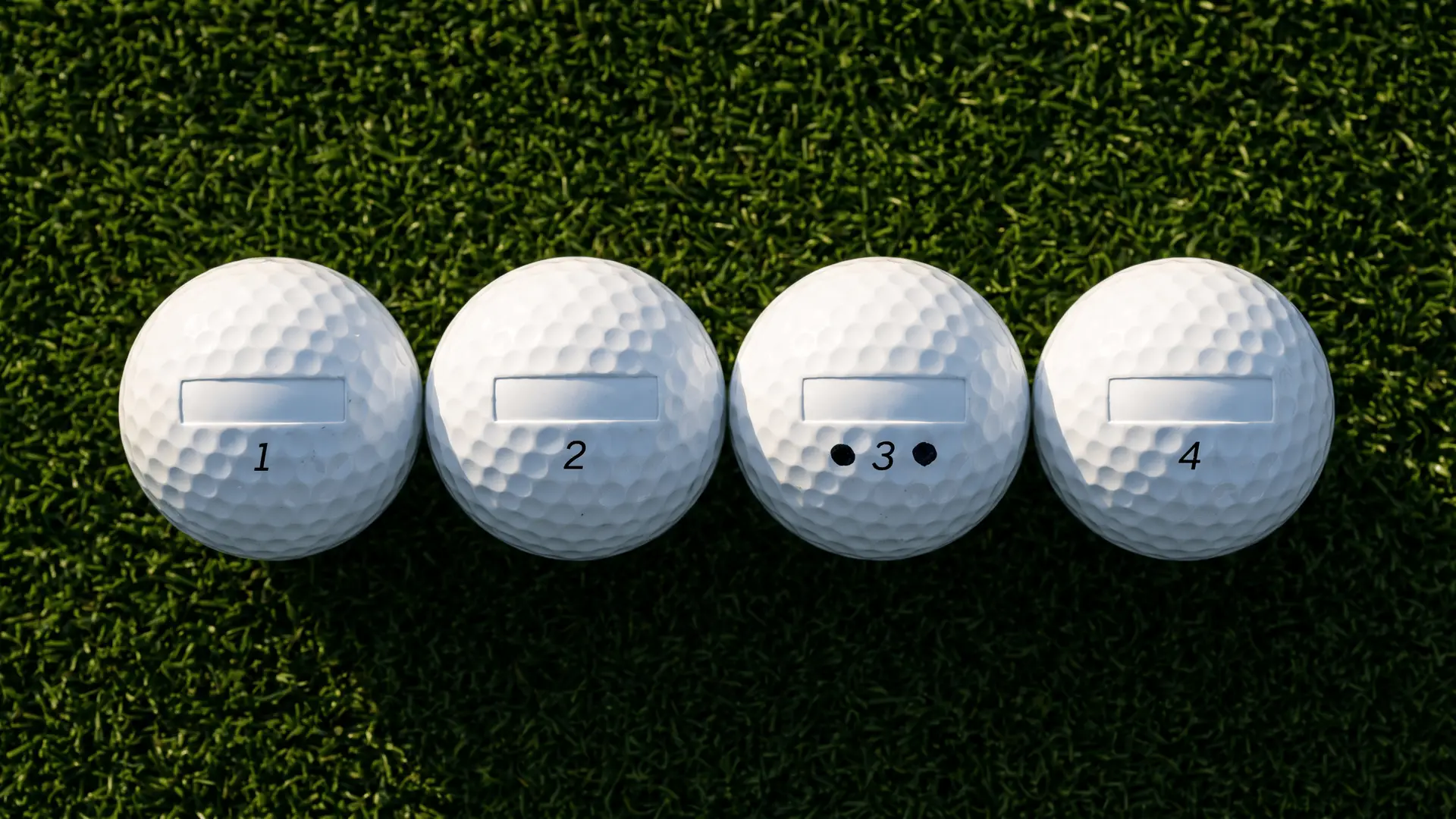
The big number under the brand name is your play number, and it exists to tell your ball apart from an identical ball in your group. It carries no performance meaning: a Pro V1 (~92) stamped 1 and one stamped 4 are the same ball. Three-digit numbers usually point to a dimple count folded into a model name. The 80/90/100 stamps on older balls were compression ratings, and that system died with the wound ball around 2001.
Every number and marking on a modern golf ball
| Where it appears | What it is | What it means | Changes how it plays? |
|---|---|---|---|
| Large digit under the brand name | Play number | Identification only | No |
| On the equator, beside the model name | Sidestamp | Model and generation | No |
| Three digits inside the model name (RB 566, Pro V1 392) | Dimple count | Aerodynamic pattern shorthand | Indirectly |
| 80, 90 or 100 alone on an older ball | Nominal compression | Wound-era spec, unreliable | Historically yes |
| A dot or dash before the model name (•Pro V1, –Pro V1x) | Model variant | A different ball entirely | Yes |
| Arrows, lines or a full stripe | Alignment aid | Aiming reference for tee shots and putts | No |
Placement decides the meaning. A number under the brand is yours. A number beside the model on the equator belongs to the ball.
The play number: eight decades of telling balls apart
Titleist and Acushnet balls carried no numerals until 1945. Before that, Acushnet filled a few dimples around the nameplate with colored paint so a player could recognize a ball on the ground. The stamped numeral replaced the paint, and eight decades later that is still the entire purpose.
A standard dozen ships as four sleeves of three, one number per sleeve. Four golfers, four numbers, no arguments in the fairway. Titleist sells 1 through 4 as “standard low” and 5 through 8 as “standard high”, each as its own dozen, and will print any number from 00 through 99 for an extra $1 per dozen.
So a 00 exists, and it means nothing. It isn’t a practice ball, a range rock, a zero-compression ball or a factory second. Somebody just wanted a 00.
The same holds for every digit in between. A Pro V1x (~102) with a 7 on it is the same product as one with a 2 — Titleist sells the entire 00-through-99 range as one ball with different ink. If a group of four is playing the same model, swapping numbers is the difference between a clean round and a two-stroke penalty on the sixth hole.
When 90 and 100 actually meant compression
Golfers who started before 2000 remember buying compression off the shelf. An 80 was sold as the women’s ball, a 90 for most men, a 100 for stronger players or hot days, and the number was right there on the cover.
Golf Digest ran the autopsy in 2009. Dean Snell, then TaylorMade’s senior director of golf ball R&D, put it flatly: “Compression was the biggest myth in golf. Back then tour balls labeled 90 or 100 compression were more like 65 or 75.”
Worse, the labels meant different things at different brands. Bill Morgan, Titleist’s senior VP of golf ball R&D, explained in the same piece that there was no industry standard for the measurement at all. Different companies used different devices that squeezed the ball differently and produced different results.
“That’s enough of a reason to stop publishing compression values. Every golf-ball designer uses compression specifications as one of the many design elements needed to achieve the desired performance characteristics of golf balls, so it is still important. It just doesn’t make sense if we start talking numbers.”
The practice faded alongside the wound ball. Titleist launched the solid-core Pro V1 in 2000, and the switch was so total that by the end of 2001 no champion on any major tour had won with a wound ball and Titleist had stopped making them altogether. The multilayer designs that replaced them decoupled measured compression from the feel a golfer reports at impact. There was no announcement and no cutoff date. The number stopped appearing.
Compression still decides plenty about how a ball performs for you, which is why BallCaddie’s compression chart publishes every ball’s figure measured on one calibrated gauge instead of trusting marketing copy. A modern Callaway Supersoft (~49) and a Kirkland Signature V3 (~95) sit 46 points apart, and neither number is printed anywhere on the ball.
If you see a bare 90 or 100 on a ball you found in the woods, you’ve found something old. Play it in a scramble, not a qualifier.
Three-digit numbers are usually dimples
A three-digit figure attached to a model name is aerodynamic shorthand.
Titleist’s early sidestamps spelled it out. The original Pro V1 read Pro V1 392 from its 2000 launch, and the early Pro V1x read Pro V1x 332, naming their dimple counts directly on the cover. The numerals came off in the mid-2000s, around the time the AIM alignment line arrived in 2007, which makes the marking a useful age check: golf.com’s guide to dating a Pro V1 pegged a 392 stamp at “at least 14 years old” when it ran in 2020, so one you find today is two decades old or more.
Mizuno still does it. The RB 566 (~60) takes its name from a 566 micro-dimple design that Mizuno says delays the ball’s rate of descent past the apex of its flight. The number is the pattern.
The trap is assuming every three-digit model name works this way. Srixon’s AD333 carries a 338-dimple pattern, so the name and the count don’t match. Treat a three-digit number as a lead to check, not a spec. Our dimple-count breakdown has the verified figures by model, along with the reason depth matters more than count anyway.
The sidestamp is a date stamp in disguise
Manufacturers rarely print a model year on the ball. They change the sidestamp instead, and Titleist has been explicit about why.
For a ball to be legal in competition it must appear on the USGA’s conforming ball list, and each entry requires a unique sidestamp. Titleist uses that requirement as a generation marker: every new Pro V1 and Pro V1x since 2000 has carried a different one. Fourteen designs span 2000 to 2025. The 2000 ball was plain text with no line at all. In 2007 Titleist added Alignment Integrated Marking, the black bar next to the model name, and has been refining the line’s thickness, length and ink precision ever since.
Which means the sidestamp answers a question the play number can’t: how old is this ball? Useful when you’re buying a discounted dozen or sorting a bag of recycled balls, where a five-generation-old Pro V1 is a different product from this year’s.
Punctuation is doing real work too. A dot to the left of the model name marks the Pro V1 Left Dot (~85), a lower-spinning, lower-flying build than the standard Pro V1. A dash marks the Pro V1x Left Dash (~105), the firmest ball Titleist makes. Those are separate models on the conforming list, not decoration, and we’ve covered why Left Dot exists and what Jordan Spieth’s switch to Left Dash was about.
Arrows, stripes and triple lines are aiming aids. Callaway’s Triple Track, TaylorMade’s Stripe band and Titleist’s AIM line all exist to give your eye a reference on the tee and over a putt. None of them changes flight.
Why your play number is worth two strokes
The Rules of Golf lean on ball identification harder than most golfers realize.
Rule 6.3a governs the ball you play a hole with: you may start a hole with any conforming ball, but you must hole out with that same ball unless it’s lost, out of bounds, or substituted under a Rule. The Rule then adds a line worth reading twice: “The player should put an identifying mark on the ball to be played (see Rule 7.2).”
Rule 7.2 lists the three ways a ball may be identified: somebody saw it come to rest in circumstances that make it yours, your identifying mark is visible, or you find a ball matching your brand, model, number and condition where yours should be. The third method has a hole in it. It fails when an indistinguishable ball sits in the same area with no way to tell which is which. Two golfers playing a Pro V1 with a 3 on it, both in the same rough, have no valid identification between them.
Rule 6.3c prices the mistake. Making a stroke at a wrong ball costs the general penalty: loss of hole in match play, two penalty strokes in stroke play. In stroke play you must then correct it by continuing with your original ball, either playing it as it lies or taking relief under the Rules. Miss that correction before you tee off on the next hole, or before you hand in your card on the 18th, and you’re disqualified.
Rule 7.3 covers the lookup. You may lift a ball to identify it, but you must mark its spot first and may not clean it beyond what identification requires. Lift without marking and it’s one penalty stroke.
Put those together and the practical rule is short: the factory number narrows the field, your Sharpie closes it. Retail dozens ship with only eight numbers between them, 1 through 4 and 5 through 8, so on a busy Saturday the odds of a duplicate in your own foursome are real. Two dots on the sidestamp takes three seconds and makes the question unanswerable.
What the number can’t tell you
No number printed on a modern golf ball tells you whether the ball suits your swing.
Four specifications do that work, and none of them appear on the cover: compression, cover material, spin profile and price. A Callaway Chrome Soft (~77) and a Supersoft (~49) are both Callaways with a 1 on them, and they’re 28 compression points and one cover material apart. The urethane ball checks up on a pitch shot. The ionomer one releases.
Swing speed sets the compression tier, and the swing-speed framework maps the bands with example balls in each. How much greenside spin you actually use decides the cover. How many balls you lose per round decides the budget. The digit under the logo is orthogonal to all four.
Color is the one marking that changes anything measurable, and only for your eyes: yellow and matte covers track better in flight for most golfers without changing spin or distance.
The next step
Numbers on a ball are a filing system. What sits under the cover decides your scores, and none of it is printed anywhere you can read it.
The fitting quiz scores all 70+ balls in the BallCaddie catalog on compression, cover, spin and budget in about 90 seconds, and it’ll tell you when a $19.99 dozen is the honest answer for your swing.
For deeper dives on the specs that move the ball:
- Golf ball compression chart — every ball’s compression measured on one calibrated gauge, with the swing-speed tier breakdown the old 80/90/100 stamps were pretending to give you.
- How to choose the right golf ball for your swing speed — the framework that maps swing speed to compression tier.
- How many dimples are on a golf ball? — the verified count by model, and why depth outranks count.
- Golf ball compression and swing speed: the fitting logic — why a soft ball isn’t automatically faster for a slow swing.
- Used golf balls: recycled vs refurbished — where sidestamp-reading pays off, and what a pond ball loses.
Key takeaways
- The number under the brand is a play number. Identification only. Titleist added them in 1945 to replace colored paint in the dimples.
- 1-4 and 5-8 are packaging conventions, one number per three-ball sleeve. Titleist will print 00 through 99 for $1 more per dozen.
- 80, 90 and 100 were compression, and they lied. Tour balls stamped 90 or 100 measured closer to 65 or 75, per TaylorMade’s Dean Snell. No industry standard existed for the test, which is why the numbers came off.
- Three digits inside a model name usually mean dimples — Pro V1 392, Pro V1x 332, Mizuno RB 566 — but verify, because Srixon’s AD333 has 338.
- A wrong ball costs the general penalty under Rule 6.3c: loss of hole, or two strokes and a mandatory correction in stroke play. Rule 7.2 says a matching number alone won’t identify your ball when an identical one is lying nearby.
Stop guessing your golf ball
Take the 90-second fitting quiz · matched from a 70+ ball catalog · sign up to see your match
Take the quiz →Related posts
Warm water, mild dish soap, a soft brush. The robot data on what mud and scuffs actually cost you, the Rules on cleaning mid-round, and the methods to skip.
Cut a golf ball open and you find a rubber core, up to 3 mantle layers and a urethane or ionomer cover. What each part does and how many pieces you need.
Modern golf balls don't expire on a shelf. Heat, freezing, and cover damage do real harm. The storage data, the 21-yard freezer test, and when to retire a ball.
Where pro shops, leagues, and bulk buyers get golf balls cheapest: Vice and Snell volume tiers, used 5-dozen lots, Costco, and logo minimums, per ball.
Frequently asked questions
- What does the number on a golf ball mean?
- The large number printed under the brand name is a play number, and its only job is identification. It tells your ball apart from an identical ball hit by someone else in your group. A Titleist Pro V1 stamped 1 and a Pro V1 stamped 4 are the same ball with the same core, cover, compression and dimple pattern. Play numbers carry no information about distance, spin, feel or quality.
- Why do golf balls come numbered 1, 2, 3 and 4?
- A standard dozen holds four three-ball sleeves, and packing one number per sleeve gives four golfers in a group four distinguishable balls of the same model. Titleist calls 1 through 4 its standard low numbers and 5 through 8 its standard high numbers, sold as a separate dozen. Nothing about the numbering reflects a manufacturing batch, a quality grade or a performance tier.
- Does a higher number on a golf ball mean it goes farther?
- No. The play number has no relationship to distance, compression, spin or construction. High-number dozens exist because golfers wanted more identification choices and because some players prefer a specific number. Titleist sells Pro V1 and Pro V1x with any play number from 00 through 99 for an extra dollar per dozen, and every one of those balls is built to the same specification.
- Did golf balls used to have compression numbers on them?
- Yes. Through the wound-ball era, balls were sold as 80, 90 and 100 compression, with 80 marketed to women, 90 to most men and 100 to stronger players. Golf Digest reported in 2009 that the labels were unreliable: tour balls stamped 90 or 100 often measured closer to 65 or 75. Titleist stopped producing wound balls by the end of 2001, and the numbers went with them.
- What does a three-digit number on a golf ball mean?
- It usually points to a dimple count folded into the model name, though it is worth checking. Early Titleist sidestamps read Pro V1 392 and Pro V1x 332, and the Mizuno RB 566 takes its name from a 566 micro-dimple pattern. Read the placement: a three-digit figure sitting beside the model name on the equator is part of the model, while the big number under the brand is your play number.
- What is the penalty for playing the wrong golf ball?
- Under Rule 6.3c you get the general penalty, which is loss of hole in match play and two penalty strokes in stroke play. In stroke play you must also correct the mistake by continuing with your original ball, either playing it as it lies or taking relief under the Rules. If you fail to correct it before teeing off on the next hole, or before returning your scorecard on the last hole, you are disqualified.
- Do I have to mark my golf ball with a Sharpie?
- The Rules say you should, not that you must, so skipping it carries no penalty by itself. It matters at the moment you need to prove a ball is yours. Rule 7.2 says matching brand, model, number and condition fails as identification when an indistinguishable ball sits in the same area, and a personal mark is what settles it. Two dots takes three seconds.
Stop guessing your golf ball
Take the 90-second fitting quiz · matched from a 70+ ball catalog · sign up to see your match
Take the quiz →