🎯 New here? BallCaddie matches golfers to the right ball. → Take the 90-second quiz
Back to BlogYellow and Colored Golf Balls: Do They Help, and Which to Play (2026)
Do yellow and colored golf balls help you see the ball, and do they cost you distance or spin? The vision science, the rules, and the balls worth playing.
Answer a few questions about your swing and BallCaddie matches you against a 70+ ball catalog.
Take the 90-second quizQuick answer
A yellow ball is the easiest to see across the most conditions, and on a modern ball the color costs you nothing you’ll notice in distance or spin — with one live exception, the Kirkland Signature Performance+, whose yellow and white come out of different factories and tested as different balls in 2026. Every color on the USGA conforming list is legal for tournament play. So fit the ball to your swing first, then choose its yellow or matte version. High-optic yellow works for almost everyone; matte finishes help most in bright midday sun.
Yellow and colored golf balls worth playing
| Ball | Compression | Cover | Color / finish | $/dz | Best for |
|---|---|---|---|---|---|
| Maxfli SoftFli | 35 | Ionomer | Matte green, red, yellow | $19.99 | Cheapest soft matte ball |
| Titleist TruFeel | 70 | Ionomer | Yellow, matte red | $24.99 | Brand-name value color |
| Callaway Supersoft | 49 | Ionomer | Matte red, orange, green, yellow | $26.99 | Widest matte color range |
| Vice Pro Air | 72 | Urethane | Neon lime | $39.99 | High-launch urethane, direct-to-consumer color |
| Srixon Q-Star Tour | 70 | Urethane | Tour Yellow | $39.99 | Value urethane spin and visibility |
| Kirkland Signature Performance+ | 95 | Urethane | High-optic yellow | ~$15 | Cheapest urethane in color — and the yellow is the better ball |
| Srixon Z-Star | 81 | Urethane | Tour Yellow | $54.99 | Premium tour yellow at a fair price |
| Titleist Pro V1 | 92 | Urethane | High-optic yellow | $57.99 | Tour-level yellow, maximum greenside spin |
Prices are MSRP per dozen. Every ball above is conforming and shares its white version’s construction, so any on-course difference is too small to notice. Pick the row that matches your swing speed and feel, then take the color you can see best.
The visibility case for colored balls
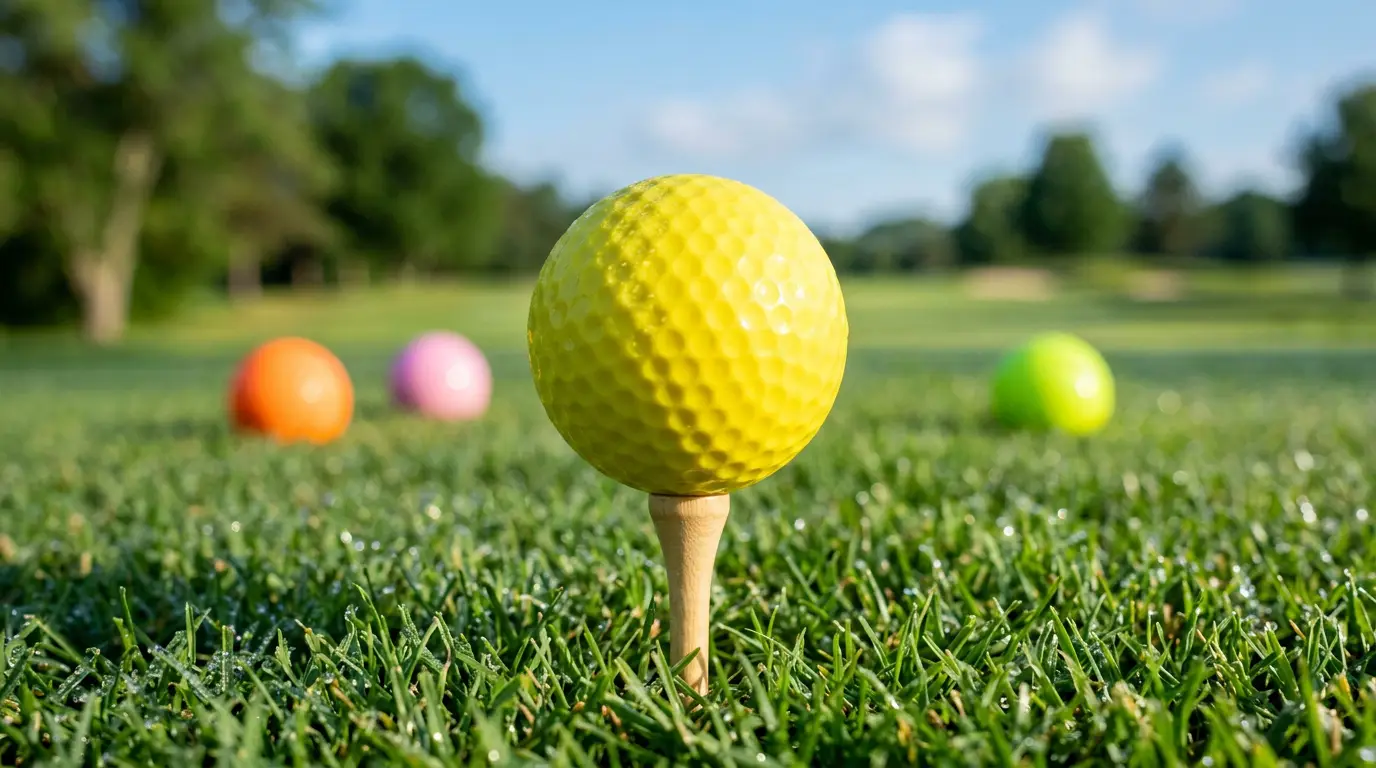
Yellow wins because your eye is built for it. Human vision peaks in sensitivity around 555 nanometers, right in the yellow-green band, which is the same reason tennis switched to optic yellow for television and why road signs lean that way. An eye clinic breakdown of golf ball color ties this peak sensitivity directly to how quickly you pick a ball out of the sky. A yellow ball gives your brain a stronger signal to lock onto, so you track it faster off the face and lose it less often on the way down.
Contrast does the rest. White holds up well against a green fairway in direct sun, then washes out against a bright or hazy sky, in long shadows, and on dry, light-colored turf. Yellow keeps its contrast against all of those backgrounds, which is why it travels best across seasons. A Golf Monthly writer who spent years as a white-ball purist finally switched and called the yellow ball “incredibly visible”, the kind of reaction that shows up over and over once players try it.
Not every color behaves the same way. Here is the honest read on the common options:
- High-optic yellow holds contrast against the widest range of backgrounds and light. The safe default.
- Neon green rivals yellow in overcast skies, then can disappear into a lush green fairway.
- Orange pops against grass and blue sky, then hides in autumn leaves and brown winter turf.
- Red and pink show up well in flight, then fade on the ground in shadow or dark turf.
- White tracks fine in clear sun against green, then becomes the hardest color to follow in flat or low light.
Age tilts the math further toward yellow. After about 50, the eye’s lens yellows and filters out blue light, so white balls drift toward gray against a hazy sky. Yellow and green keep their punch, which is why color adoption skews older and why a switch is worth a try if your playing partners keep spotting your ball before you do. The same logic runs through our best golf balls for seniors picks.
Does the color change how the ball performs?
No, not on a ball built this decade. The old worry was real once: bright balls from the 1970s and 80s used thick paint layers that could fill dimples unevenly and nudge the flight. Modern manufacturing blends the pigment into the urethane or ionomer cover itself, so a yellow Pro V1 and a white Pro V1 share the same dimples, the same weight, and the same aerodynamics.
Independent testing backs that up. In one head-to-head of a Pro V1 in white versus yellow, the white ball spun about 400 rpm (roughly 9%) more on wedges and carried a yard or two farther, a gap narrower than the scatter you create with two swings of the same club. For context on how small real ball-to-ball gaps are in the first place, MyGolfSpy’s robot ball testing shows most of the meaningful performance lives in compression, core, and cover material, the things covered in our golf ball compression chart, rather than in the paint.
So the construction is what matters, and color is a free choice layered on top. Match the cover to your short game first. If you want tour-level greenside spin you need a urethane cover, the dividing line we cover in urethane vs. ionomer golf balls; the yellow option exists in both camps.
The one ball where color really does change performance
There is a live exception, and it’s the most popular value ball in golf. The Kirkland Signature Performance+ (~95) is two balls built in two factories. MyGolfSpy’s Ball Lab teardowns name the plants: the yellow comes from SM Global in China, the white from SM Parker in Vietnam. Its 2026 ball test states only that the two colors are “produced in different factories,” which is why it scored them as separate models. Costco sells both under one name at one price — $29.99 for the two-dozen box in the warehouse.
MyGolfSpy’s 2026 ball test (48 balls, robot-controlled, published August 2026) entered them as separate models for exactly that reason, and the numbers justified it:
| Kirkland yellow | Kirkland white | |
|---|---|---|
| Driver spin, high swing speed | Top five; third-highest at the top speed tested | 10-plus spots lower |
| Full-swing spin, all conditions | Top ten in every condition | 13th–17th in five of six |
| Low driver speed | 8th | 9th |
| Greenside, 35-yd wedge | Tied with the test’s best ionomer ball | Below it |
Two things follow. First, if you play a Kirkland, buy the yellow — you are getting a measurably better ball for the same money, and the July 2026 Ball Lab teardown of the yellow V3.0 backs it up with a quality score of 84, a grade B, and zero defects across 36 balls. Second, this doesn’t overturn the rule above. Nothing about the pigment is doing this. Two production lines with different tooling and materials happen to be split by color, so the color is a label for the factory rather than a cause. Every other ball in this guide is the same ball in a different shade.
One more thing the 2026 test flagged, color aside: Kirkland’s greenside spin has slipped. MyGolfSpy’s words are “across recent tests we’ve seen its greenside spin dip appreciably,” and premium urethane now spins roughly 1,250 rpm more from 35 yards. Buy the yellow Kirkland for visibility and full-swing performance, not for wedge bite.
Matte vs glossy: a finish, not a performance setting
Matte is a coating choice that trades a little durability for easier tracking. A matte surface scatters light instead of reflecting it, so it cuts the midday glare that makes a glossy ball glint and vanish, and the color reads as more saturated against the grass. Plenty of golfers find a matte ball the single easiest thing to follow in bright sun.
The trade-offs are minor but worth knowing. Matte covers tend to scuff and show wear a touch faster than a hard clear-coat, and some testers find a matte cover sheds water less cleanly, costing a small amount of wedge spin in heavy dew or rain.
That is why the matte options cluster in the soft, value tier, including the Callaway Supersoft, the Maxfli SoftFli (~35), and the Wilson Duo Soft (~37), plus the colored-ball specialist Volvik, whose Vivid line is matte across the board. Premium tour balls stay glossy, because the players who buy them want every last rpm of wet-weather spin. Choose matte for visibility, glossy for greenside bite.
Are colored and yellow golf balls legal?
Yes, every color is legal. The USGA and R&A conforming ball list is the only gate, and it judges balls on size, weight, speed, and symmetry, never on color. The list even has a dedicated column for cover color, where yellow leads the non-white options and pink and orange follow close behind. The R&A Rules of Golf take the same color-neutral position worldwide.
There is one wrinkle in serious competition. The optional One Ball Local Rule, which some professional and championship events adopt, requires you to play the same brand and model, and therefore the same color, for an entire round. It is not in force in everyday rounds or most amateur events, so you can put a yellow ball in play any time you like. The proof shows up at the highest level: Bubba Watson has teed up a pink ball at the Masters without breaking a rule.
The best colored and yellow balls, by tier
Premium tour balls in yellow
Every flagship tour ball now comes in high-optic yellow at the same price as white. The Titleist Pro V1 and firmer Titleist Pro V1x (~102) lead the category.
Callaway offers the Chrome Soft (~77) and the faster Chrome Tour (~94) in yellow, while TaylorMade covers both ends of the spin range with the TP5 (~93) and TP5x (~98). Srixon’s Tour Yellow runs from the Z-Star through the higher-launching Z-Star XV (~96), and Bridgestone offers optic yellow on the Tour B XS (~89) and lower-spinning Tour B X (~100). All glossy, all conforming, all the same construction as the white version.
Soft, low-compression colored and matte balls
If your swing is under roughly 95 mph, or you just want soft feel, the matte and color options cluster in the value tier. The Callaway Supersoft carries the widest matte palette, the Maxfli SoftFli is the cheapest soft matte ball at $19.99, and the Titleist TruFeel gives you a brand-name yellow for $24.99. Add the Srixon Soft Feel (~58) in its Brite colors and the Wilson Duo Soft (~37) in its matte finishes. The Titleist Velocity (~90) also comes in matte green and orange, though it belongs with the firm distance balls rather than the soft ones. These are the value picks our best value golf ball guide leans on, now in a color you can find.
Value urethane and direct-to-consumer color
Greenside spin and color without the $55 ticket is its own sweet spot. The Srixon Q-Star Tour puts urethane spin in Tour Yellow for $39.99, and the direct-to-consumer Vice Pro Air (~72) and firmer Vice Pro (~89) sell neon lime and a range of colors at DTC prices. The cheapest entry is the yellow Kirkland Signature Performance+ (~95) at about $15 a dozen from Costco, which is also the one color choice in golf that changes the ball you get. All of these use a urethane cover, though the 2026 test says to expect ionomer-level wedge spin from the Kirkland specifically.
How to choose your color
Get the fit right, then let preference and conditions pick the color. A few honest pointers:
- Don’t expect color to fix a mismatch. A yellow ball that’s too firm for your swing is still too firm. Set your ball for your swing speed first, then take that model’s color.
- Skip orange if you play into late fall. It’s brilliant against green grass and turns invisible against fallen leaves and brown turf. Yellow holds up year-round.
- Reach for matte in bright sun, glossy in the wet. Matte kills glare; a glossy cover keeps a touch more wedge spin when the grass is soaked.
- Match color to your eyes, not the rack. If white balls already vanish on you against a hazy sky, that’s the signal to switch, regardless of what your group plays.
The next step
The right color sits on top of the right ball, so start with the fit. Run your swing speed, typical miss, greenside priority, and budget through the BallCaddie quiz; it scores the whole ball catalog against your game in about 90 seconds. Sign up to see your full match, then check whether that ball comes in yellow or matte, almost all of them do now, and play the version you can actually follow off the tee. You can also compare any two balls side by side to see compression, cover, and price together before you commit.
Related guides
- How to choose the right golf ball for your swing speed — fit the ball to your swing first; the color is the easy part.
- Golf ball compression chart 2026 — what actually moves distance and spin, the stuff color has nothing to do with.
- Urethane vs. ionomer golf balls — the cover-material fork that decides greenside spin, in white or yellow.
- Best golf balls for seniors — the swing speeds and aging-eye changes that make a yellow ball worth trying.
- Best value golf ball in 2026 — where most of the soft matte and color options live.
- Callaway Chrome Soft review — the mid-soft urethane tour ball that also comes in yellow.
Key takeaways
- Yellow is the most visible color across the most conditions, thanks to the eye’s peak sensitivity near 555 nm and its steady contrast on grass, sky, and brown turf.
- Color and finish don’t change performance on a modern ball; pigment is blended into the cover, and independent testing puts any white-versus-yellow gap inside swing noise.
- One exception: the Kirkland Signature Performance+ yellow and white are made in different factories, and MyGolfSpy’s 2026 test scored them as separate balls. Buy the yellow.
- Matte cuts glare and tracks easily in bright sun, at a small cost in durability and wet-weather spin. It lives in the soft, value tier.
- Every color is legal if the model is on the conforming list. Only the optional One Ball Local Rule, used in some elite events, limits a color change mid-round.
- Fit first, color second. Match swing speed, cover, and feel, then play the yellow or matte version of the ball you’d buy anyway.
Stop guessing your golf ball
Take the 90-second fitting quiz · matched from a 70+ ball catalog · sign up to see your match
Take the quiz →Related posts
MyGolfSpy put 48 balls through a robot at three swing speeds. The findings that actually change which ball you should play, and the ones that don't.
Match golf ball compression to your driver swing speed — what robot testing really says about soft versus firm, and the three bands that pick your ball.
Cut a golf ball open and you find a rubber core, up to 3 mantle layers and a urethane or ionomer cover. What each part does and how many pieces you need.
Where pro shops, leagues, and bulk buyers get golf balls cheapest: Vice and Snell volume tiers, used 5-dozen lots, Costco, and logo minimums, per ball.
Frequently asked questions
- Are yellow golf balls easier to see than white?
- For most golfers in most conditions, yes. The human eye is most sensitive to yellow-green light, around 555 nanometers, so a yellow ball holds contrast against blue sky, green grass, and brown turf better than white, which can wash out against a hazy or bright sky. Yellow is the most consistent color across seasons and lighting. White still tracks well in clear sun against a green fairway.
- Do colored golf balls go shorter or spin less than white?
- Not on a modern ball. Manufacturers blend the pigment into the cover instead of painting on a thick colored layer, so the dimples and aerodynamics match the white version. One independent white-versus-yellow test measured about 400 rpm (roughly 9%) more wedge spin and a yard or two more carry on the white ball, a gap smaller than the shot-to-shot scatter of a human swing. There is one real exception, and it is not about pigment: the Kirkland Signature Performance+ yellow and white are made in different factories, and MyGolfSpy's 2026 ball test scored them as separate balls, with the yellow well ahead on full swings. Otherwise, choose color for visibility and let the fitting handle performance.
- Are yellow and colored golf balls legal in tournaments?
- Yes. Any ball on the USGA and R&A conforming list is legal regardless of color, and the list tracks cover color in its own column. The only catch is the optional One Ball Local Rule that some elite events adopt, which makes you keep the same model and color for the whole round. In everyday and most amateur play it is not in force. Bubba Watson has teed up a pink ball at the Masters.
- What is the most visible golf ball color?
- High-optic yellow is the best all-around choice because it holds contrast against the widest range of backgrounds and light. Neon green rivals it in overcast skies but can disappear into lush fairway. Orange pops against green grass but vanishes in autumn leaves and brown winter turf. Red and pink show up in flight but fade on the ground in shadow. Yellow is the safe default.
- Is a matte or glossy golf ball better?
- Matte cuts glare and reads as a more saturated color, so many golfers track it more easily in bright sun. The trade-offs are durability, since matte covers scuff a little faster, and wet weather, where some testers find matte loses a touch of wedge spin. Matte options are mostly soft, value-tier balls, while premium tour balls come in glossy yellow. Pick matte for visibility, glossy for wet-weather spin.
- Do any tour pros play a yellow golf ball?
- A few do, though white still dominates professional golf out of tradition more than performance. Yellow versions of tour balls like the Pro V1, Pro V1x, Chrome Tour, TP5, and Z-Star are all available and conforming. Colored balls are fully legal at every level, which is why you will occasionally see one in a major. The visibility benefit is the same one that helps amateurs find their drives.
- Should I switch to a yellow ball if I am over 50?
- It is worth a try. After about age 50 the eye's lens yellows and filters blue light, which makes white balls fade toward gray against a hazy sky. Yellow and green hold their contrast, which is why color use skews toward older golfers. Pick the ball that fits your swing speed and feel first, then play the yellow or matte version of it.
Stop guessing your golf ball
Take the 90-second fitting quiz · matched from a 70+ ball catalog · sign up to see your match
Take the quiz →