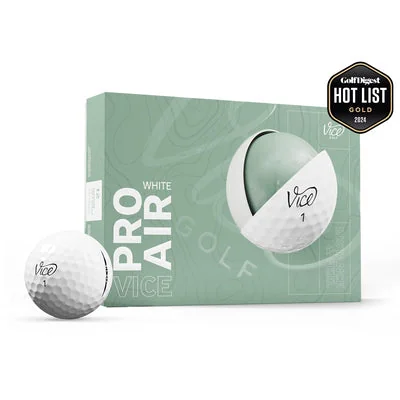
Vice Pro Air Golf ball compression, specs & review
The Vice Pro Air is a 72-compression, 3-piece golf ball with a urethane cover, low spin and a mid flight. A lightweight three-piece urethane (soft, grippy cover) ball with 72 compression delivering the lowest long-game spin in the Vice lineup with a high launch, plus soft feel and urethane greenside grip, for moderate and slower swing speed players.
Is 72 compression right for your swing? The quiz checks your swing speed and feel against every ball in our catalog, this one included.
Take the quiz →What do these specs mean?
Compression
How soft the ball feels. Lower numbers (70–80) compress easier and help slower swings get distance. Higher (90+) rewards faster swings.
Cover
Surlyn is tough and cheap — great for distance and durability. Urethane is softer and grips wedges for more spin around the green.
Layers
2-piece: simple, long, straight. 3-piece and 4-piece add layers for more feel and spin control on approach shots.
Trajectory
How high the ball flies. Low = flatter flight with more roll. High = peaks up and lands soft. Mid = balanced.
Spin
Low spin = straighter shots, less curve, more roll. High spin = more control and stopping power on the green (but also magnifies slices/hooks).
Tier
Price bucket. Value = budget-friendly distance balls. Mid = solid all-around. Premium = tour-level spin and feel, costs more per dozen.
Best For
Try a sleeve first — ~$5 for 3 balls before committing to a dozen.
How the Vice Pro Air did in MyGolfSpy's 2026 robot test
- Driver distance: 38th of 48 at an 86 mph swing (227 yards), 39th at 102 mph (285 yards) and 45th at 116 mph (310 yards).
- Driver spin at 102 mph: 2,577 rpm, the 11th-lowest of the 48 balls.
- 35-yard wedge spin: 5,373 rpm, the 24th-lowest of the 48 balls.
Source: MyGolfSpy 2026 ball test. Ranks out of 48 balls; distances in total yards.
What golfers told our quiz
When we run the answers from 2,698 finished quizzes through our current fitting engine, the Vice Pro Air lands in the top 3 for 27% of golfers. 54% of those golfers swing 85–99 mph, and the most common shot shape they reported was mostly straight with a slight right turn (42%).
Take the 90-second quiz to see which balls fit your swing.
Self-reported answers from 2,698 finished quizzes, as of Oct 4, 2026.
A lightweight three-piece urethane (soft, grippy cover) ball with 72 compression delivering the lowest long-game spin in the Vice lineup with a high launch, plus soft feel and urethane greenside grip, for moderate and slower swing speed players.
Who It’s For
The Vice Pro Air is built for slow-to-moderate swing speeds (roughly 80–95 mph). It suits golfers who prioritize moderate swing speed, slow swing speed, seniors, soft feel, high launch. In the Vice lineup, the Pro Air is the softest, highest-launching urethane ball, sitting well below the Vice Pro — and it’s the ball Vice replaced the discontinued Pro Soft with. Vice’s product page lists it as Ranked Gold by Golf Digest.
Feel
With a compression of 72 and a urethane cover, feel is balanced — soft enough for touch shots, firm enough for a lively tee strike.
Spin Profile
Expect low driver and long-iron spin — the lowest in the Vice lineup — traded for a higher launch that keeps carry up. Around the green the urethane cover pulls its weight; its 35-yard wedge dispersion was 47% tighter than its group in MyGolfSpy’s 2026 robot test.
Trajectory & Construction
A high-launching ball, and the irons prove it: 7-iron launch 4th of 48 and apex 7th at 80 mph club speed in MyGolfSpy’s 2026 robot test, with 7-iron carry 9th. The three-piece build gives up driver ball speed for softness (44th of 48 at 102 mph in that test), which is the trade a 72-compression ball makes. Performs well in cooler temperatures.
Price & Value
At $39.99 per dozen (direct-to-consumer, no retail markup), the Pro Air delivers premium materials at a meaningful discount to the big brands.
Buy it if
- You sit in the 80–95 mph range and want a ball that works across your bag.
- You play shoulder-season golf; it is the only Vice ball we list as cold-weather suitable.
Similar Balls
- Titleist Pro V1 — 92 compression, high-spin, $58
- Titleist AVX — 81 compression, low-spin, $50
Frequently Asked Questions
What is the compression of the Vice Pro Air golf ball?
The Vice Pro Air has a compression of about 72, which puts it in the mid-compression range. At 72 it is the softest ball in Vice’s Pro series, softer than the discontinued Pro Soft by Vice’s own account, and it suits slower swingers who want urethane grip without a firm click. It is one of several specs the BallCaddie fitting quiz weighs against your swing speed, usual miss, feel preference and budget.
Who should play the Vice Pro Air?
The Vice Pro Air is built for slow-to-moderate swing speeds (roughly 80–95 mph). It suits golfers who prioritize moderate or slower swing speed, seniors, soft feel, high launch — including anyone who played the discontinued Vice Pro Soft.
What swing speed is the Vice Pro Air designed for?
It’s aimed at the 80–95 mph range, and Vice rates it for efficient distance at any speed.
Does the Vice Pro Air have high greenside spin?
Moderately. The urethane cover grips, but Vice calls it the lowest-spinning ball in its Pro series; 7-iron spin was 45th of 48 in MyGolfSpy’s 2026 robot test, so it holds greens with height rather than bite.
Is the Vice Pro Air good in cold weather?
Yes. At 72 it is the softest ball in Vice’s Pro series and the one we list as cold-weather suitable, so it is the Vice to play when the Pro starts feeling firm.
How much does the Vice Pro Air cost?
MSRP is $39.99 per dozen.
Read more about the Vice Pro Air
Vice golf ball compression chart: the five adult models by swing speed, spin, and price, with robot-test data and how the Pro Plus undercuts a Pro V1x.
Where pro shops, leagues, and bulk buyers get golf balls cheapest: Vice and Snell volume tiers, used 5-dozen lots, Costco, and logo minimums, per ball.
Do yellow and colored golf balls help you see the ball, and do they cost you distance or spin? The vision science, the rules, and the balls worth playing.
The best low-compression golf balls for swing speeds under 95 mph — measured compressions, robot-test distance data, and when soft urethane is worth it.
Similar Balls
Balls with comparable specs