🎯 New here? BallCaddie matches golfers to the right ball. → Take the 90-second quiz
Back to BlogWhat's Inside a Golf Ball? Core, Mantle, Cover and Dimples, Explained
Cut a golf ball open and you find a rubber core, up to 3 mantle layers and a urethane or ionomer cover. What each part does and how many pieces you need.
Answer a few questions about your swing and BallCaddie matches you against a 70+ ball catalog.
Take the 90-second quizQuick answer
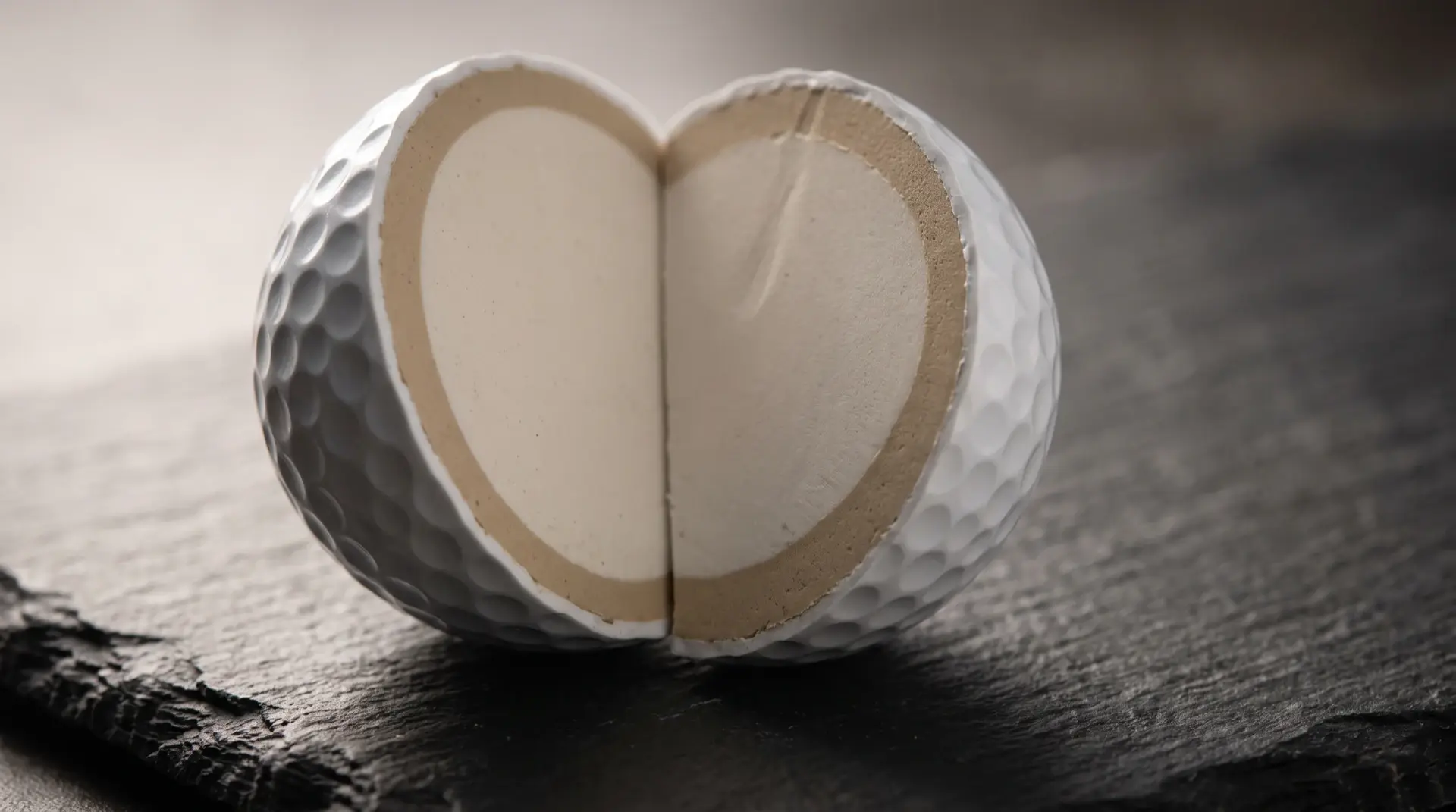
A golf ball is a polybutadiene rubber core, zero to three firm ionomer mantle layers, and a cover that is either urethane or ionomer, wrapped in 300 to 500 dimples. The core sets ball speed. The mantle keeps driver spin low while letting the cover grip on wedges. The cover material is the biggest single spin decision: a urethane cover spun about 1,900 rpm more than ionomer on a 35-yard wedge in MyGolfSpy’s 2026 test.
Golf ball construction chart
| Pieces | What’s inside | What the extra layer adds | Examples from our catalog |
|---|---|---|---|
| 2-piece | Big rubber core + a single cover, usually ionomer | Cheapest to build, most durable, lowest spin everywhere | Titleist Velocity (~90), Callaway Supersoft (~49), Titleist TruFeel (~70) |
| 3-piece | Core + mantle + cover | A firm backstop under a soft cover, so driver spin drops and wedge spin rises | Titleist Pro V1 (~92), Srixon Z-Star (~81), Bridgestone Tour B X (~100), Kirkland Signature (~95) |
| 4-piece | Dual core + mantle + cover, or core + two mantles + cover | One more stiffness boundary to tune iron launch and spin | Titleist Pro V1x (~102), Callaway Chrome Tour (~94), Callaway Chrome Tour X (~99) |
| 5-piece | Three-stage core + two mantles + cover | The layers take over progressively as impact speed drops from driver to wedge | TaylorMade TP5 (~93), TaylorMade TP5x (~98) |
Compression numbers are MyGolfSpy gauge readings from our golf ball compression chart, so they compare to each other rather than to a brand’s marketing number.
Why the inside of the ball matters
The clubface touches the ball for about 450 microseconds. In that time the USGA’s research primer says the clubhead applies an average force of more than 2,000 pounds and squashes the ball to about three-quarters of its diameter. Every layer inside the ball is a decision about how that squash happens and how fast the ball springs back.
That’s why two balls with the same paint job can play so differently. A Titleist Velocity and a Titleist Pro V1 are the same size, the same weight and both legal, and the Pro V1 will stop a wedge shot yards shorter because of what sits under the cover. Construction is the mechanism behind every number on the compression chart and every spin gap in the urethane vs ionomer breakdown.
The core: where ball speed comes from
The core is a solid mass of polybutadiene, a synthetic rubber, cross-linked with zinc diacrylate and a peroxide initiator under heat and pressure. Titleist’s Learning Lab explains the chemistry: the cross-links are what let the rubber store energy when it’s crushed and give most of it back as ball speed. Fillers set the weight. The core takes up most of the ball’s volume, which is why it sets the speed for the whole ball.
Compression is a static stiffness reading. A gauge presses the ball under a fixed load and reports how far it gives; higher numbers are firmer. It measures nothing about impact. MyGolfSpy’s Ball Lab uses an OK Automation 55-M gauge and averages three readings per ball. Across our catalog of 72 balls that gauge runs from 35 on the softest Maxfli SoftFli to 105 on the Pro V1x Left Dash.
Firmer cores keep more ball speed, and the effect grows with swing speed. MyGolfSpy’s 2026 ball test also found the softest balls tend to be the lowest-spinning, since a soft core can’t act as a backstop for the cover. The swing-speed guide turns that into a band-by-band recommendation.
Dual cores and gradient cores
Manufacturers now tune stiffness inside the core itself. The Pro V1x uses a dual core, a soft center inside a firmer outer core, which is why it counts as 4 pieces. Srixon’s FastLayer DG core on the Z-Star goes from soft in the center to firm at the edge without adding a piece, per Srixon’s spec page. Titleist’s “high gradient core” and Bridgestone’s Gradational Compression Core are the same idea under different names: a soft middle for feel and low spin, a fast outer region for speed.
The mantle: low driver spin and high wedge spin in one ball
The mantle (Titleist calls its single layer a “casing”) is a firm thermoplastic, almost always an ionomer, injection-molded around the core. It does two jobs that pull in opposite directions. On a full driver swing the mantle and core flex together as one stiff spring, which holds driver spin down. On a wedge, the soft cover gets pinched against that firm mantle, friction goes up and spin goes up with it.
That contrast is the whole reason tour balls have at least 3 pieces. A 2-piece ball has one core doing both jobs, so it can be low-spin off the driver or grippy on wedges but rarely both. MyGolfSpy’s construction and spin explainer walks through the physics. Titleist describes its own single layer on the casing-layer page of its Learning Lab.
The cover: urethane or ionomer
The cover is the choice you’re paying for. Three materials are in play:
| Cover | How it’s made | On the course | Thickness | Price band |
|---|---|---|---|---|
| Cast thermoset urethane | Two liquids react inside dimpled hemisphere molds and cure; can’t be remelted | Thin, soft, high-friction; tour-level greenside spin and soft feel | Very thin: a design range of roughly 0.02–0.04 in in Acushnet’s cast-cover patent | Mostly $45–58/dz; direct-to-consumer brands from about $19 |
| Thermoplastic urethane (TPU) | Solid pellets melted and molded; softens again with heat | Between cast urethane and ionomer on spin and feel; cheaper to mold | 0.6 mm on the Srixon Z-Star (Srixon) | ~$45–55/dz |
| Ionomer (Surlyn is DuPont’s brand name) | Injection-molded resin | Hard, cut-resistant, fast, low spin everywhere | Thicker and harder than a cast cover | Mostly $15–30/dz; a few reach $40 |
The spin gap is the headline number. In MyGolfSpy’s 2026 cover-material analysis, urethane covers averaged 5,415 rpm on a 35-yard wedge against 3,506 rpm for ionomer, about 1,900 rpm more, and 10,339 vs 7,079 rpm on a full dry wedge. Those are two specific shots; pooled across every greenside shot in the 48-ball field the gap narrows to nearer 1,250 rpm. The same article warns that individual balls overlap, so a urethane cover predicts spin without guaranteeing it.
The cover is also the cost split. Titleist casts urethane covers in a process MyGolfSpy timed at 4 balls per mold per roughly 45-minute cycle on its Ball Plant III tour, and the scrap can’t be remelted. An ionomer cover is injection-molded in a fraction of that time. Across our catalog, urethane balls average $44.53 a dozen and ionomer and Surlyn balls $24.67.
Two exceptions keep the categories honest. The Snell Prime 2.0 (~82) is a 2-piece ball with a urethane cover, and the Titleist AVX (~81) uses molded TPU rather than cast urethane, which the AVX vs Pro V1 comparison covers. Bridgestone injection-molds its Tour B urethane. “Urethane” on the box names the material only; the process varies by brand.
Dimples: why the ball flies at all
A smooth golf ball struck at 110 mph carries roughly 130 yards, by Frank Thomas’s estimate in Golf Digest, against a tour-average drive near 285. Titleist’s own dimple-less demo ball managed 125 yards at 157 mph ball speed (Golf Monthly). Dimples trip the thin layer of air on the ball’s surface into turbulence, which keeps that air attached farther around the back of the ball and shrinks the wake. Scientific American puts the drag at roughly half that of a smooth sphere.
Backspin plus that attached air layer is what produces lift. Most balls carry 300 to 500 dimples around 0.010 inches deep, and Titleist’s aerodynamics page is direct about the lever: shallower dimples fly higher, deeper dimples fly lower. Count is the number on the box; depth, edge radius and coverage are what the engineers adjust.
| Ball | Dimples | Source |
|---|---|---|
| Titleist Pro V1 | 388 | Titleist |
| Titleist Pro V1x | 348 | Titleist |
| Srixon Z-Star | 338 | Srixon |
The Rules of Golf regulate size, weight, velocity and symmetry and never mention a dimple count. The USGA adopted its Symmetry Rule in 1980, after The Wall Street Journal put a self-correcting ball on its front page in May 1977; the USGA’s account of that fight is the short version of why every conforming ball flies the same no matter how you tee it. Non-conforming self-correcting balls are still sold — they just can’t be used in competition, which the straightest golf ball guide covers. The full count for every major model is in how many dimples are on a golf ball?.
How many pieces do you need?
Piece count is a design budget, and the speed still comes from the core. Every extra layer is one more boundary between materials of different stiffness, and each boundary is a place to tune how the ball behaves at one impact speed without disturbing another. It’s also one more molding step, one more thing to center, and more money.
2-piece: speed and durability at the lowest price
One big core, one cover, almost always ionomer. The Titleist Velocity (~90) is the distance version; the Callaway Supersoft (~49) and Wilson Duo Soft (~37) are the soft-feel versions. All three spin less than a tour ball on every club, which helps a slicer off the tee and costs a good wedge player around the green. At $25–30 a dozen they’re the honest pick for anyone who loses more balls than they spin.
3-piece: the tour-ball baseline
Core, mantle, cover. This is the construction of the Pro V1 (~92), the Srixon Z-Star (~81), the Bridgestone Tour B X (~100), the Callaway Chrome Soft (~77) and the $15-a-dozen Kirkland Signature (~95). Three pieces is enough to separate driver spin from wedge spin, which is the whole trick. The longest 7-iron in MyGolfSpy’s 2026 test at high swing speed was a 3-piece ball, the Bridgestone Tour B RX (~89), as our breakdown of that test covers.
4-piece: a second core or a second mantle
The Pro V1x (~102) splits its core in two. The 2026 Chrome Tour (~94) and Chrome Tour X (~99) went to 4 pieces this year, per Callaway’s January 2026 launch coverage, while the Chrome Soft stayed at 3. The extra boundary mostly shows up in iron launch and spin. Whether it shows up for you depends on your swing speed, which is the argument in Pro V1 vs Pro V1x.
5-piece: TaylorMade’s progressive layers
The TP5 (~93) and TP5x (~98) are the only 5-piece balls in our catalog. TaylorMade stacks a three-stage core and two mantles of increasing stiffness so that, in its description, the layers take over progressively as impact speed drops from driver to wedge. MyGolfSpy’s Ball Lab teardown confirms the five layers.
In Today’s Golfer’s 2025 robot test the TP5x carried 272.5 yards at 114 mph against 273.2 for the 3-piece Pro V1, 0.7 yards apart. Five layers is a different route to the same place. TP5x vs Pro V1 puts the two head to head, and TP5 vs TP5x covers the two TaylorMades.
How a golf ball is made
The premium cast-urethane process, drawn from Titleist’s manufacturing pages and MyGolfSpy’s Ball Plant III tour:
- Mix and mold the core. Polybutadiene, zinc diacrylate and a peroxide initiator are compounded, formed into slugs and compression-molded under heat and pressure.
- Grind and check it. Cores are ground to size and inspected for weight and concentricity, since an off-center core wobbles in flight.
- Injection-mold the mantle. The ionomer casing goes on around the core. A 4- or 5-piece ball repeats this step, or molds the second core first.
- Cast the cover. Liquid urethane is dispensed into two dimpled hemisphere molds. As it starts to gel, the core assembly is set in, the halves close and the cover cures. Four balls per mold, about 45 minutes per cycle.
- Buff the seam. The flash line at the equator is removed without touching the dimples next to it. Callaway now grinds the whole surface on its 2026 Chrome line, per Golf.com.
- Paint, print, clear coat. Thin coats of paint, the script and play number pad-printed on, then a clear topcoat.
- Inspect. Titleist says each Pro V1 passes more than 90 quality checks and the dual-core Pro V1x more than 120.
Ball Plant III turns out hundreds of thousands of balls a day. An ionomer 2-piece ball skips step 3 and swaps step 4 for a far faster injection mold, which is most of the price difference on the shelf.
What the rules allow
Every ball on the USGA conforming list meets four limits:
| Limit | Value |
|---|---|
| Maximum weight | 1.620 oz / 45.93 g (no minimum) |
| Minimum diameter | 1.680 in / 42.67 mm (no maximum) |
| Initial velocity | 250 ft/s, plus a 2% tolerance, on the USGA’s lab apparatus |
| Overall Distance Standard | 317 yards plus 3 yards of tolerance under test conditions |
The distance rollback announced for 2028 is off that timetable. The June 17, 2026 joint statement from the USGA, R&A and the tours says the Overall Distance Standard won’t change before January 2030. That freezes the distance standard, not a given ball’s status, so a conforming ball you buy this year is not going to be rolled back before 2030.
What the data actually says
The construction facts above get sold as slogans, and several of the slogans point the wrong way.
| The slogan | What the testing shows |
|---|---|
| “Softer means more spin” | Usually the reverse. The softest balls in MyGolfSpy’s test are low-spin, because a soft core can’t backstop the cover. Wedge spin comes from a soft cover over a firm mantle. |
| “Compression is how much the ball squashes” | Compression is a static gauge reading. The USGA’s driver example squashes a ball about a quarter of its diameter; how fast it recovers is what differs between balls. |
| “More layers, better ball” | Layers are tuning points and molding steps. A well-matched 3-piece beats a mismatched 5-piece for the same golfer. |
| “More dimples, more distance” | The Pro V1 (388) and TP5 (fewer) are both tour balls. Depth, edge shape and coverage move the flight; count barely does. |
| “2-piece distance balls go farther” | They spin less, which helps some swings. Firmer tour balls carry the ball-speed edge at higher swing speeds in the 2026 test. |
| “Urethane guarantees spin” | It predicts spin. Individual balls overlap, and the cheapest urethane balls spin like some of the firmer premium ones. |
The cover material is the biggest single spin lever and the core is the biggest single speed lever. The rest of the construction tunes those two.
Which construction fits your swing
Construction is a means to two numbers: how fast the ball leaves your driver and how hard it grips on your wedges. The swing-speed guide handles the first. The cover-material question handles the second.
If your swing is under 85 mph and your chips run to the hole anyway, a 2-piece ionomer ball at $25 a dozen gives up almost nothing. If you’re over 90 mph and you want a wedge shot to check, 3-piece urethane is where the spin lives. The $15 Kirkland (~95) out-drove the Pro V1 by a yard in MyGolfSpy’s robot data, though its greenside spin now reads closer to a good ionomer ball than to premium urethane, so it wins on price and driver distance rather than on bite. Our Kirkland performance post has the full data.
BallCaddie’s fitting engine scores all 72 balls in the catalog on exactly those inputs. The 90-second quiz asks for your driver carry, your miss and your short-game priorities. Sign-in is required to see your full match, and the cover and compression math behind it. You can also put any two balls side by side in compare balls to see layers, cover and compression next to price.
For deeper dives
- Golf ball compression chart — the gauge reading for every ball in the catalog, and the swing-speed bands that use them.
- Urethane vs ionomer golf balls — the cover decision on its own, with who should pay for the spin and who shouldn’t.
- How many dimples are on a golf ball? — the count for every major model and why depth beats count.
- How to choose a golf ball for your swing speed — the fitting framework that turns construction into a pick.
- Highest spin golf ball — the wedge-spin ranking, where cover and mantle show up as rpm.
- Do golf balls go bad? — what solid cores and sealed casings did to shelf life and pond balls.
Key takeaways
- A golf ball is a polybutadiene rubber core, zero to three ionomer mantle layers and a urethane or ionomer cover, under 300 to 500 dimples.
- The core sets ball speed. Compression is a gauge stiffness reading, 35 to 105 across our catalog, and firmer cores keep more speed as swing speed rises.
- The mantle is the backstop that lets one ball spin low off the driver and high on wedges. That’s why tour balls have at least 3 pieces.
- Urethane covers spun about 1,900 rpm more than ionomer on a 35-yard wedge in MyGolfSpy’s 2026 test. Cast urethane is also the slow, expensive part to make.
- Dimples cut drag roughly in half; a smooth ball flies about 130 yards against a tour drive near 285. Depth moves flight more than count.
- Extra pieces are tuning points. The longest 7-iron in MyGolfSpy’s 2026 test was a 3-piece ball.
- Legal limits: 1.620 oz max, 1.680 in minimum, and no distance rollback before January 2030.
Stop guessing your golf ball
Take the 90-second fitting quiz · matched from a 70+ ball catalog · sign up to see your match
Take the quiz →Related posts
Warm water, mild dish soap, a soft brush. The robot data on what mud and scuffs actually cost you, the Rules on cleaning mid-round, and the methods to skip.
The big number under the brand is your play number and nothing more. What 1-4, 00, three-digit stamps and the old 90/100 compression numbers actually mean.
Where pro shops, leagues, and bulk buyers get golf balls cheapest: Vice and Snell volume tiers, used 5-dozen lots, Costco, and logo minimums, per ball.
The most expensive golf balls of 2026, from $58 Pro V1 tour balls to the $249 Attomax and $70,000 gold collectibles — and what the price actually buys.
Frequently asked questions
- What is a golf ball made of?
- A modern golf ball is a synthetic rubber core (polybutadiene, cross-linked with zinc diacrylate under heat and pressure), zero to three firm thermoplastic mantle layers, usually ionomer, and a cover that is either cast urethane, molded thermoplastic urethane, or ionomer resin. Paint, a printed stamp and a clear coat go on last. Titleist's Learning Lab documents each material, and the same recipe covers everything from a $15 Kirkland to a $58 Pro V1.
- What is the difference between a 2-piece and a 3-piece golf ball?
- A 2-piece ball is a large rubber core inside a single cover, almost always ionomer, so one core has to handle both driver spin and wedge spin. A 3-piece ball adds a firm mantle between the core and a softer cover. That mantle acts as a backstop the cover gets pinched against on wedges, which is how a 3-piece urethane ball spins low off the driver and high around the green at the same time. Two-piece balls are cheaper, more durable and lower-spinning everywhere.
- Are 4-piece or 5-piece golf balls better than 3-piece?
- Extra layers give the engineer more places to tune spin, launch and feel, and the speed still comes from the core. A 4-piece ball like the Titleist Pro V1x uses a dual core; TaylorMade's 5-piece TP5 stacks three mantles that take over progressively from driver speed down to wedge speed. In MyGolfSpy's 2026 robot test the longest 7-iron at high swing speed was the 3-piece Bridgestone Tour B RX, ahead of every 4- and 5-piece ball in the field. More layers is a design choice.
- How much more does a urethane cover spin than an ionomer cover?
- MyGolfSpy's 2026 robot test measured a 35-yard wedge at 5,415 rpm for urethane covers against 3,506 rpm for ionomer, about 1,900 rpm more. On a full dry wedge the gap was 10,339 vs 7,079 rpm. Those are two specific shots; pooled across every greenside shot in the 48-ball field the gap narrows to nearer 1,250 rpm. Individual balls overlap, so urethane predicts spin without guaranteeing it, but the cover material is still the biggest single spin lever on a ball.
- How many dimples does a golf ball have?
- Most balls carry 300 to 500 dimples. The Titleist Pro V1 has 388, the Pro V1x 348 and the Srixon Z-Star 338. The Rules of Golf set weight, size, velocity and symmetry limits but never a dimple count. Depth matters more than count: dimples are roughly 0.010 inches deep, and that depth, along with edge shape and coverage, moves launch and flight far more than the count does.
- How are golf balls made?
- The core is compression-molded from a polybutadiene rubber compound, then ground and checked for size, weight and concentricity. Mantle layers are injection-molded around it. For a cast urethane cover, liquid urethane is dispensed into two dimpled hemisphere molds, the core assembly is set in as it gels, and the halves cure together. Titleist's molds make 4 balls per roughly 45-minute cycle. The seam is buffed, paint goes on, the stamp is pad-printed and a clear coat finishes it.
- Does a golf ball have to be a certain size and weight?
- Yes. The USGA and R&A cap weight at 1.620 ounces (45.93 grams) and set a minimum diameter of 1.680 inches (42.67 millimeters). There is no minimum weight and no maximum diameter. Balls also pass an initial-velocity test (250 feet per second with a 2% tolerance) and the Overall Distance Standard of 317 yards plus 3 yards of tolerance. The distance rollback originally planned for 2028 was pushed back in June 2026, with no change before January 2030.
Stop guessing your golf ball
Take the 90-second fitting quiz · matched from a 70+ ball catalog · sign up to see your match
Take the quiz →