🎯 New here? BallCaddie matches golfers to the right ball. → Take the 90-second quiz
Back to BlogTitleist AVX vs Pro V1: Which Ball Fits Your Flight?
Titleist AVX vs Pro V1: same-test robot spin and carry numbers, the 10-point compression gap, the $8 price difference, and which flight fits your game.
Answer a few questions about your swing and BallCaddie matches you against a 70+ ball catalog.
Take the 90-second quizQuick answer
The Titleist AVX (~81) and Titleist Pro V1 (~92) carried 2.1 yards apart in Today’s Golfer’s robot test, and Titleist itself calls distance “a non-factor” across its tour line. Flight decides it: the AVX flies lower, spins less, feels softer, and costs $8 less. The Pro V1 flies a window higher and keeps a clear greenside edge inside 50 yards. Balloon your drives, play the AVX. Live on stopping power, pay for the Pro V1.
Head-to-head specs
| Spec | Titleist AVX | Titleist Pro V1 |
|---|---|---|
| Price per dozen | ~$50 | $57.99 |
| Construction | 3-piece | 3-piece |
| Cover | Injection-molded TPU (urethane) | Cast thermoset urethane |
| Compression | ~81 (soft) | ~92 (mid) |
| Dimples | 346 | 388 |
| Trajectory | Low | Mid |
| Driver spin | Low | Low-mid |
| Greenside spin | Strong | Tour benchmark |
| Cold weather | Suited | Below 55°F, look elsewhere |
| Best fit | High-launch, high-spin players | All-around, spin-hungry players |
How they’re built differently
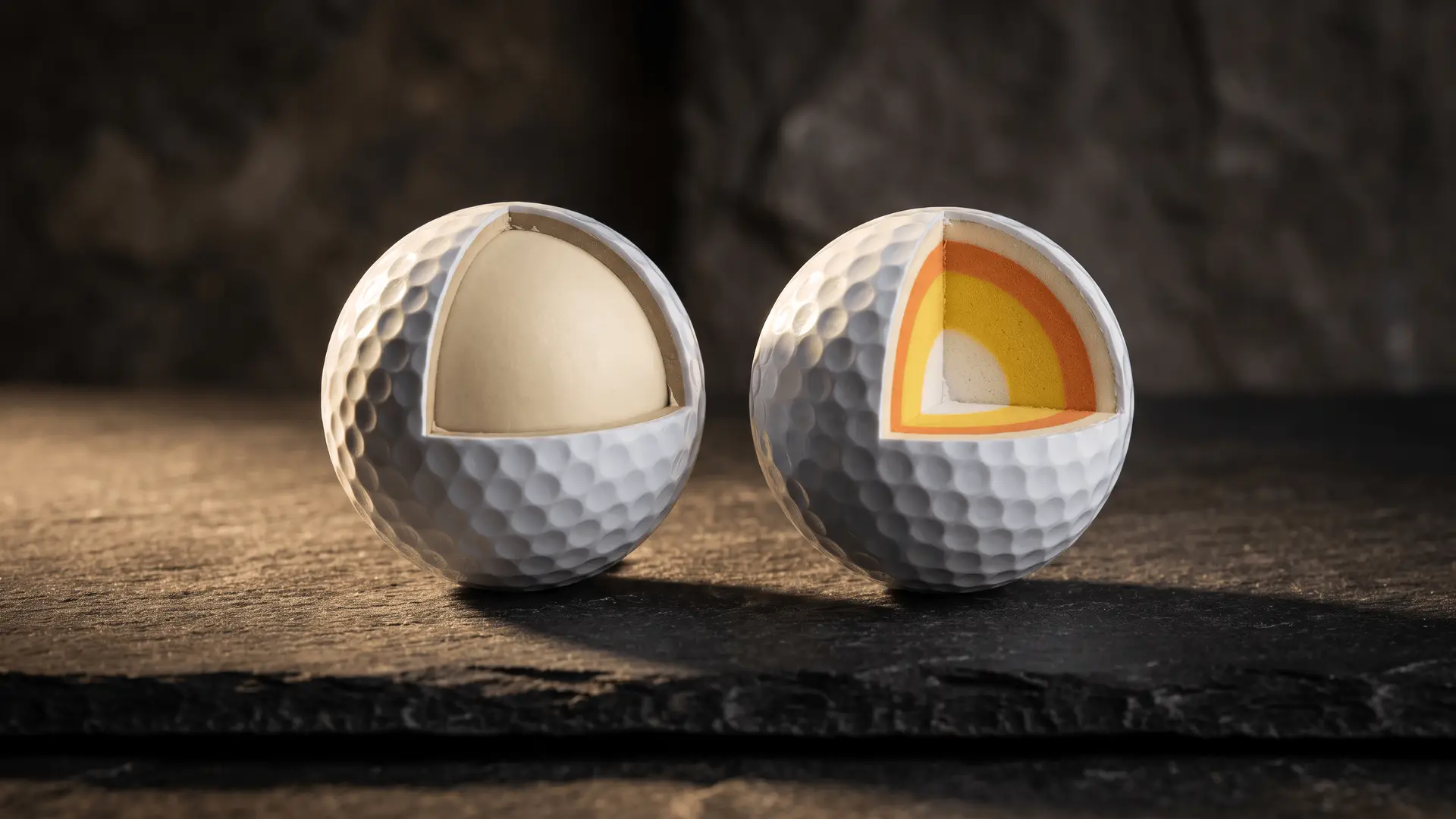
Both balls are 3-piece Titleists built around the same core idea, tuned in opposite directions. MyGolfSpy’s Ball Lab teardown of the AVX found “the same high gradient core technology found in Pro V1 and Pro V1x” — a core that runs soft in the center and progressively firmer toward its edge.
AVX: soft core, TPU cover, 346 dimples
The AVX wraps that gradient core in a thin high-flex casing layer and an injection-molded thermoplastic urethane (TPU) cover, per the same teardown. Titleist’s launch materials describe the current generation’s cover as softer and its 346 quadrilateral dipyramid catenary dimple pattern as the source of its piercing flight. On the gauge it measured an average compression of 81, five points under MyGolfSpy’s database average.
Pro V1: firmer core, cast urethane, 388 dimples
The Pro V1 runs the same architecture eleven points firmer, with a soft cast thermoset urethane cover over 388 tetrahedral dimples. Cast urethane is the more expensive process and the one Titleist reserves for the Pro V1 family. It shows in the lab: MyGolfSpy’s Pro V1 Ball Lab scored it 85 out of 100 and called it the most consistent ball tested to that point, against the AVX’s 76.
What the robot data says off the driver
Titleist tells fitters that distance is a non-factor across the Pro V1, Pro V1x, and AVX, and Today’s Golfer’s robot test — run on a Foresight GCQuad at Loughborough University — agrees:
| Driver @ 114 mph | AVX | Pro V1 |
|---|---|---|
| Backspin | 2,613 rpm | 2,684 rpm |
| Launch angle | 11.1° | 11.1° |
| Carry | 271.1 yds | 273.2 yds |
Identical launch, 71 rpm apart, 2.1 yards to the Pro V1. Golf Insider’s head-to-head at human speeds found the same picture: carry within a yard of identical around 247 yards, with the AVX peaking a yard lower (24 vs 25 yards of height) and rolling out slightly farther on landing.
The flight difference is real even when the carry number isn’t. The AVX held its low billing across every speed Today’s Golfer tested — 2,408, 2,606, and 2,613 rpm at 78, 93, and 114 mph — with a flat 36.4° descent angle. If your drives climb, hang, and fall short of their launch-monitor carry, that window is the fix. If your flight is already flat, the AVX takes away height you need on approach shots.
Irons are where the AVX earns its name
The gap through the bag is bigger than the tee shot suggests. Plugged In Golf’s reviewer measured the AVX spinning about 1,000 rpm less than the Pro V1 with his own mid-irons, and Golf Insider’s testing found roughly 5 extra iron yards at 105 mph. Titleist’s own fitters nickname the AVX the “fountain of youth” because golfers commonly pick up a half to a full club with their irons — a marketing claim, but one the independent numbers lean toward.
That extra iron carry is spin you no longer have when you need it. A 7-iron that spins 1,000 rpm less lands flatter and releases farther, which is a gift on a 15-handicapper’s long approach and a problem when you’re attacking a tucked pin over a bunker.
Greenside spin: the Pro V1’s territory
Inside 50 yards the order flips. Golf Insider’s verdict was direct: the Pro V1 is the better short-game ball for spin inside 50 yards. Both covers are urethane and both stop the ball, and Golf.com’s review credits the current AVX’s thicker, softer cover with better greenside performance than the old one. But the Pro V1 is the two-decade benchmark for a reason, and no AVX generation has matched it there.
The honest framing: the AVX gives up its short-game margin to buy its long-game flight. If you play firm greens where everything releases anyway, that trade costs you little. If you rely on one-hop-stop wedges, it costs you the exact shot you bought a tour ball for.
Feel, cold weather, and the compression gap
Eleven points of compression is the difference you notice without a launch monitor. Golf Monthly calls the AVX the softer-feeling, lower-flying alternative to the Pro V1, and at ~81 it is one of the softest balls in the premium tier — quiet off the putter where the Pro V1 gives a firmer click.
Cold weather splits them cleanly. BallCaddie’s catalog flags the AVX as cold-weather suitable: its softer core keeps compressing at the slower effective speeds cold air and layered clothing produce. The Pro V1’s firmer build turns harsh below about 55°F. A shoulder-season golfer in the Northeast has a real reason to bag the AVX from October to April and switch back in summer. The golf ball compression chart covers why temperature moves soft balls less.
Price per dozen
The AVX runs about $50 a dozen against $57.99 for the Pro V1 — the cheapest urethane ball in Titleist’s premium line, roughly $8 under both Pro V1 models. That gap is recent: a few years ago all three shared one price, and Titleist quietly moved the AVX down. Titleist runs no manufacturer discounts on the Pro V1, so the sticker gap is the real-world gap.
Per ball that’s $4.17 against $4.83. Real money over a season, and still double what a value urethane ball costs — if price is the deciding variable, the best value golf ball guide is the better starting point than either of these.
Which one fits you
Titleist fits these two by launch and spin profile; swing speed barely enters it. Both live in the same 90–105 mph catalog band, so the question is what your ball flight already does.
Play the AVX if:
- Your drives balloon — high launch, high spin, carry that dies into the wind.
- Your irons spin enough that you’re losing a half club of distance.
- You want the softest feel in the premium tier, or you play a lot of cold-weather golf.
- You’d rather pay $50 than $57.99 for a ball you fit better anyway.
Play the Pro V1 if:
- Your flight is already flat and you need height and spin to hold greens.
- Your scoring depends on wedges that stop inside a step of their pitch mark.
- You want the most consistent build in golf — MyGolfSpy’s Ball Lab scored the Pro V1 85 to the AVX’s 76.
- You play fast, firm summer conditions where greenside bite is the whole game.
Play neither if your driver speed sits under about 90 mph — the best golf ball for a slow swing speed guide covers the softer balls that actually fit, at half the price. And if your miss is a slice rather than a balloon, ball spin is not your problem; TrackMan’s club-speed data puts the average male amateur at 94 mph, where either ball compresses fine and face control decides everything.
The honest verdict
These two split a fitting axis the TP5x vs Pro V1 decision never touches. That one is a swing-speed question between two high-spin balls; this one is a spin-profile question between two balls at the same speed. Off the tee the AVX and Pro V1 are 2 yards apart. What you’re choosing is a flight window and a short-game ceiling: the AVX flattens a ballooning long game, adds iron distance, feels softer, and saves $8, while the Pro V1 keeps the greenside spin that made its reputation and the tightest manufacturing tolerances in golf.
Most golfers who balloon the ball have never tried the low-spin half of the premium aisle, and most golfers buying the Pro V1 by default have never checked whether their flight needs it. Fifteen minutes on a launch monitor answers the question this article can only frame.
The BallCaddie fitting quiz scores your flight, feel preference, and budget against the full ball catalog in about 90 seconds — sign up to see your match. It covers both of these, the Titleist Pro V1x (~102) if you need more height than either, and the value alternatives that copy each profile for less.
For deeper dives:
- Golf ball compression chart — where 77 and 87 actually sit on one calibrated scale, and why the gap matters more in the cold.
- How to choose a golf ball for your swing speed — the speed-to-compression framework, for when speed is the deciding axis.
- Titleist AVX review — the single-model deep dive on the robot numbers and the “fountain of youth” iron claim.
- Titleist Pro V1 review — the Ball Lab consistency case and who the benchmark ball actually fits.
- Pro V1 vs Pro V1x — the in-family comparison on the firmer, higher-spin side of the lineup.
- Best low spin golf ball — the full low-spin field if the AVX profile fits but the price doesn’t.
Key takeaways
- Distance is a wash. 2.1 yards of driver carry apart at 114 mph, identical 11.1° launch — Titleist’s “distance is a non-factor” line holds up on the robot.
- The AVX is the flight change: lower peak, less spin at every speed tested, flatter descent, and about 1,000 rpm less mid-iron spin that often converts to 5–7 iron yards.
- The Pro V1 keeps the short game. Better spin inside 50 yards and an 85-vs-76 Ball Lab consistency edge.
- Feel and weather favor the AVX — 10 points softer and the only one of the two suited to cold rounds.
- The AVX costs ~$8 less at ~$50 a dozen, the cheapest urethane ball in Titleist’s premium line.
- Fit by flight, not speed. Same 90–105 mph band; ballooning flight fits the AVX, spin-hungry scoring fits the Pro V1.
Stop guessing your golf ball
Take the 90-second fitting quiz · matched from a 70+ ball catalog · sign up to see your match
Take the quiz →Related posts
Srixon Z-Star vs Titleist Pro V1 — 2025 specs, MyGolfSpy robot-test deltas, and the $3/dozen MSRP gap. Which tour ball fits your game and your wallet?
The Pro V1 Left Dot is a 3-piece urethane Pro V1 variant with a lower, more penetrating flight and reduced long-game spin. Who it fits, who it doesn't.
Titleist Pro V1 vs TaylorMade TP5 — a detailed comparison of construction, spin, trajectory, and which ball fits your swing speed and scoring priorities.
Vice Pro Plus vs Pro V1: the Pro Plus is a firm 4-piece ball that plays closer to the Pro V1x. Compression, spin, price, and which swing speed each one fits.
Frequently asked questions
- Is the Titleist AVX or Pro V1 better?
- Neither wins outright, and Titleist says distance is a non-factor across its tour line — the robot data backs that up at 2.1 yards of driver carry apart. The AVX is the lower-flying, lower-spinning, softer ball at roughly 81 compression and $50 a dozen. The Pro V1 flies a window higher, spins more into greens, and holds a clear short-game edge inside 50 yards at $57.99. Pick by your flight: ballooning drives fit the AVX, maximum stopping power fits the Pro V1.
- What is the difference between the AVX and Pro V1?
- Three things separate them. Compression: the AVX measures about 81 on MyGolfSpy's gauge against 92 for the Pro V1, so it feels noticeably softer. Cover: the Pro V1 uses a cast thermoset urethane cover, while MyGolfSpy's teardown found the AVX wears injection-molded TPU — both urethane, built differently. Flight: the AVX launches low with less spin through the bag, while the Pro V1 flies a mid window with more greenside bite. Price adds a fourth: $50 versus $57.99.
- Does the AVX go farther than the Pro V1?
- Off the tee, no meaningful difference. Today's Golfer's robot test carried the Pro V1 273.2 yards and the AVX 271.1 at 114 mph, and Golf Insider's testing measured nearly identical carry with slightly more AVX rollout. The AVX distance story is in the irons: its lower spin and flatter flight often add carry-plus-rollout there, which is why Titleist fitters nickname it the 'fountain of youth.' Golf Insider's testing found roughly 5 extra iron yards at 105 mph.
- Does the Pro V1 spin more than the AVX?
- Yes, everywhere in the bag. The same robot test measured 2,684 rpm of driver spin for the Pro V1 against 2,613 for the AVX, and the gap widens with shorter clubs — Plugged In Golf measured the AVX spinning about 1,000 rpm less with a mid-iron. Around the green both urethane covers grip, but Golf Insider's head-to-head found the Pro V1 clearly better for spin inside 50 yards. That is the trade the AVX asks you to accept for its flatter, lower-spin long game.
- Is the AVX good for slower swing speeds?
- It tolerates them better than the Pro V1. At roughly 81 compression the AVX core compresses fully at more moderate speeds, and Titleist is explicit that it fits the AVX by launch and spin profile rather than swing speed — a high-launch 88 mph player can fit it well. BallCaddie's catalog places it in the 90–105 mph band, the same as the Pro V1, but the AVX is the more forgiving end of that range and the better cold-weather ball of the two.
- Why is the AVX cheaper than the Pro V1?
- Titleist quietly moved it down. All three premium tour balls shared one price a few years ago; today the AVX lists around $50 a dozen while the Pro V1 and Pro V1x hold at $57.99, and Titleist runs no manufacturer discounts on the Pro V1. The AVX's injection-molded TPU cover is also cheaper to produce than cast thermoset urethane. For a player who fits the AVX's low-spin profile anyway, the $8 gap is a discount on the better-fitting ball.
Stop guessing your golf ball
Take the 90-second fitting quiz · matched from a 70+ ball catalog · sign up to see your match
Take the quiz →