🎯 New here? BallCaddie matches golfers to the right ball. → Take the 90-second quiz
Back to BlogBridgestone Ball Fitting: Honest Review + Brand-Neutral Alternative
Bridgestone pioneered golf ball fitting — Find My Ball, OTTO, and live launch-monitor events. What it does well, and when a brand-neutral fitter wins instead.
Answer a few questions about your swing and BallCaddie matches you against a 70+ ball catalog.
Take the 90-second quizQuick answer
Bridgestone helped invent modern golf ball fitting, and it backs the Find My Ball selector with launch-monitor events, the autonomous OTTO kiosk, and a database it says holds 300,000-plus live fittings. It’s genuinely good — but it only recommends Bridgestone balls, and it leans on the 105 mph swing-speed split as its main lever. Use it to find your best Bridgestone match; run a brand-neutral fitter like BallCaddie to see whether a different brand fits your swing better.
Bridgestone’s whole Tour B line is organized around one number — 105 mph of driver swing speed:
| Tour B ball | Compression | Driver swing speed | Character |
|---|---|---|---|
| Tour B X (~100) | Firm | Over 105 mph | Distance, controlled driver spin |
| Tour B XS (~89) | Firm-mid | Over 105 mph | More greenside spin, softer feel (“Tiger ball”) |
| Tour B RX (~89) | Mid | Under 105 mph | Balanced tour performance |
| Tour B RXS (~72) | Soft | Under 105 mph | Softest urethane, most spin + feel |
Compression values are from the BallCaddie catalog; MyGolfSpy’s gauge reads several points softer on each (more below).
What Bridgestone ball fitting actually is
Bridgestone runs a multi-channel fitting program, and it’s more serious than most brand tools. Three ways in:
- The online Find My Ball selector — a few questions about your game, answered from a phone in minutes, that returns a Bridgestone recommendation. Bridgestone says it draws on a database of more than 300,000 live launch-monitor fittings.
- Live fitting events — a national program that brings a fitter and a launch monitor to courses and shops, where you hit shots and see real ball-flight numbers against your current ball.
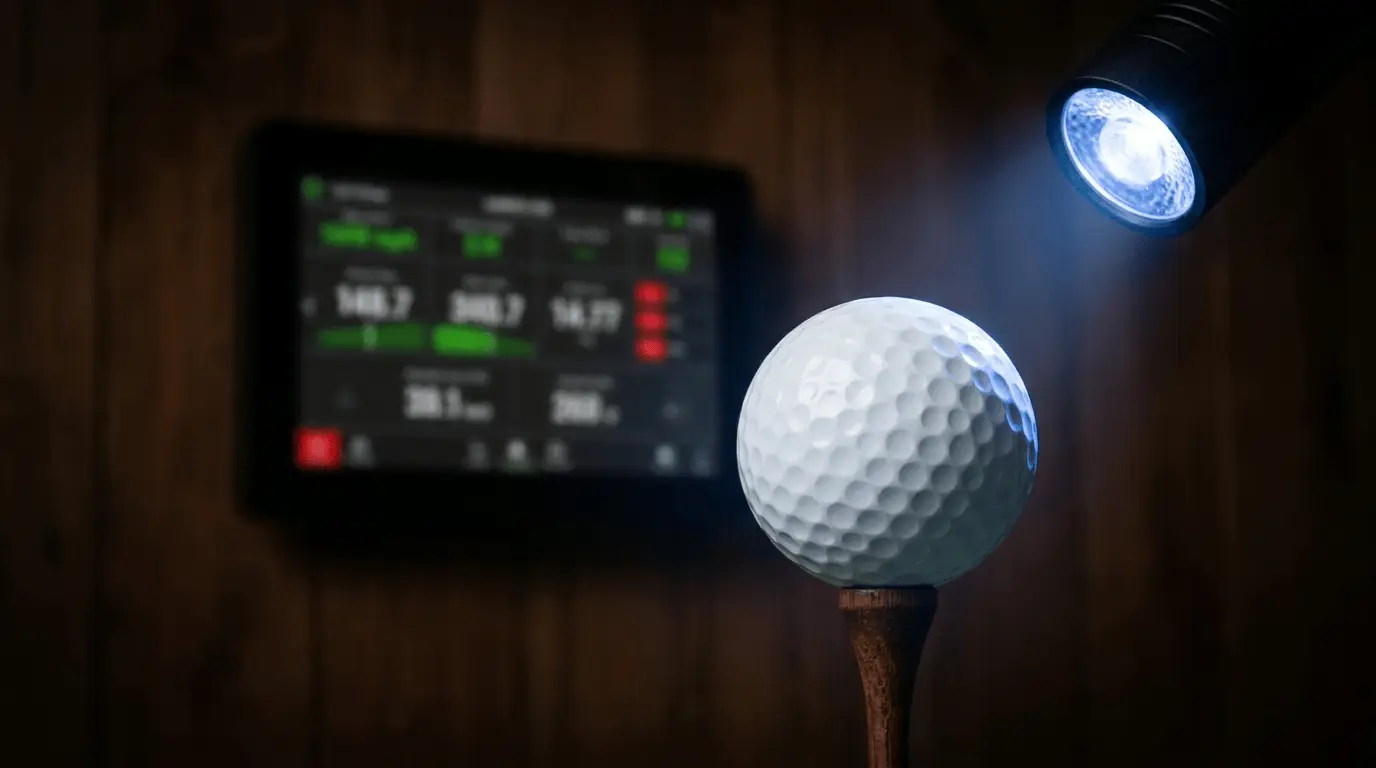
- OTTO — a fully autonomous fitting kiosk that reads three tee shots and recommends a ball on the spot, no fitter required.
Bridgestone leans hard on this data in its marketing, claiming that “millions of ball fittings” show more than 85% of golfers would gain from a ball tuned to their launch conditions. Treat the round numbers as brand claims, but the underlying point holds: ball choice responds to how you deliver the club, and a launch-monitor fitting measures that directly.
The 105 mph rule (and where it bends)
The signature Bridgestone heuristic is a driver swing-speed split at roughly 105 mph. Over 105, you’re pointed at the Tour B X (~100) or Tour B XS (~89); under 105, the Tour B RX (~89) or Tour B RXS (~72). Within each pair, the “S” ball adds greenside spin and softer feel — the swing-speed guide covers why compression tracks speed this way.
Firmer, higher-compression balls like the Tour B X reward a fast swing with ball speed and lower driver spin, but can feel harsh and lose distance for slower players who can’t fully compress them. Softer balls like the RXS compress easily at moderate speed for efficient energy transfer and higher launch, at the cost of some workability for very fast swingers. The 105 mph line is Bridgestone’s chosen boundary between those two regions.
It’s a strong first filter that gets weaker up close. MyGolfSpy, which lab-tested all four Tour B balls, is blunt: “it’s no secret that we’re not fans of compression-based ball fitting.” Swing speed correlates with the right compression, but it misses attack angle, strike quality, and your own feel and spin preferences. A 103 mph swing with a steep, high-spin delivery might play a firmer ball happily; a 107 mph player who loves soft feel might sit on an RX. The golf ball compression chart shows why a single swing-speed number can’t settle the pick alone.
Below the Tour B line: the e-series
Plenty of golfers don’t need a urethane tour ball, and Bridgestone’s fitting routes slower or value-focused players to its Surlyn-covered e-series instead. The three-piece e12 Speed (~80) is the mid-price distance option, part of what Bridgestone calls its Optimal Flight System of launch-tuned models. The two-piece e6 (~45) is the softest and cheapest, aimed at moderate and slower swings that want straight, easy distance over greenside bite.
If the selector points you here, the real question is whether a value urethane ball from another brand would give you more short-game control for similar money — exactly the cross-brand call a one-brand tool can’t make.
What it can’t tell you
Bridgestone’s fitting has the same structural limit as every manufacturer tool: it only knows Bridgestone balls. A 100 mph swinger who wants maximum greenside bite might be a better match for the Titleist Pro V1 (~92) or Srixon Z-Star (~81), but Bridgestone’s selector will return a Tour B RX or RXS, because those are its closest fits.
The compression numbers also read firmer in marketing than on an independent gauge. MyGolfSpy measured the Tour B X at 94, the Tour B XS at 84, the Tour B RX at 79, and the Tour B RXS at 65 — the last being the softest urethane ball they had tested at the time. The BallCaddie catalog lists them a few points higher, which is normal across measurement methods. Compare on relative firmness, not the absolute number.
Side-by-side: Bridgestone ball fitting vs. BallCaddie
| Feature | Bridgestone ball fitting | BallCaddie |
|---|---|---|
| Cost | Free (online, OTTO, live events) | Free quiz; Pro features behind subscription |
| Account required | No | Yes (to view ranked matches) |
| Brands covered | Bridgestone only (~9 models) | 70+ balls across Titleist, Callaway, TaylorMade, Bridgestone, Srixon, Vice, Snell, Cut, Wilson, Mizuno, and more |
| Main fitting input | Swing speed + launch data (in person) | Swing speed, short game, feel, trajectory, and budget |
| Output | Single Bridgestone ball | Top 3 ranked picks with match scores and reasoning |
| Compares vs. other brands | No | Yes — every pick is ranked against the full catalog |
| Launch-monitor data | Yes, at live events / OTTO | No (self-reported inputs) |
At a live event or OTTO kiosk you get measured ball flight, which no self-reported online quiz can match. The limitation is the menu: every recommendation stays inside Bridgestone’s lineup.
When to use which
Use Bridgestone ball fitting when:
- You’re committed to Bridgestone and want the right model within the line.
- You can reach a live fitting or OTTO kiosk and want real launch-monitor numbers.
- You’re deciding between the Tour B X and XS, or the RX and RXS, on spin and feel.
Use BallCaddie when:
- You haven’t settled on a brand.
- You want to know whether a Titleist, Srixon, Callaway, or TaylorMade ball fits your swing better than the Bridgestone the tool suggests.
- You want price-tier flexibility across the full $13–$58 per dozen market — from the Surlyn e6 (~45) up to tour urethane, including value picks like the Kirkland Signature (~95).
- You want ranked picks that weigh swing speed alongside short-game spin, feel, trajectory, and budget.
Use both when:
- You’re seriously shopping. Run the brand-neutral fitting quiz first; if a Bridgestone ball lands in your top 3, use Bridgestone’s fitting — ideally a live one — to confirm the exact model and see the launch numbers. It’s the same pattern as the Srixon golf ball selector: a strong brand tool with a brand-shaped blind spot.
For the full Bridgestone range, the Bridgestone golf balls guide, the Tour B XS review, and the e12 review go deeper on each model.
Key takeaways
- Bridgestone ball fitting is a real, data-heavy program — the free Find My Ball selector, live launch-monitor events, and the OTTO kiosk — but every channel recommends only Bridgestone balls.
- The 105 mph split routes you: Tour B X (~100) / XS (~89) over 105 mph, RX (~89) / RXS (~72) under it, with the “S” ball adding greenside spin.
- MyGolfSpy measured every Tour B ball softer than its marketing compression and warns that swing-speed-only fitting is too blunt on its own.
- A live Bridgestone fitting gives you launch-monitor data an online quiz can’t — its only limit is the one-brand menu.
- For a pick across every brand, a brand-neutral fitting quiz ranks 70+ balls on your full profile, then you can validate any Bridgestone match on Bridgestone’s own tool.
- Compare Bridgestone’s fitting against every other tool — Ballnamic, Club Champion, and the rival brand selectors — in the best online golf ball fitting tools guide.
Stop guessing your golf ball
Take the 90-second fitting quiz · matched from a 70+ ball catalog · sign up to see your match
Take the quiz →Frequently asked questions
- Is Bridgestone ball fitting free?
- Yes. Bridgestone's online [Find My Ball selector](https://www.bridgestonegolf.com/en-us/find-my-ball/ball-selector-tool) is free and takes a few minutes from a phone or computer. Its live launch-monitor fitting events and its autonomous OTTO kiosk — which reads three tee shots and recommends a ball — are also free where a course or shop hosts them. Every channel recommends only Bridgestone balls, so treat the result as the best Bridgestone match, not the best ball overall.
- What is Bridgestone's 105 mph rule?
- Bridgestone splits its four-ball Tour B line at roughly 105 mph of driver swing speed. Players over 105 mph are steered to the firmer Tour B X or Tour B XS; players under 105 mph to the softer Tour B RX or Tour B RXS. Within each pair, the 'S' ball (XS or RXS) adds greenside spin and a softer feel. It's a useful first filter, though MyGolfSpy cautions that swing speed alone is a blunt fitting input.
- Which Bridgestone ball is best for a slower swing speed?
- For driver speeds under about 105 mph, Bridgestone points you to the urethane Tour B RX (~89 compression) for balanced tour performance, or the Tour B RXS (~72) — the softest urethane ball MyGolfSpy has tested — if you want more spin and a softer feel. If you'd rather save money or need help getting the ball airborne, the Surlyn-covered e12 (~55) and e6 (~45) are the value picks.
- Does Bridgestone's fitting ever recommend a non-Bridgestone ball?
- No. Bridgestone's online selector, OTTO kiosk, and live fitting events all recommend only Bridgestone balls. Even if a Titleist Pro V1 or Srixon Z-Star fit your swing better, the tool surfaces the closest Bridgestone model. That's the trade-off of any manufacturer-built fitter — the launch-monitor data may be excellent, but the menu is one brand deep.
- Bridgestone Tour B X vs XS — which is right for me?
- Both are built for driver speeds over 105 mph. The Tour B X (~100 compression) is the firmer, longer ball with more controlled driver spin — the all-purpose choice for fast swingers who want distance. The Tour B XS (~89), the 'Tiger ball,' trades a little of that for higher greenside spin and a softer feel. Pick the X for distance and control, the XS if short-game spin is your priority.
- Why use BallCaddie instead of Bridgestone's fitting?
- Use BallCaddie when you want the best ball across every major brand for your swing and priorities, Bridgestone included. BallCaddie scores 70+ balls (Bridgestone, Titleist, Callaway, TaylorMade, Srixon, Vice, Snell, Cut, Wilson, Mizuno, and more) on the same criteria and returns ranked matches with reasoning. If a Bridgestone ball is genuinely your best fit, both tools agree. If another brand fits better, only the brand-neutral tool will say so.
Stop guessing your golf ball
Take the 90-second fitting quiz · matched from a 70+ ball catalog · sign up to see your match
Take the quiz →