🎯 New here? BallCaddie matches golfers to the right ball. → Take the 90-second quiz
Back to BlogOnCore Golf Balls: The Complete Lineup and Buyer's Guide (2026)
Every OnCore golf ball by swing speed, spin, and price: where the VERO XP1, X2, X1, ELIXR, and AVANT 55 fit your game, and what the quality data says.
Answer a few questions about your swing and BallCaddie matches you against a 70+ ball catalog.
Take the 90-second quizQuick answer
OnCore sells five balls built around one idea: push mass toward the outside of the ball. The tour tier runs the VERO X2 (95 compression, $40) and VERO X1 (85, $40), with the newer VERO XP1 (85, $44.99) on top. The ELIXR (~84) is the value-urethane pick at $30, about half a Pro V1. The 2-piece AVANT 55 anchors the bottom at $20. Independent spin numbers land close to tour balls; the manufacturing consistency data is the weak spot.
OnCore golf ball lineup at a glance
| Model | Cover | Compression | Layers | Best for | MSRP/dozen |
|---|---|---|---|---|---|
| OnCore VERO XP1 | Cast urethane | 85 | 3 | 95–105 mph, highest-MOI build | $44.99 |
| OnCore VERO X2 | Cast urethane | 95 | 4 | 105+ mph, firm feel, max greenside grab | $40 |
| OnCore VERO X1 | Cast urethane | 85 | 4 | 90–105 mph, softer tour feel | $40 |
| OnCore ELIXR | Urethane | ~84 (mid) | 3 | 90–105 mph, value tour ball | $30 |
| OnCore AVANT 55 | Surlyn blend | 55 | 2 | Under 90 mph, soft feel, straight flight | $20 |
Only the ELIXR is fitted in BallCaddie’s ball catalog, so its ~84 compression and $30 MSRP come from our own data. The other four numbers come from OnCore’s product pages, and none of them has been checked on an independent compression gauge — a distinction that matters more here than with the majors, and one this guide comes back to.
What OnCore is actually selling
Every OnCore ball is an argument about where the weight should sit. Move mass out of the center and toward the cover, the theory goes, and you raise the ball’s moment of inertia, which slows the rate at which it spins down off the driver and stabilizes flight.
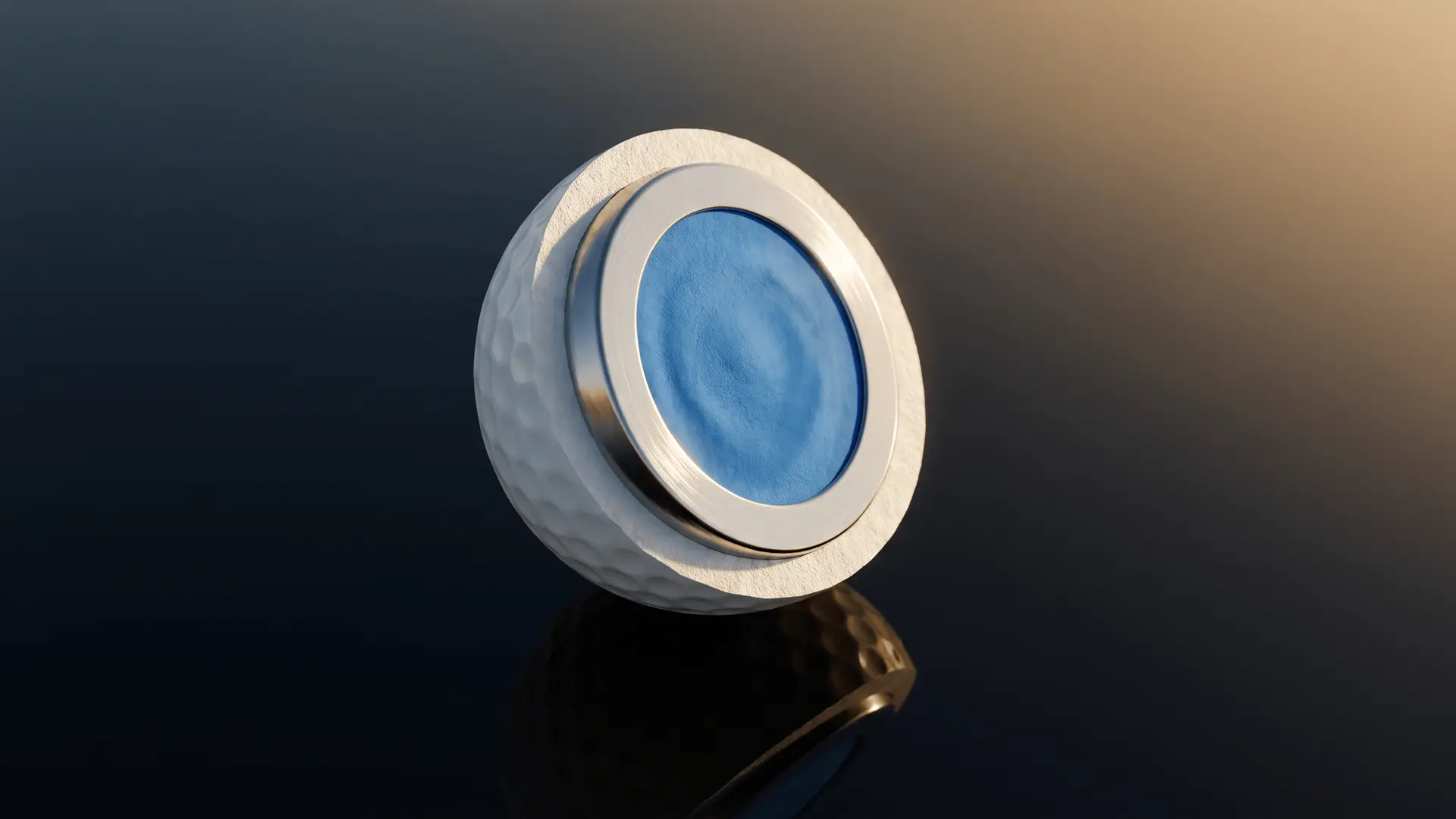
The company took that idea further than anyone else has. In 2013 the USGA advised that a rigid core no larger than 0.9 inch could be permitted, and OnCore’s EVO prototype went onto the conforming list that November — the ruling was reported at the time as the approval of a hollow-metal-core golf ball. The MA 1.0 shipped in January 2014 with a hollow steel sphere roughly 0.9 inch across at its center, which Golf Digest covered as the hard-core ball that had just been declared legal. The Caliber followed in 2016.
Both are gone. What survived is the objective, executed through the mantle: the VERO X1 and X2 wrap a conventional core in a metal-infused mantle layer, and the newer VERO XP1 uses a metal-injection-molded mantle that OnCore says raises MOI by 25 percent. The ELIXR does it with a perimeter-weighted polymer mantle and no metal at all.
Worth knowing if you’ve read old coverage: the AVANT was never the metal-core ball. That lineage was MA 1.0 into Caliber, and it ended a decade ago.
How to pick an OnCore ball by swing speed
Swing speed is the first filter because compression decides how much of your energy the ball actually returns. OnCore’s five balls sort cleanly across three bands:
- Under 90 mph: the AVANT 55 at 55 compression is a 2-piece Surlyn-blend ball built to compress easily and fly straight. It’s the only non-urethane ball OnCore makes, so it trades greenside bite for $20 pricing and durability.
- 90–105 mph: the ELIXR (~84) and the VERO X1 (85) sit within a point of each other on paper and $10 apart on price. This is where TrackMan’s amateur data puts the average male driver, near 94 mph, so it’s where most golfers reading this belong.
- 105+ mph: the VERO X2 (95) is the firmest thing OnCore sells, aimed at players who can load a tour-compression core.
The VERO XP1 complicates that a little. It carries the same 85 rating as the X1 but the highest-MOI construction in the line at the highest price, which makes it a fast-swinger’s ball on paper and a mid-speed ball by compression. Absent independent gauge testing, treat OnCore’s 85 as the better guide and the MOI claim as the reason for the $5 premium.
Don’t know your number? The swing-speed fitting framework covers how to measure it without a launch monitor, and the golf ball compression chart plots the wider market on one calibrated gauge.
The VERO tour balls
Three balls, two compressions, a $5 spread. The VERO line is where OnCore competes directly with the Pro V1 shelf, at roughly $18 less per dozen.
VERO X1: the softer tour ball
The X1 is a 4-piece cast-urethane build at 85 compression. Plugged In Golf’s review recorded just over 1,900 rpm of driver spin for their roughly 85 mph tester at a 1.50 smash factor, with excellent drop-and-stop spin on full wedges. Their faster tester found driver spin average for the category rather than exceptionally low, which is a useful correction to the marketing: high MOI is a spin-decay argument, not a low-spin guarantee.
Golf Monthly’s review put the feel close to a Pro V1x on long shots, with a slightly more metallic click, and flagged one honest limitation — lower-flighted drives sometimes lost lift earlier than their comparison balls.
VERO X2: the firm one
The X2 is the same 4-piece architecture with the core firmed to 95. Golf Monthly measured it against a Pro V1x and published the numbers most useful for a fitting decision: 2,243 rpm and 282 yards of carry off the driver for the X2, against 1,986 rpm and 291 yards for the Pro V1x. On wedges the X2 produced 6,895 rpm, about 200 rpm above the previous VERO generation and about 200 rpm below the Pro V1x.
Read that honestly. The X2 spun more and carried nine yards shorter than the Titleist Pro V1x (~102) in that test, and landed within about 3 percent of it on wedge spin, for $18 less per dozen. Whether that trade is good depends entirely on whether nine yards of carry or $18 matters more to your golf.
VERO XP1: the newest and priciest
The XP1 is the 2025–26 release: 3-piece, an NRG core, a dense MIM mantle, and a 0.035-inch cast-urethane cover at $44.99. It’s the only OnCore ball priced within $13 of a Pro V1. No independent review with published launch-monitor numbers exists for it yet, so the MOI claim is currently OnCore’s word. A VERO XP2 has been announced but isn’t on sale.
The ELIXR: the OnCore ball we actually fit
The OnCore ELIXR (~84) is the only OnCore in BallCaddie’s fitting catalog, and for most golfers it’s the right one anyway. It’s a 3-piece urethane ball at $30 — roughly half a Pro V1 — built on a polybutadiene core with a perimeter-weighted polymer mantle.
The performance case is solid. Plugged In Golf’s review of the enhanced generation measured driver spin less than 5 percent below their average tour ball, with half- and full-wedge spin within a few hundred rpm of premium alternatives, and described a premium putter feel with a soft, almost squishy sensation on full wedges. Golf Monthly’s take singled out long-game distance and cover durability, with slightly more rollout than comparison balls on partial wedges.
One generational note before you buy. OnCore’s own product page says the enhanced white ELIXR uses the newer polybutadiene core and a 350-dimple cover, while some yellow and green inventory is still built on the original foundation. The reviews above are of the newer ball.
Our catalog also rates the ELIXR as cold-weather friendly. An 84-compression core holds feel and carry below 60°F better than the 95-compression X2 will, which makes it the OnCore to keep in the bag through shoulder season.
What the quality data actually says
This is the part most brand guides skip, and it’s the one OnCore fact worth knowing before you order six dozen.
MyGolfSpy’s Ball Lab teardown of the original ELIXR cut apart a 36-ball sample and found real inconsistency: about 14 percent had unacceptable layer concentricity, another 42 percent showed lesser cover and mantle thickness variation, compression across the sample spanned nearly 14 points, and two visibly different core-material mixes turned up in the same batch. Their defect-adjusted True Price came to $42 against a $35 MSRP — 20 percent over retail. That works back to a 16.7 percent reject rate, or about six unusable balls in every three dozen you pay for. Average measured compression was 78, well under the printed number.
Three caveats keep that from being the whole story. The teardown covers the original ELIXR. MyGolfSpy later reported that the enhanced 350-dimple ELIXR moved production to Launch Technologies from Foremost in Taiwan, so a different factory builds the current ball. And every ball in the sample passed the roundness test and came in under the USGA’s 1.620-ounce weight limit, which makes these consistency findings rather than conformance failures.
Still, no OnCore ball has been re-tested since. Compare that to the Wilson Staff Model, whose Ball Lab True Price came in just six percent above retail, and the gap is the honest reason a $30 ELIXR isn’t automatically a better buy than a ~$15 Kirkland Signature V3 (~95). Our fuller read on how much the factory decides is in golf ball brands, ranked.
Buffalo, investors, and the GENiUS ball
OnCore was founded in Buffalo, New York in November 2011 by Bret Blakely and Steve Coulton, and still runs from downtown Buffalo. It sells primarily direct, which is how the pricing works — as its own company profile puts it, skipping conventional pro-shop distribution is what funds the gap against major-brand premium prices.
The investor roster is unusually athletic: Charles Schwab came in during 2018, and the shareholder group has included Josh Allen, Ezekiel Elliott, Gary Player, and Thomas Pieters. One correction worth making, because it circulates: Ernie Els is not an OnCore investor. His documented golf-tech investment was in 18Birdies.
On the tour side, OnCore was the official ball of the 2023 APGA Tour, supported PGA and Korn Ferry player Erik Compton with the VERO X1, and the X1 became the official ball of the professional Putt Tour in 2024. That’s real validation at a level below the majors, and it’s the honest ceiling of the claim — none of it establishes PGA Tour ball counts.
Then there’s GENiUS. Announced in 2017 as a GPS-equipped ball that would report location, speed, flight, and spin, it became the i-Roll sensor putting ball by 2023 — OnCore’s own explanation being that onboard sensors plus Bluetooth removed the need for GPS, and that a metal shell would have blocked the signal anyway. Nine years on, OnCore’s technology page still lists the tee-to-green version as coming soon. It’s a roadmap item. Don’t factor it into a purchase.
Is OnCore worth it?
For the 90–105 mph golfer who wants urethane and doesn’t want to pay $57.99, yes — the ELIXR at $30 is the pick, and the numbers behind it are close enough to premium balls that the gap won’t show up in your scores. The VERO X1 at $40 buys a fourth layer and a slightly firmer feel; whether that’s worth $10 is a feel question, not a performance one.
The honest mismatches:
- You swing under 100 mph and grabbed the VERO X2. The 95 core needs speed you don’t have. The ELIXR or X1 at 84–85 will give you more back.
- You’re shopping purely on price. The ~$15 Kirkland Signature V3 is urethane too, and undercuts the ELIXR by $15. Its build consistency is better documented, though the record is uneven: earlier versions varied badly dozen to dozen, while MyGolfSpy’s July 2026 Ball Lab report on the yellow V3.0 scored 84, a grade B, with zero defects across 36 balls. The best value golf ball guide runs that cross-shop properly.
- You need documented lot-to-lot consistency. The only independent teardown OnCore has is a poor one on a superseded ball from a factory it no longer uses. That’s not damning, but it isn’t reassurance either.
- You want the metal-core ball. It’s been discontinued since 2016. The current balls put the metal in the mantle.
On conformance: OnCore’s current balls are standard conforming products, but before a competition the safe move is checking your exact model against the current USGA and R&A conforming list rather than trusting a brand page.
The next step
This guide narrows OnCore to the one ball that fits your swing and budget. To pressure-test that against the wider market, take the BallCaddie fitting quiz — it scores the ELIXR alongside the rest of the catalog on swing speed, typical miss, greenside priority, and budget. The quiz runs about 90 seconds, and sign-in is required to see your full match, ranked with no affiliate tilt toward the pricier ball.
For deeper dives on the inputs this guide leans on:
- How to choose a golf ball for your swing speed — the compression-to-speed framework that sorts the whole OnCore lineup.
- Golf ball compression chart — where every ball lands on a calibrated gauge, by swing-speed tier.
- Best value golf ball — the cross-brand value shelf the ELIXR competes on, Kirkland included.
- Golf ball brands, ranked — which contract factories build which value-tier balls, and why that decides consistency.
- Urethane vs. ionomer golf balls — the cover-material wall that splits the AVANT 55 from the rest of the OnCore line.
- Vice golf balls: the complete lineup — the other direct-to-consumer brand built in the same Taiwanese factory.
Key takeaways
- Five balls, one thesis: perimeter weighting, now delivered through metal-infused and MIM mantles rather than the discontinued hollow steel core.
- The ELIXR (~84, $30) is the pick for most golfers — roughly half a Pro V1’s price, with Plugged In Golf measuring driver spin under 5 percent below their average tour ball.
- The VERO X2 traded nine yards of carry for $18 against a Pro V1x in Golf Monthly’s test, at 2,243 rpm versus 1,986 rpm off the driver.
- The quality data is OnCore’s weak spot: MyGolfSpy’s Ball Lab put the original ELIXR’s True Price at $42 against a $35 MSRP, 20 percent over retail.
- The metal core is history — MA 1.0 in 2014, Caliber in 2016, both discontinued.
- GENiUS is still coming soon nine years after announcement. Buy the ball in front of you, not the roadmap.
Stop guessing your golf ball
Take the 90-second fitting quiz · matched from a 70+ ball catalog · sign up to see your match
Take the quiz →Related posts
Every Maxfli golf ball ranked by swing speed, spin, and price: where the Tour, Tour S, Tour X, and SoftFli fit your game, and how they undercut the Pro V1.
Every Callaway golf ball ranked by swing speed, spin, and price: where the Chrome Tour, Chrome Tour X, Chrome Soft, ERC Soft, and Supersoft fit your game.
Every TaylorMade golf ball ranked by swing speed, spin, and price: where the TP5, TP5x, Tour Response, Distance+, and SpeedSoft fit, and which one your game needs.
Every Titleist golf ball ranked by swing speed, spin, and price: where the Pro V1, Pro V1x, AVX, Tour Soft, and TruFeel fit, and which one your game needs.
Frequently asked questions
- Are OnCore golf balls any good?
- The performance data says yes, the quality data says check your dozen. Golf Monthly measured the VERO X2 at 6,895 rpm on wedges, roughly 200 rpm under a Pro V1x, and Plugged In Golf found the ELIXR's full-wedge spin within a few hundred rpm of premium tour balls. The caveat comes from MyGolfSpy's Ball Lab teardown of the original ELIXR, which calculated a defect-adjusted True Price of $42 against a $35 MSRP — 20 percent over retail, driven by concentricity problems in about 14 percent of the sample.
- What is the difference between the OnCore VERO X1 and VERO X2?
- Compression, and that's mostly it. Both are 4-piece cast-urethane balls at $40 a dozen with the same metal-infused mantle. OnCore rates the X1 at 85 and the X2 at 95, so the X1 suits the 90–105 mph band and the X2 wants 105 mph and up. Plugged In Golf described the X2 as markedly firmer than the ELIXR with strong greenside response; Golf Monthly called it the firmest OnCore they tested. Pick by swing speed, not by model number.
- Do OnCore golf balls still have a metal core?
- No. The hollow-steel-core lineage ran from the MA 1.0 in 2014 through the Caliber in 2016, and both are discontinued. Current OnCore balls chase the same perimeter-weighting goal through the mantle instead: the VERO X1 and X2 use a metal-infused mantle layer, and the VERO XP1 uses a dense metal-injection-molded mantle that OnCore says raises moment of inertia by 25 percent. The ELIXR uses a proprietary polymer mantle with no metal at all.
- Is the OnCore ELIXR worth it compared to a Pro V1?
- It's about half the price for most of the performance, which is the whole direct-to-consumer pitch. The ELIXR lists at $30 a dozen against the Titleist Pro V1's $57.99. Plugged In Golf measured the enhanced ELIXR's driver spin under 5 percent below their average tour ball, with half- and full-wedge spin within a few hundred rpm of premium balls. What you give up is manufacturing consistency documented at the older generation, and the tour validation Titleist has and OnCore doesn't.
- What swing speed do you need for an OnCore VERO X2?
- About 105 mph and up. The X2's 95 compression is the firmest core OnCore sells, and a firm core you can't fully load hands back less ball speed than a softer one. TrackMan's amateur data puts the average male driver near 94 mph, which sits below the X2's window and inside the ELIXR and VERO X1 band at 84 and 85 compression. If you're under 100 mph and reaching for the X2 because it's the tour ball, that's the mistake worth avoiding.
- Where are OnCore golf balls made?
- Taiwan, mostly, through contract manufacturers rather than an in-house plant. MyGolfSpy identified Foremost in Taiwan as the factory for the original ELIXR and both VERO models, and reported that the enhanced 350-dimple ELIXR moved to Launch Technologies. Foremost also builds urethane balls for Vice and Maxfli, which is part of why the value-tier urethane balls perform so similarly. OnCore designs and specs the balls from Buffalo, New York; it doesn't mold them.
- What happened to the OnCore GENiUS ball?
- It's still in development, nine years after the concept went public in 2017. The original pitch was a GPS-equipped ball reporting location, speed, flight, and spin. By 2023 that had become the i-Roll putting ball using onboard sensors and Bluetooth instead of GPS, partly because a metal shell blocks GPS signal. OnCore's technology page still lists the tee-to-green version as coming soon, and no consumer purchase listing exists. Treat it as a roadmap item, not a ball you can buy.
Stop guessing your golf ball
Take the 90-second fitting quiz · matched from a 70+ ball catalog · sign up to see your match
Take the quiz →