🎯 New here? BallCaddie matches golfers to the right ball. → Take the 90-second quiz
Back to BlogBridgestone Tour B X vs XS vs RX vs RXS: Which One Actually Fits You?
Bridgestone Tour B X, XS, RX and RXS compared on gauge-measured compression and 2026 robot data, and why the 105 mph split sends most golfers to the wrong ball.
Answer a few questions about your swing and BallCaddie matches you against a 70+ ball catalog.
Take the 90-second quizQuick answer
Bridgestone sells the Tour B X and XS for swings over 105 mph and the RX and RXS for under 105 mph, then splits each pair into distance (X, RX) and spin (XS, RXS). All four cost $54.99. The speed split is real off the driver at high speed and unreliable everywhere else — gauge testing puts the “slow” RX firmer than the “fast” XS. Most amateurs swing ~94 mph and belong in the RX or RXS.
The Tour B lineup at a glance
| Ball | Compression | Bridgestone sells it for | Its job | 2026 robot standout |
|---|---|---|---|---|
| Bridgestone Tour B X (~100) | Firmest | Over 105 mph | Distance | Top Pick, high speed — 288.8 yd carry |
| Bridgestone Tour B XS (~89) | Mid | Over 105 mph | Spin | Among the shortest at 65 mph |
| Bridgestone Tour B RX (~89) | Mid | Under 105 mph | Distance | Longest 7-iron at high speed |
| Bridgestone Tour B RXS (~72) | Softest | Under 105 mph | Spin | Top-tier greenside spin, lowest driver spin |
Compression values are from the BallCaddie catalog. Every robot figure below is MyGolfSpy’s measurement, not ours.
The two questions Bridgestone asks you
The lineup is a 2x2, and Bridgestone’s own product pages say so in plain language. The first axis is speed. The Tour B X is “higher compression for swing speeds OVER 105 mph.” The Tour B RX is “low compression for swing speeds UNDER 105 MPH.”
The second axis is what you want back. The X and RX are “designed for players who want additional distance.” The XS and RXS are “designed for players who want additional spin.” The S is the spin letter, in both halves.
That gives you four boxes: fast-and-long (X), fast-and-spinny (XS), moderate-and-long (RX), moderate-and-spinny (RXS). All four share the same construction — a 3-piece urethane ball with the REACTIV X cover system and a gradational core, at $54.99 a dozen. For 2026 Bridgestone replaced the internal recipe with a core-and-mantle package it calls VeloSurge, announced ahead of the January 30, 2026 retail date.
The second question is a genuine preference. The first one is where most buyers get sorted into the wrong ball.
Why the 105 mph line misfits most golfers
TrackMan’s amateur data puts the average male driver swing at 93–94 mph, and most recreational women well under 90. Bridgestone’s dividing line sits more than 10 mph above the typical buyer.
Read the shelf the way the marketing reads and a 94 mph golfer walks past the RX and RXS — the two balls built for them — and reaches for the X or XS, because those are the ones the tour bags and the Tiger Woods quote sit next to. The mechanics of why a firmer ball costs a moderate swing are in the swing-speed pillar, how to choose the right golf ball for your swing speed.
The split has a second problem. It does not describe the balls.
What the compression gauge says
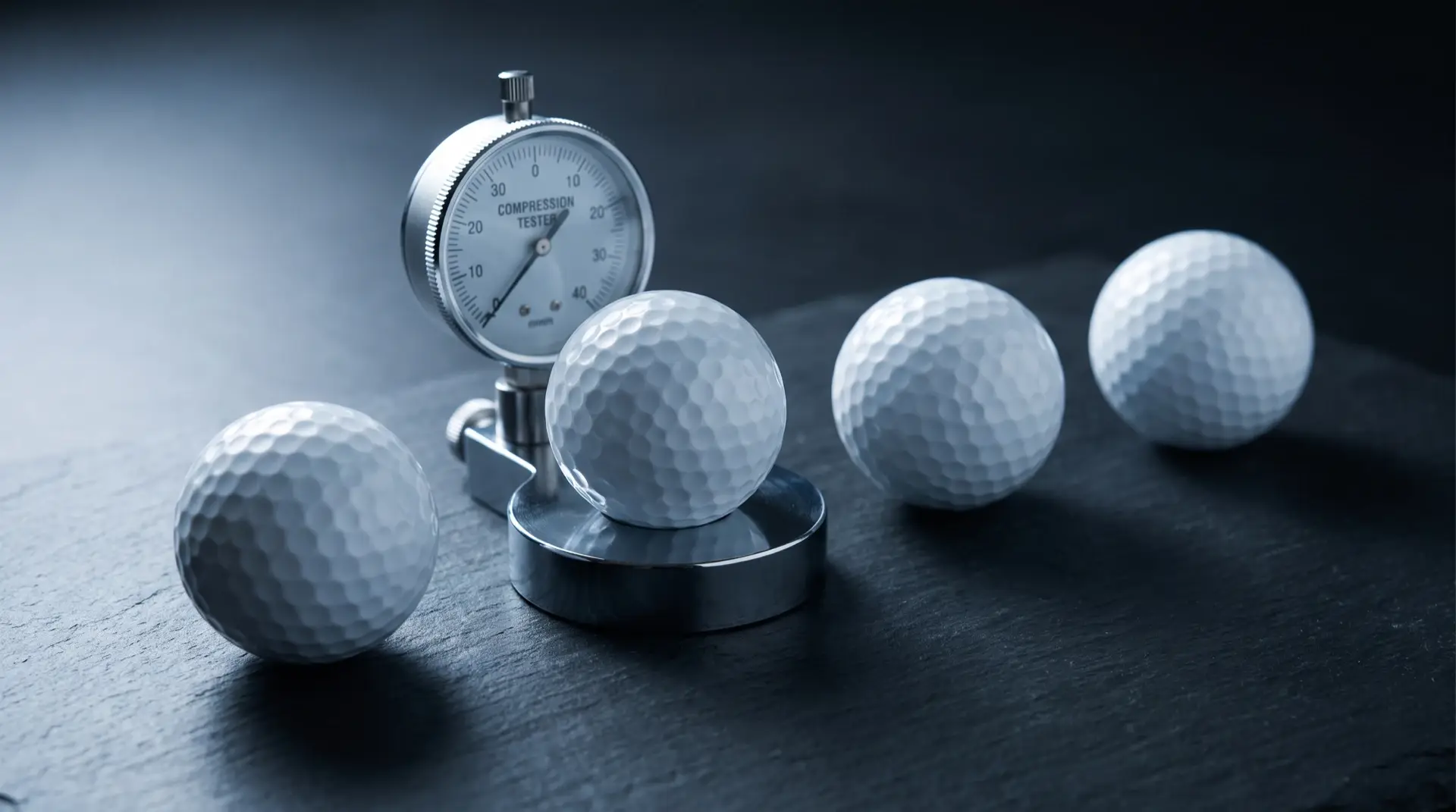
Plugged In Golf ran all four models across a Rimac gauge for its 2026 Tour B review and published the averages:
| Ball | Measured compression | Range | Balls tested |
|---|---|---|---|
| Tour B X | 96.17 | 91–101 | 36 |
| Tour B XS | 83.17 | 77–88 | 36 |
| Tour B RX | 84.58 | 81–91 | 12 |
| Tour B RXS | 70.58 | 68–73 | 12 |
The RX measured firmer than the XS. Bridgestone markets the RX as “low compression” for slower swings and the XS as “higher compression” for faster ones, and on a calibrated gauge the order reverses. Our catalog lands in the same place from a different measurement, listing both at ~89.
The practical read: this is a lineup with one firm ball (X), one truly soft ball (RXS), and two nearly identical mid-compression balls in the middle wearing labels that suggest otherwise. What separates the RX from the XS is spin. If you want the full cross-brand picture, the golf ball compression chart puts every ball on one gauge.
What the robot says
MyGolfSpy’s 2026 test ran 48 balls through a robot at three swing speeds with a driver and a 7-iron, plus a separate greenside wedge test, with no manufacturer funding. All four Tour B models were in the field.
High swing speed, driver: the X earns its label
| Ball | Ball speed | Spin | Carry | Total |
|---|---|---|---|---|
| Tour B X ★ | 168.7 mph | 2,346 rpm | 288.8 yd | 320.7 yd |
| Tour B XS | 168.0 mph | 2,377 rpm | 283.9 yd | 313.4 yd |
| Tour B RX | 167.7 mph | 2,326 rpm | 277.9 yd | 309.9 yd |
| Tour B RXS | 166.7 mph | 2,180 rpm | 276.2 yd | 310.4 yd |
The Tour B X took a Top Pick at high swing speed and carried about 11 yards past the RX. Above 105 mph, off a driver, Bridgestone’s split holds up — this is the one place the marketing and the measurement agree.
Two mph of ball speed separated the four balls, and 12.6 yards of carry separated them. Spin and descent angle did the work: the X came down at 29.4 degrees, the flattest of the family, while the XS landed at 31.8.
High swing speed, irons: the label inverts
Off a 7-iron the picture flips completely. MyGolfSpy’s own summary is worth quoting: “The longest 7-iron we measured at high speed, Bridgestone’s Tour B RX, ranked 43rd out of 48” for ball speed.
The ball Bridgestone sells for under-105 swings hit the longest iron shot in a 48-ball field at high swing speed, while sitting near the bottom of that field for iron ball speed. Across the whole test about 1.5 mph separated the fastest ball from the slowest off the 7-iron, against more than 10 yards between longest and shortest. Iron distance is governed by spin, and the RX keeps iron spin down while flying low — MyGolfSpy called it “the interesting one here, flying low while still sneaking into the top group for distance.”
Low swing speed: the XS runs out of road
At 65 mph of club speed the Tour B XS was among the shortest balls in the entire test. MyGolfSpy’s explanation is that the leaders at that speed were nearly all below-average spinners, and “at 65 mph of club speed, there isn’t enough speed to carry high spin.”
The RX went the other way, flying above average and finishing inside the top 11 for distance. A slow swing on the XS gives away yards in a way no amount of cover technology recovers.
Around the green: the RXS is the spin ball
In the 35-yard greenside test the Tour B RXS sat just behind the Chrome Tour X, Pro V1x and Z-Star Diamond — the only three balls to clear 5,900 rpm. That puts it in the top handful of 48 for wedge spin.
The same ball was among the lowest-spinning in the field off the driver, and MyGolfSpy repeatedly grouped it with the low-spin urethane exceptions. Low spin off the tee and high spin off the wedge is the combination every ball claims and few deliver.
The four balls, one at a time
Bridgestone Tour B X — the fast-swing distance ball
The Tour B X (~100) is the firmest ball in the family and the only one that measured clearly apart from the rest at 96.17 on the Rimac gauge. It won its bracket in 2026: Top Pick at high swing speed, 288.8 yards of carry, the flattest descent of the four.
Buy it if you actually swing over 105 mph and want the longest tee shot in the line. Skip it below about 100 mph, where the compression stops paying back. Bridgestone’s product page names Tiger Woods, Jason Day, Chris Gotterup, Kurt Kitayama, Harry Hall and Matt Kuchar as Tour B X players.
Bridgestone Tour B XS — the fast-swing spin ball
The Tour B XS (~89) is the softest of the two balls Bridgestone sells above 105 mph, and at 83.17 measured it is softer than the RX beneath it. That softness is why it stretches down into the mid-90s better than its label suggests, which is the case the full Tour B XS review makes in detail.
Its weakness is speed dependence. It spins above average, and at 65 mph that spin turns into lost distance. Play it if you swing hard and want more spin than the X gives you.
Bridgestone Tour B RX — the quiet iron performer
The Tour B RX (~89) is Bridgestone’s top-selling Tour B model, and the 2026 iron data explains why people keep buying it. Longest 7-iron at high swing speed, top-11 distance at low swing speed, above-average flight at slow speeds and a low flight at fast ones.
It is the most speed-tolerant ball of the four. If you play a lot of approach shots and your swing sits anywhere from the mid-80s to the low 100s, this is the safest pick in the family. Bridgestone lists Fred Couples as playing it in competition.
Bridgestone Tour B RXS — the ball most amateurs should try first
The Tour B RXS (~72) is the one soft ball here, measured at 70.58, and it is the one the robot data flatters most for a typical amateur. Top-tier greenside spin, the lowest driver spin of the four, and a low, controlled flight.
It gives up about 12 yards of carry to the X at high swing speed. At 94 mph that gap narrows considerably, and what you get back is wedge spin you can use on every approach. For a mid-handicap golfer at average swing speed, this is the Tour B that fits.
The mistakes that cost the most strokes
Buying by the 105 mph number alone. It is Bridgestone’s marketing split, and the gauge data does not follow it. Measure your speed first — a launch monitor session runs $75–$150, or estimate from carry distance × 0.55.
Assuming the S models are the soft ones. The S means spin. The XS at ~89 is not a soft ball, and buying it for feel at a moderate swing speed costs distance at exactly the speeds where distance is scarcest.
Reading the tour bags. Bridgestone puts Tiger Woods on the X and Fred Couples on the RX. Both are professionals with swing speeds most readers do not have, and a staffer’s ball tells you nothing about yours.
Paying $54.99 for spin you never use. The XS and RXS earn their price on wedge shots. If you convert few up-and-downs, the extra greenside spin is not returning strokes, and the Bridgestone e-series covers the same swing speeds for less.
So which one do you buy?
Answer two questions in order.
- What is your driver swing speed? Over 105 mph, look at the X and XS. Under 105, look at the RX and RXS. If you are between about 95 and 105, the XS and RX both measure near ~89 and either works — pick on the second question.
- Distance or greenside spin? Distance takes you to the X or RX. Spin takes you to the XS or RXS.
For the average male amateur at roughly 94 mph, that lands on the RX if you want the tee shot and the iron, or the RXS if you want the wedge. Those two are the honest answer for most people reading this, and they are the two the shelf pushes you past.
At $54.99 all four cost the same, which makes this purely a fitting question. The Titleist Pro V1 (~92) sits a few dollars above the whole line if you want the cross-brand comparison.
The next step
Swing speed sorts you into a half of this lineup, and spin preference picks the ball inside it. Both are things a fitting can answer in about 90 seconds.
Take the BallCaddie fitting quiz — it scores your speed, spin profile, feel preference and budget against the full catalog and names the ball that fits, Bridgestone or otherwise. Sign up to see your match. Or browse the ball catalog and compare the Tour B models against every other urethane option directly.
For deeper dives
- How to choose a golf ball for your swing speed — the pillar behind the 105 mph question, with the compression brackets and the carry × 0.55 estimate.
- Bridgestone golf balls: the complete lineup — the whole brand including the e12 and e6 value balls that undercut the Tour B line.
- Bridgestone Tour B XS review — the single-ball deep dive on the softest of the over-105 pair.
- Golf ball compression chart — every ball’s measured compression on one gauge, which is how the RX-firmer-than-XS result becomes obvious.
- What the 2026 MyGolfSpy ball test found — the full 48-ball read, including why iron distance tracks spin instead of ball speed.
Key takeaways
- The Tour B line is a 2x2: speed (X/XS over 105 mph, RX/RXS under) crossed with intent (X/RX distance, XS/RXS spin). All four are 3-piece urethane at $54.99.
- The compression labels do not hold. Plugged In Golf’s Rimac gauge measured the RX at 84.58 and the XS at 83.17 — the “low compression” ball came out firmer than the “higher compression” one.
- The X earns its billing off the driver at high speed, taking a 2026 Top Pick with 288.8 yards of carry, about 11 yards clear of the RX.
- The RX hit the longest 7-iron MyGolfSpy measured at high swing speed while ranking 43rd of 48 for iron ball speed — iron distance is a spin result, not a speed result.
- The XS was among the shortest balls in the field at 65 mph. Above-average spin needs speed to carry it.
- The RXS pairs top-handful greenside spin with the lowest driver spin of the four, which makes it the best fit for a typical ~94 mph amateur who wants wedge control.
Stop guessing your golf ball
Take the 90-second fitting quiz · matched from a 70+ ball catalog · sign up to see your match
Take the quiz →Frequently asked questions
- What is the difference between the Bridgestone Tour B X, XS, RX and RXS?
- The four balls form a 2x2. Bridgestone splits them first by driver swing speed: the X and XS are sold for over 105 mph, the RX and RXS for under 105 mph. Inside each pair, the plain letter targets distance and the S adds greenside spin. So X is fast-and-long, XS is fast-and-spinny, RX is moderate-and-long, RXS is moderate-and-spinny. All four are 3-piece urethane balls at $54.99 a dozen.
- What swing speed do you need for Bridgestone Tour B golf balls?
- Bridgestone draws the line at 105 mph of driver clubhead speed and puts the X and XS above it, the RX and RXS below it. TrackMan's amateur data puts the average male golfer at 93–94 mph, which lands most buyers in the RX/RXS half. Treat the 105 number as Bridgestone's marketing split rather than a fitting result, because the measured compressions do not divide along the same line.
- Is the Bridgestone Tour B RX softer than the Tour B XS?
- No, and this is the most useful thing to know about the lineup. Bridgestone calls the RX low compression and the XS higher compression, but Plugged In Golf's Rimac gauge measured the RX at 84.58 and the XS at 83.17 — the under-105 ball came out marginally firmer than the over-105 ball. Our catalog lists both at ~89. The real soft option in the family is the RXS at ~72.
- Which Bridgestone Tour B ball is best for greenside spin?
- The Tour B RXS. In MyGolfSpy's 2026 35-yard greenside test it sat just behind the three balls that cleared 5,900 rpm, putting it in the top handful of the 48-ball field for wedge spin. It pairs that with the lowest driver spin of the four Tour B models, which is an unusual combination and the reason it suits moderate swings that want control without ballooning the tee shot.
- Did the Bridgestone Tour B balls do well in the 2026 MyGolfSpy ball test?
- All four were in the 48-ball field. The Tour B X earned a Top Pick at high swing speed, where it carried 288.8 yards, 4.9 clear of the next-longest Tour B and about 11 clear of the RX. The Tour B RX produced the longest 7-iron MyGolfSpy measured at high speed despite ranking 43rd of 48 for iron ball speed. The Tour B XS was among the shortest balls in the test at 65 mph of club speed.
- How much do Bridgestone Tour B golf balls cost?
- All four models list at $54.99 per dozen on Bridgestone's own site, which puts the whole Tour B line a few dollars under the Titleist Pro V1 family. There is no price difference between the X, XS, RX and RXS, so the choice is purely a fitting one — you are picking a swing-speed half and a distance-or-spin preference at a single price.
Stop guessing your golf ball
Take the 90-second fitting quiz · matched from a 70+ ball catalog · sign up to see your match
Take the quiz →