🎯 New here? BallCaddie matches golfers to the right ball. → Take the 90-second quiz
Back to BlogKirkland Yellow vs White: Two Factories, Two Different Golf Balls (2026)
Costco's Kirkland yellow and white come from different factories, and the 2026 robot test scored them as separate balls. Here's which one to buy.
Answer a few questions about your swing and BallCaddie matches you against a 72-ball catalog.
Take the 90-second quizQuick answer
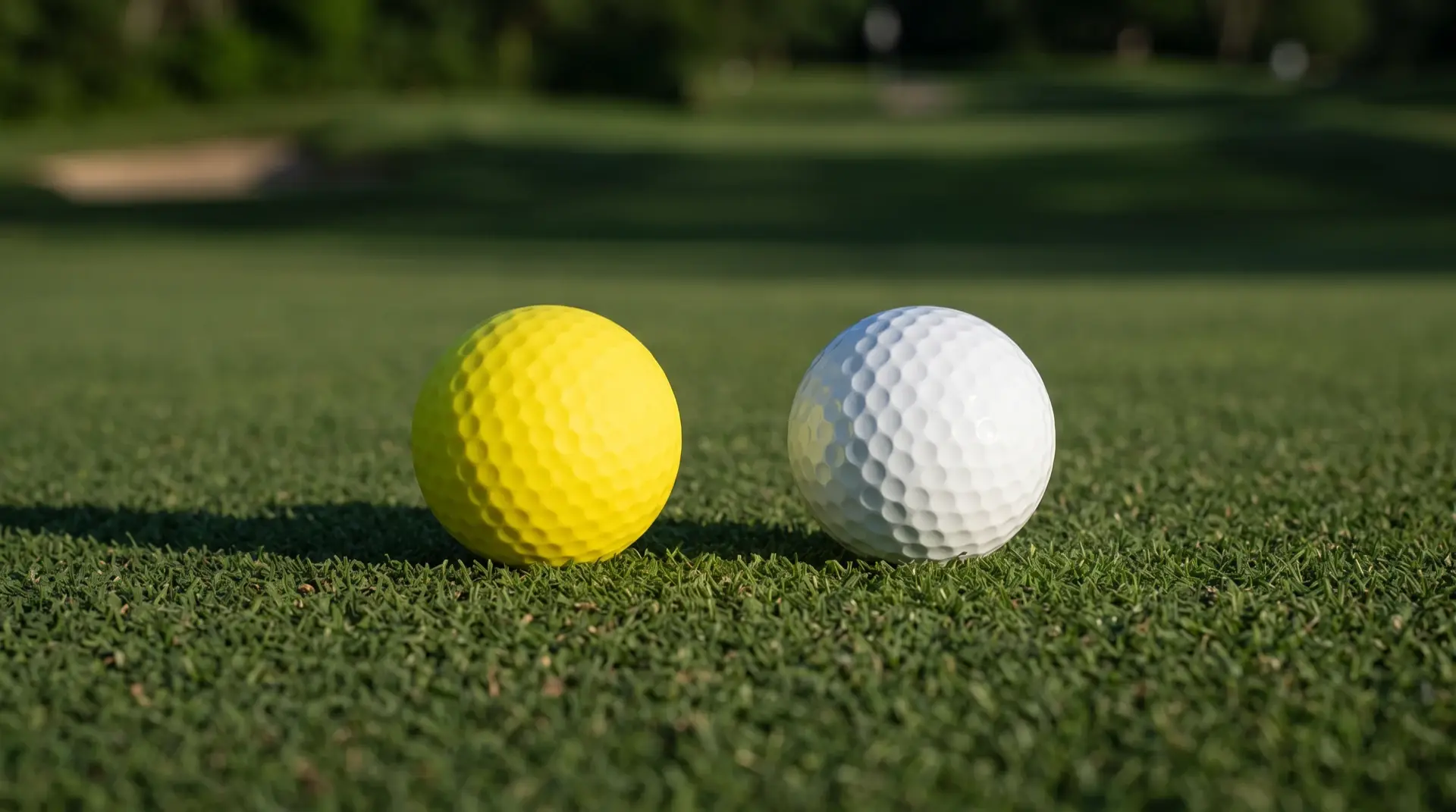
Buy the yellow. Costco’s Kirkland Signature Performance+ (~95) is sold as one ball at one price, but the yellow and white come out of different factories — and the 2026 robot test entered them as separate models because of it. The yellow finished inside the top 10 for spin in all six full-swing conditions. The white landed 13th to 17th in five of them. You pay the same for either color, and the yellow is the better ball.
Kirkland yellow vs white at a glance
| Kirkland yellow | Kirkland white | |
|---|---|---|
| Factory | SM Global, China | SM Global, Vietnam |
| Driver spin rank, top speed | 3rd of 48 | 13th |
| Driver spin rank, mid speed | 9th | 17th |
| Driver spin rank, low speed | 8th | 9th |
| Full-swing spin, all 6 conditions | Top 10 in every one | 13th–17th in five of six |
| Greenside, 35-yd wedge | Tied with the best ionomer ball | Below it |
| Ball Lab quality score | 84 (grade B), July 2026 | 85 (grade B), September 2026 |
| Price | $29.99 per 2-dozen box in the warehouse, $39.99 shipped | $29.99 per 2-dozen box in the warehouse, $39.99 shipped |
Spin ranks are from MyGolfSpy’s 2026 ball test, a 48-ball robot-controlled study published in August 2026. The two Ball Lab scores come from teardowns run in July and September 2026, on the same scoring system — see the quality section below.
Why one product name covers two balls
Costco contracts its ball production out, and as of 2026 it uses two plants at the same time. MyGolfSpy’s Ball Lab places the white Performance+ V3 in Vietnam, at the SM Global plant that also makes the PXG Xtreme; its 2024 teardown called the same factory SM Parker. Its July 2026 teardown of the yellow lists the factory as SM Global in China, a plant that also turns out balls for Snell and Vice.
That means two separate production lines. Costco sells the output under one name at one price, and the box tells you which one you’re holding if you read the country of origin.
Golfers spotted this before the robots did. The comment thread under that January 2024 white-ball teardown has readers asking for the yellow to be tested, one of them calling it “the best kept secret in the game.” When the test finally split the two colors in 2026, the stated reason was exactly that: “As readers have noted, the yellow and white versions of the ball are produced in different factories.”
What the robot measured
The robot test ran driver and 7-iron at three swing speeds each, six conditions in total. The yellow out-spun the white by 8 to 12 places in five of them.
Off the driver at the top speed tested, the yellow ranked third-highest for spin in a 48-ball field. The white ranked 13th. Drop to mid speed and the yellow sits ninth, the white 17th. The test’s own note on the pair is blunt: the white “sits well back of it at both, 17th and 13th, which is its own kind of finding for two balls sold under one name.”
The iron numbers run the same direction. The test’s summary of the full-swing portion was that off both the driver and the iron, at every speed tested, the yellow “sits inside the top 10 for spin. The white version does not, landing between 13th and 17th in five of the six conditions.” At slow iron speed the yellow came out fifth, behind only the Vice Pro Plus, Srixon Z-Star Diamond, Callaway Chrome Tour X and Titleist Pro V1x (~102). That is expensive company for a ball that costs about $15 to $20 a dozen.
That spin costs height and distance. At mid driver speed the test grouped the yellow with the high fliers and observed that the longest balls at that speed were not the highest-flying ones. Neither color is long there: at the 102 mph driver setting the yellow finished 42nd of 48 for total distance and the white 47th. If you already fight a ballooning drive, the yellow’s spin is the wrong kind of help. The compression chart covers where that trade starts to cost carry.
The one condition where they match
Slow driver speed is the exception. There the white finished ninth for spin and the yellow eighth, on what the testers called “effectively the same number” and “the one condition where the two Kirklands behave alike.” In the other five, the published rankings put the white 8 to 12 places behind the yellow.
The testers also named the white the value standout here, the ninth highest-spinning ball in the test and “by some distance the most spin available at that price.” The slow driver setting was 86 mph. If you swing in the mid-80s and already have a box of white balls in the garage, you haven’t made a mistake. At the 102 mph setting and above, the yellow is the better buy.
Greenside is a problem for both
The bigger change in this ball is around the green. Golfers bought the Kirkland for tour-level wedge spin at value pricing, and the 2026 numbers no longer back that up.
On a 35-yard wedge shot, the white Kirkland spun less than the highest-spinning ionomer ball in the test, with the yellow effectively tied with it. Across the full field, urethane balls averaged roughly 1,250 rpm more greenside spin than ionomer ones. The test’s own summary: “You need urethane to get greenside spin but it’s not guaranteed just because you’ve bought urethane.”
Both Kirklands have a urethane cover. Neither one spins like it from 35 yards. If your scoring comes from spinning wedges inside 50 yards, price this ball against a premium urethane option on short-game merit and expect to pay for the difference. Our urethane vs. ionomer breakdown covers what that cover material is supposed to deliver.
Quality control: zero defects in both colors
The 2026 teardown numbers are close to a tie: 84 for the yellow, 85 for the white.
The July 2026 Ball Lab report on the yellow scored it 84, a grade B, built on a 100% good-ball rate: zero defects across 36 balls from three boxes. Compression averaged 91.0 with a 6.7-point spread, better than the database average of 9.7. Diameter consistency graded C and compression symmetry C+, the two categories that kept it out of B+ territory, and the ball runs slightly large and light for a urethane model.
The September 2026 report on the white scored it 85, also a grade B, with zero bad balls in 36. Compression averaged 92, but the spread was wider than the yellow’s at 10.5 points (graded C+), and compression symmetry graded D at 3.0 points against a 1.9 field average. The white’s earlier teardown, in January 2024 on the 2023 ball, had scored 45 on the old scale, with a 15-point compression spread rated “Poor” and 3% of balls over the USGA weight limit.
Both 2026 reports used the same scoring system and three boxes each, and both came back with zero defects. One point is no edge at all; the yellow’s tighter compression spread is the only real separation.
Which one to buy
- Swing speed above roughly 85 mph: buy the yellow. It won five of six full-swing conditions, ties the white on build quality, and costs the same.
- Slow driver speed, under about 85 mph: either color works on the data, though the ball’s ~95 compression is firm for that swing regardless. The swing-speed guide covers what fits better down there.
- You score with your wedges: neither. Both now spin at ionomer level from 35 yards.
- You already own white boxes: play them. The gap is real on a robot; it will not be the reason you shot 92.
What this doesn’t mean about colored balls
The Kirkland result comes from two factories, and the color only tells you which one built the ball. It says nothing about yellow balls generally.
Pigment on any modern ball is blended into the cover rather than painted on, so the dimples and aerodynamics match the white version. The 2026 robot test uses a yellow Pro V1 as its control ball for exactly that reason, noting that differences between the yellow and white versions of that model “are small and often statistically insignificant.” Buying a yellow Titleist Pro V1 (~92) or a yellow Srixon Z-Star (~81) gets you the same ball you’d get in white, with better visibility.
Kirkland is the exception because Costco happens to source its two colors from two plants. Our full guide to yellow and colored golf balls covers the vision science behind why yellow tracks best, and every color on the USGA and R&A conforming list is legal for tournament play.
The next step
The yellow Kirkland is a strong full-swing ball at an unusual price, with a short game that no longer justifies the old reputation. Whether that trade works for you depends on your swing speed and where your strokes come from. Run it through the BallCaddie fitting quiz — about 90 seconds, scored against the full ball catalog — or compare any two balls side by side before your next Costco run. Your fitting report is free; your #1 ball is paid.
For deeper dives
- Golf ball compression chart 2026 — where the Kirkland’s Ball Lab readings of 91 and 92 land against every ball we track, and which tier fits your speed.
- How to choose the right golf ball for your swing speed — the fitting framework that decides whether a ~95-compression ball belongs in your bag at all.
- Costco golf balls: price, who makes them, worth it? — the full buying guide to Costco’s single-SKU golf aisle, including the manufacturer history.
- Yellow and colored golf balls: do they help? — why color changes nothing on every other ball on the market.
- Best value golf ball in 2026 — where both Kirklands rank against the rest of the budget and DTC field.
Key takeaways
- The yellow and white Kirkland Performance+ are built in different factories — SM Global’s plants in China and Vietnam — and sold under one name at one price.
- The 2026 robot test scored them as separate balls: the yellow inside the top 10 for full-swing spin in all six conditions, the white 13th to 17th in five of them.
- Off the driver at top speed the split is 3rd versus 13th of 48 balls.
- Slow driver speed is the only condition they match, finishing eighth and ninth on effectively the same spin number.
- Greenside, both have slipped to roughly ionomer level from 35 yards, against a ~1,250 rpm urethane-to-ionomer average gap.
- Build quality is a tie in 2026 Ball Lab testing: 84 for the yellow, 85 for the white, both grade B with zero defects across 36 balls. The yellow’s compression was the more consistent of the two.
- Color is doing none of this work. On every other ball on the market, yellow and white are the same ball.
Sources
- MyGolfSpy, 2026 golf ball test
Stop guessing your golf ball
Take the 90-second fitting quiz · matched from a 72-ball catalog · sign up to see your match
Take the quiz →Related posts
Amazon's $17.59 Core Soft was a MyGolfSpy top pick at slow swing speeds and scored 1.5/5 from an on-course tester. Both are right. Here's who should play it.
Every Wilson golf ball ranked by swing speed, spin, and price: where the Staff Model, Staff Model X, Triad, and Duo Soft fit your game, and what they cost.
Every Srixon golf ball compared by swing speed, spin, and price: where the Z-Star, XV, Diamond, and Q-Star Tour fit and how they undercut a Pro V1.
Every Bridgestone golf ball compared by swing speed, spin, and price: where the Tour B X, XS, RX, and RXS fit and how the e-series undercuts a Pro V1.
Frequently asked questions
- Is there a difference between the yellow and white Kirkland golf balls?
- Yes, and it is measurable. The two colors are produced in different factories, and the 2026 robot test entered them as separate models for that reason. Off the driver at its top test speed the yellow ranked third for spin and the white 13th. At mid speed it was ninth against 17th. The test's summary is that the yellow sits inside the top 10 for spin off both the driver and the iron at every speed tested, while the white lands between 13th and 17th in five of the six conditions.
- Should I buy the yellow or the white Kirkland ball?
- Buy the yellow. It costs the same money, sits in the same box design, and measured as the better full-swing ball across nearly every condition tested in 2026. Build quality is a tie: in 2026 Ball Lab testing the yellow scored 84 and the white 85, both with zero defects across 36 balls. The one exception is slow driver speed, where the two colors finished eighth and ninth on effectively the same spin number, so a slower swinger has less riding on the choice.
- Where are Kirkland golf balls made?
- In two different plants. The Ball Lab teardowns place the white Performance+ V3 at SM Global's plant in Vietnam, which also makes the PXG Xtreme (an earlier teardown called it SM Parker). Its July 2026 teardown of the yellow lists the factory as SM Global in China, which also produces balls for Snell and Vice. Costco sells both under one product name at one price, and the packaging carries the country of origin if you want to check the box before you buy.
- Does the yellow color itself make the ball spin more?
- No. Pigment is blended into the cover on any modern ball, so a yellow cover and a white cover of the same model fly and spin the same. The robot test uses a yellow Pro V1 as its control ball precisely because the color differences on that model are small and often statistically insignificant. With the Kirkland, color is a label that happens to identify which factory built the ball. The production line is what moves these numbers.
- Do the yellow and white Kirkland balls cost the same?
- Yes. Both sell as a two-dozen box at the same price — $29.99 in the Costco warehouse, about $15 a dozen, and $39.99 shipped from Costco.com, about $20 a dozen. Since the price is identical across the two colors, the yellow's advantage on full swings comes at no extra cost, which is the entire reason the buying advice is this simple.
- Is the Kirkland still a good ball for greenside spin?
- Its greenside spin has slipped. In the 2026 robot test on a 35-yard wedge shot, the white spun less than the highest-spinning ionomer ball in the field and the yellow was effectively tied with it. Across that test urethane balls averaged roughly 1,250 rpm more greenside spin than ionomer ones, and neither Kirkland is collecting that gap. Buy either color for full-swing performance and price, not for wedge bite.
- Are yellow Kirkland golf balls legal in tournaments?
- Yes. The Kirkland Signature Performance+ appears on the USGA and R&A conforming ball list, and the list judges size, weight, initial velocity and symmetry, never cover color. Any conforming ball is legal at every level of play in any color. The only restriction is the optional One Ball Local Rule used in some elite events, which requires you to keep the same model and color for a full round.
Stop guessing your golf ball
Take the 90-second fitting quiz · matched from a 72-ball catalog · sign up to see your match
Take the quiz →