🎯 New here? BallCaddie matches golfers to the right ball. → Take the 90-second quiz
Back to BlogCut Golf Balls Review (2026): DC, Blue, Grey and Red, Tested
MyGolfSpy sawed open a Cut DC and measured an exceedingly thick cover. What that costs the DC, and what reviewers found in the Blue, Grey and Red.
Answer a few questions about your swing and BallCaddie matches you against a 70+ ball catalog.
Take the 90-second quizQuick answer
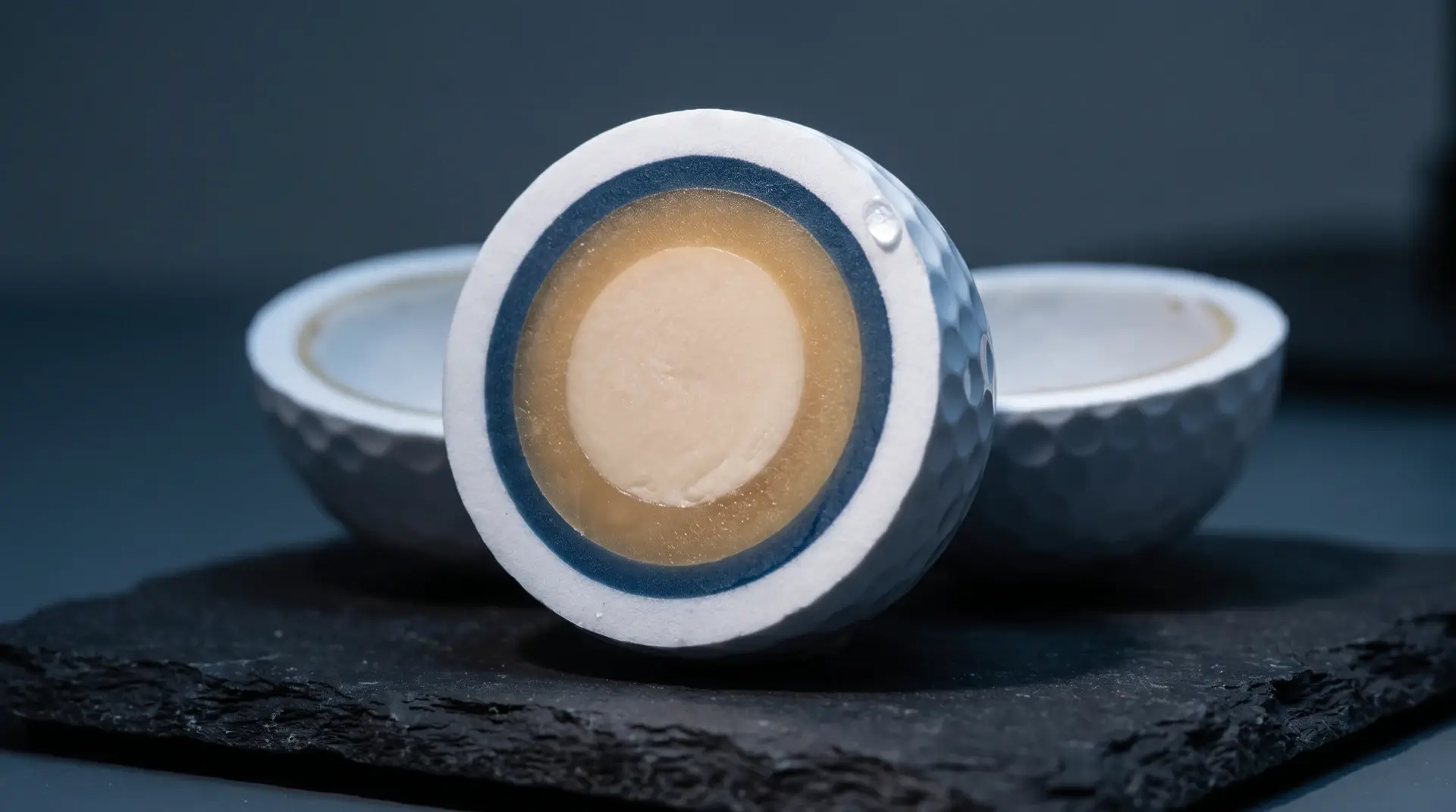
Exactly one lab has ever cut a Cut open. MyGolfSpy’s Ball Lab tore down the Cut DC, graded it 84, flagged 11 percent of the sample as bad, and called the cover “exceedingly thick for a premium urethane offering.” A thick cover costs greenside spin and durability, which is what reviewers report across the range: Cut balls fly as far as a Pro V1, lose spin inside 50 yards, and in the Grey and Blue scuff fast. The DC is the one worth buying at $29.95.
The four Cut balls, and how each one graded
| Model | Build | Compression | Price | Durability vs Pro V1 | Greenside spin vs Pro V1 |
|---|---|---|---|---|---|
| Cut Red (~60) | 2-piece ionomer | 60 | $16.00 | Fair | Poor |
| Cut Grey (~80) | 3-piece urethane | 80 | $24.95 | Poor | Fair |
| Cut Blue (~90) | 4-piece urethane | 90 | $24.95 | Poor | Fair |
| Cut DC (~99) | 4-piece dual-core urethane | 99 | $29.95 | Good | Good |
Prices and constructions verified on cutgolf.co in September 2026. Compression tiers come from BallCaddie’s ball catalog. The two ratings columns are Golf Insider UK’s November 2024 comparison, which graded all four Cut balls against a Titleist Pro V1 that scored Excellent in both.
This is the review companion to our Cut lineup and buyer’s guide. That post answers which Cut to buy. This one works through what has been measured.
The gap Cut is selling into is real, and Golf Digest sized it
Golf Digest ran 50-yard wedge shots on a Foresight GCHawk across its whole 2020 test field and published the split by price: balls at $25 and under averaged 5,400 rpm, balls over $35 averaged 7,000 rpm. Off the tee the same test found almost nothing between them — 218 yards versus 217 at 90 mph clubhead speed, and 275 versus 270 at 110 mph, with the cheap balls winning both.
So the cheap-ball trade is roughly 1,600 rpm of wedge spin for a yard or five of driver distance, which is noise. That’s the shape of the whole category, and Cut lives in it. Cut’s answer is a cast-urethane cover on three of its four balls, which should buy back most of that 1,600 rpm. The evidence below says it buys back some of it.
The teardown, and what it does and doesn’t cover
MyGolfSpy’s Ball Lab is the only independent teardown of a Cut ball. Tony Covey ran 36 Cut DCs across three boxes in June 2021 and published the numbers.
- Measured compression: 99. That put the DC level with the Wilson Staff Model (~94) and the Mizuno RB Tour X, and a whisker softer than a Pro V1x Left Dash. Firm, by any standard.
- Overall grade: 84. Weight and compression consistency both landed in the Good range; diameter consistency sat at the low end of average.
- 11 percent bad balls. Four of 36 were flagged, every one of them for significant variation in cover or mantle thickness; one of those four also failed the roundness standard.
- True Price: $33.69 — MyGolfSpy’s estimate of what you actually pay to end up with 12 good balls, 13 percent above the $29.95 sticker.
Under “The Bad,” Covey wrote that “the cover is exceedingly thick for a premium urethane offering,” and in the final grade explained why it matters: a thick cover “typically coincides with decreased durability and greenside spin, and a firmer feel relative to the actual compression.”
Three predictions off one physical measurement, and reviewers have since reported all three about the DC. The limit matters, though. This was a DC teardown. Nobody has put a Grey, Blue or Red on a gauge or sliced one open, so everything below about those three rests on reviewer testing, which is weaker evidence than a lab.
What the launch monitor measured
Today’s Golfer put a test pro on a Foresight GC Quad with a Ping G410 Plus driver and an i210 wedge and ran Cut balls head-to-head with their Titleist counterparts. The teardown predicted a wedge-spin loss. These are the numbers on it.
| Matchup | Driver | Iron | Wedge spin |
|---|---|---|---|
| Cut Blue vs Titleist Pro V1 (~92) | +8 yards carry (+2.9%) | +2 yards (+1.2%) | −900 rpm (−10.9%) |
| Cut DC vs Titleist Pro V1x (~102) | +4 yards carry, +2.8 mph ball speed | level | −375 rpm (−4.5%) |
Both Cut balls beat their Titleist equivalent off the tee. Both gave the spin back on a wedge. The DC gave back less than half as much as the Blue, which tracks with the DC being the ball that got the dual core and the extra $5.
Human testing, not a robot, so treat the yardages as directional. The spin gap is the durable finding, because it repeats across the reviews below and it has a stated mechanism behind it.
Ball by ball
Cut DC — the one to buy
The Cut DC is a 4-piece urethane ball with a soft inner core inside a firmer outer core, 360 dimples, and a 99 measured compression, at $29.95 a dozen in white or Atomic Yellow. Cut aims it at 100+ mph swings and scores of 70 to 80.
It is the only Cut ball with lab data behind it, the only one Golf Insider UK rated Good rather than Poor for durability, and the best of the four inside 50 yards — their testers found it could produce “a low spinner with this golf ball similar to the Pro V1 (not quite as well).” A MyGolfSpy commenter who played all three urethane models put it more bluntly: the DC’s durability was “at the top of the urethane covered golf balls,” while the Blue’s was “the worst I have ever seen.”
At 99 compression the DC needs speed to work. Under roughly 95 mph you won’t compress it, and the Cut Grey is the better fit. Our compression and swing-speed guide covers where that threshold bites.
Cut Grey — the value urethane, with a cover warning
The Grey is a 3-piece urethane ball at 80 compression and $24.95, aimed at 85+ mph. On full shots it holds up well: St. Charles Golfer played several rounds and reported “no drastic yardage losses” against premium balls and enough cover grip to rip back a 9-iron.
The cover is the problem. That same reviewer described a Vokey wedge shaving the cover off in roughly 65-degree weather, and Golf Insider UK rated the Grey Poor for durability with the memorable line that “the Cut Grey & Blue really scuff quickly, even when you don’t hit them in the trees.” Greenside spin graded Fair.
At 80 compression against a 94 mph amateur average from TrackMan, the Grey is the correct compression for more golfers than any other ball Cut makes. It’s the right fit wearing the wrong cover.
Cut Blue — the longest one, and the least durable
The Blue is a 4-piece urethane ball at 90 compression, $24.95, sold to 95+ mph swings. It is the ball with the single most impressive measured result in the range and the single worst durability reputation.
The result: 8 yards more carry than a Pro V1 in the Today’s Golfer test. The cost: 900 rpm less wedge spin, a 10.9 percent shortfall, plus a Poor durability grade and a stack of reviewer reports about shave marks after iron shots. A buyer on Cut’s own site praised the ball and then wrote that “the cover gets cut from my irons and wedges,” which is a fair summary of the whole model.
If you want the Blue’s distance but can’t live with its cover, the DC is the same architecture with a better one for $5 more.
Cut Red — the honest budget ball with a confused label
The Red is a 2-piece ionomer ball at 60 compression, $16 a dozen, and the lowest-priced ball Cut sells. Golf Insider UK rated it Excellent for distance, the only Excellent any Cut ball earned from them, and Poor for both iron spin and greenside spin. That’s the job description of a 2-piece ionomer ball, and at $16 it does it well.
The labeling is the issue, and Cut argues with itself about it. The golf-ball collection page lists the Red under “SPIN: High.” The Red’s own product page says the ionomer cover “minimizes spin and maximizes distance and longevity.” The product page is right — our catalog classes the Red as low-spin, and the only independent grade it has says Poor. A beginner reading the first page and buying on it has been pointed at the wrong expectation.
Where Cut’s own paperwork disagrees with itself
Four first-party contradictions, all live on cutgolf.co the day this was written. Read Cut’s spec sheets accordingly.
- The DC is listed at two compressions on one page. The specification bullets say “105 Compression.” Six scrolls down, the marketing copy says “With 99 compression, Cut DC is for high swing speed golfers.” The collection page says 99. MyGolfSpy’s gauge said 99, so that is the number our catalog carries — but a brand publishing a 6-point spread on its flagship is a reason to verify everything else.
- The Grey is sold as softer than the Red. Cut describes the 80-compression Grey’s feel as “Softest, like Butter” and the 60-compression Red as “Pretty Soft.” A 20-point compression gap runs the other direction. See the compression chart for what those numbers mean.
- The Red is high spin on one page and low spin on another. The collection page says “SPIN: High”; the Red’s product page says the cover “minimizes spin.” Covered above.
- The Red carries two dimple counts on one page. The specification bullets say “320 Dimple Pattern.” The body copy on the same page says the ball is “constructed with a 332 dimple pattern.”
None of this makes the balls bad. It does mean you should verify a Cut number against a lab or a reviewer before you trust it, which is a strange thing to have to say about a spec sheet.
The Hot List badge, in full
Cut’s DC page carries a “Golf Digest’s 2020 Hot List” badge. It’s real. The 2020 Hot List lists “Cut dc” under Budget, Silver, with four stars for performance, four and a half for innovation, four for feel and one for demand, praising the dual core and the mantle that “works with the urethane cover for more spin around the green.”
Two things the badge leaves out. Silver sat below eight Gold medals in that same Budget category — the Vice Pro (~89) line, the Srixon Q-Star Tour (~70), the TaylorMade Tour Response (~74), the OnCore Elixr (~84), Snell’s MTB pair, Bridgestone’s e12 Soft, the Titleist Tour Soft and Wilson’s Duo Professional. The only other Budget Silver was the Maxfli Tour (~94). And the badge is six years old — the DC that earned it in 2020 is the ball still on sale today, so the medal is fairly claimed, but it is not a current-season result.
Who should buy a Cut ball, and who should not
Buy the DC if you swing over 100 mph, you want a dual-core urethane ball for under $30, and you would rather have documented quality with a known flaw than no data at all. It’s the only budget four-piece with a published teardown behind it.
Buy the Grey if you swing 85 to 100 mph and you lose more balls than you scuff. At $24.95 for a genuine urethane cover it is priced fairly, and a ball you lose on the fourth hole never gets a chance to scuff.
Buy the Red if you are new, you are shooting 90-plus, and $16 matters. Ignore the spin label. You get the longest ball Cut makes and an ionomer cover that outlasts the urethane ones, though Golf Insider UK still rated its durability only Fair.
Skip the Grey and Blue if you hit a lot of wedges into firm greens or you play the same ball for three or four rounds. Both rated Poor for durability and Fair for greenside spin, and the DC is the only Cut that answers either complaint. Skip the brand if you want a lineup that has been through a lab, because three of these four never have. The Kirkland Signature (~95) is cheaper urethane with far more published robot data behind it — see our Kirkland review. Our best value golf ball roundup ranks the rest of the field.
On the rules: Cut lists its balls as USGA conforming, and the DC product page states it directly. Only exact models on the current conforming list are legal in competition, and direct-to-consumer lineups change, so check your model before a tournament rather than taking the brand’s word.
The next step
Picking a Cut ball on price alone is how golfers end up with a 99-compression flagship and an 88 mph swing. Compression is one input among several. BallCaddie’s ball fitting quiz scores your speed, spin needs, feel preference and budget against the full catalog and tells you where the Cut balls land for you. Sign in to see your match. Or browse the full ball catalog and compare any two balls side by side.
For deeper dives
- Cut golf balls: the complete lineup and buyer’s guide — the brand story, the DTC pricing math, and which model fits which swing.
- Golf ball compression chart — every ball in the catalog ranked by measured compression, with the tier boundaries the Cut lineup spans.
- How to choose a golf ball by swing speed — the fitting framework behind the 95 mph threshold that decides between the Grey and the DC.
- Urethane vs ionomer golf balls — why the cover material, not the layer count, sets greenside spin, and when the upgrade is worth paying for.
- Best value golf balls — where Cut ranks against Kirkland, Maxfli, Vice and the rest of the sub-$30 urethane field.
Key takeaways
- MyGolfSpy’s Ball Lab has torn down exactly one Cut ball, the DC: grade 84, 11 percent bad balls, True Price $33.69, and a cover called “exceedingly thick for a premium urethane offering.”
- A thick cover grabs a wedge face less and wears through sooner, which is what reviewers keep finding: weaker greenside spin, faster scuffing, a firm feel.
- Measured on a launch monitor, the Blue carried 8 yards further than a Pro V1 and spun 900 rpm less on a wedge; the DC gave back 375 rpm, less than half as much.
- Golf Insider UK graded the Grey and Blue Poor for durability against the Pro V1’s Excellent. The DC rated Good.
- Cut publishes 99 and 105 for the DC on the same page, calls the 80-compression Grey softer than the 60-compression Red, and labels a 2-piece ionomer ball high spin.
- The 2020 Hot List Silver is real, and it sat behind eight Golds in the same Budget category — a six-year-old medal, fairly claimed but not a current result.
Stop guessing your golf ball
Take the 90-second fitting quiz · matched from a 70+ ball catalog · sign up to see your match
Take the quiz →Related posts
Plugged In Golf gauged the Snell PR3 firmer than the PR4, and MyGolfSpy put it last for distance at mid speed. The 2026 evidence on Snell's four balls.
The $22 Mizuno RB 566 against the RB Max, Pro S and Pro X. What the 2026 robot test measured, and the two Mizuno balls no robot has tested at all.
Wilson Duo Soft vs Triad. The $15 urethane ball out-carried the soft one at all three robot driver speeds, including the slowest setting in the test.
Vice Pro review against the Tour, Drive and Pro Air. The $29.99 ionomer Tour out-spun 35 of 38 urethane balls, and Vice's price ladder runs backwards.
Frequently asked questions
- Are Cut golf balls worth it?
- For distance, yes. For your short game it depends how much you play. Today's Golfer measured the Cut Blue carrying 8 yards further than a Pro V1 off the driver while spinning 900 rpm less on a wedge. Golf Insider UK rated the whole range Great for distance, then graded the Grey and Blue Poor for durability and Fair for greenside spin where the Pro V1 rated Excellent. If you lose balls faster than you scuff them, Cut is strong value. If you hit a lot of wedges into firm greens, the money buys less than the price gap suggests.
- What did MyGolfSpy's Ball Lab find in the Cut DC?
- An overall grade of 84, with 11 percent of the sample flagged as bad balls, and a cover Tony Covey described as exceedingly thick for a premium urethane offering. All four flagged balls failed on significant variation in cover or mantle thickness, and one of those four also failed the roundness standard. The True Price came out at $33.69, about 13 percent above the $29.95 retail. The thick cover is the important part, because a thick urethane cover is the standard physical explanation for both weaker greenside spin and faster scuffing.
- What compression is the Cut DC?
- Cut publishes both 99 and 105 for the same ball, on the same page. The specification bullets on the Cut DC product page read 105 Compression, while the marketing copy further down that page says with 99 compression, and Cut's golf-ball collection page also lists 99. MyGolfSpy's compression gauge measured 99, and that measurement is what BallCaddie's catalog follows. At 99 the DC sits with the Wilson Staff Model and the Mizuno RB Tour X, a whisker softer than a Pro V1x Left Dash.
- Do Cut golf balls scuff easily?
- The Grey and the Blue do, on the published evidence. Golf Insider UK wrote that the Cut Grey and Blue really scuff quickly, even when you do not hit them in the trees, and rated both Poor for durability. A St. Charles Golfer review reported a Vokey wedge shaving the cover off a Grey in roughly 65-degree weather. The DC holds up better and rated Good, consistent with the thick cover MyGolfSpy measured, though Golf Monthly still found wear after 18 holes. The ionomer-covered Red rated Fair, above both urethane balls.
- Which Cut golf ball is the best one?
- The DC, and the gap is not close on evidence. It is the only Cut ball an independent lab has ever torn down, the only one rated Good rather than Poor or Fair for durability, the best of the four for greenside spin, and the Cut ball that took the brand's 2020 Golf Digest Hot List medal. It costs $29.95 against $24.95 for the Grey and Blue. If your swing is under about 95 mph the DC is too firm to compress, and the 80-compression Grey is the better fit.
- Did Cut golf balls win a Golf Digest award?
- The Cut DC took a Silver medal in the Budget category of the 2020 Golf Digest Hot List, praised for its dual core and for a mantle that works with the urethane cover for more spin around the green. The badge on Cut's website is real, with two caveats worth knowing. Silver sat behind eight Budget-category Gold medals that year, including the Vice Pro line, the Srixon Q-Star Tour, the TaylorMade Tour Response and the OnCore Elixr. And the badge is six years old, so treat it as a 2020 result and not a current-season one.
- Cut vs Kirkland: which is better?
- Kirkland is cheaper and better documented; Cut covers more swing speeds. The Kirkland Signature is a urethane ball near $15 a dozen against $24.95 for the urethane Cut Grey and Blue, and MyGolfSpy has robot-tested Kirkland repeatedly while Cut has appeared in no robot field at all. Cut's argument is range: a 2-piece distance ball at $16, two mid-priced urethane balls at $24.95, and a dual-core flagship. If you want one cheap urethane ball, price Kirkland first.
Stop guessing your golf ball
Take the 90-second fitting quiz · matched from a 70+ ball catalog · sign up to see your match
Take the quiz →