🎯 New here? BallCaddie matches golfers to the right ball. → Take the 90-second quiz
Back to BlogIs Golf Ball Fitting Worth It? Every Option Compared, From Free to $39
Seven ways to get fit for a golf ball, from a free 12-swing Titleist session to a $39 Ballnamic code: price, brands covered and what each one can't measure.
Answer a few questions about your swing and BallCaddie matches you against a 72-ball catalog.
Take the 90-second quizIs a golf ball fitting worth it?
Yes, and the version that pays off costs between $0 and $25. A fitting earns its price when it moves you across a cover or compression line: from an ionomer ball to urethane because your chips run out, or from a 100-compression ball to a 75 because your swing has slowed. In 2026 robot testing, the 48-ball field finished within 11 yards of each other on total driver distance at 86 mph but 2,907 rpm apart on a 35-yard pitch, so the fitting worth paying for is the one that looks at your wedges. Seven options below, from a free 12-swing session to a $39 code, with what each one is allowed to recommend.
Every page that ranks for this question answers yes, and most of them sell fittings or golf balls. This is the version with prices on it: what each option costs, which brands it can pick from, what it measures, and what you walk out holding. BallCaddie is one row in the table, the brand-neutral online one. The launch-monitor rows beat it on measurement, and the table says so.
Every ball-fitting option, side by side
Prices and details checked on each company’s own page on October 30, 2026.
| Option | Price | Can recommend | What it measures | Time | You leave with |
|---|---|---|---|---|---|
| Titleist Golf Ball Fitting App at PGA TOUR Superstore and partner locations | Free, no appointment | 4 Titleist balls: Pro V1 (~92), Pro V1x (~102), Pro V1x Left Dash (~105), AVX (~81) | 12 swings on a launch monitor: 3 half wedges, 3 pitching wedges, 3 7-irons, 3 drivers | About 15 minutes | One Titleist model |
| Bridgestone fitting event | Free | Bridgestone only | 3 driver shots with your ball, 3 with the Bridgestone they pick | 10 to 15 minutes | A 2-ball pack and your swing numbers |
| Golf Galaxy ball fitting | $19.99, or included in a Signature club fitting from $29.99 | Balls the store stocks: Callaway, TaylorMade, Titleist, Bridgestone, Maxfli, Srixon and others | Distance, trajectory, spin and feel per ball in a hitting bay (its fitting bays are TrackMan-supported) | Not published | An advisor’s pick from the shelf |
| Club Champion ball fitting | $25, waived if you start a ball subscription the same day | The major brands the studio stocks; Club Champion sells no ball of its own | Launch-monitor data per ball in a studio | Added to a club-fitting booking | A cross-brand pick |
| PING Ballnamic | $15 for 1 fitting, $29 for 3, $39 for 5; codes last 12 months | 60-plus balls from any brand, but only urethane, 3-piece or more, $20 and up | Your driver and 7-iron launch numbers, or an estimate from your distances, matched against PING’s robot data | A few minutes online | Top 5 balls with a match percentage and flight charts |
| Brand selectors (Titleist, Callaway, TaylorMade, Srixon, Bridgestone) | Free | That brand’s lineup only | 4 to about 15 self-reported answers | 1 to 5 minutes | One model and an alternate |
| BallCaddie quiz | Quiz and six-section report free; your #1 ball named for $29 one-time | 72 balls across 19 brands, $13 to $57.99 a dozen | Your reported driver speed or carry, short game, iron flight, feel and budget | 90 seconds | A spec range, a scored catalog, and the name if you pay |
Three of the seven are free start to finish, and two of those put a launch monitor on your swing. Start there.
The free fittings are better than their price suggests
The Titleist app runs at any of the 70-plus PGA TOUR Superstores in the U.S. and at Titleist partner locations, with no appointment. Titleist’s own write-up of the session, by Ashley Mayo on titleist.com, lists the five questions the fitter asks (green firmness, feel preference and how much it matters, trajectory preference and how much it matters) and the 12 swings: three each with a half wedge, a pitching wedge, a 7-iron and a driver.
The app picks one of four balls. Mayo’s line about the experience is the honest selling point: “No numbers on the screen. No data to obsess over.”
The limit is the four. Pro V1, Pro V1x, Left Dash and AVX are all urethane tour balls at $50 to $57.99 a dozen, so the app cannot tell a golfer that a $29.99 Titleist Velocity (~90) or a $39.99 Srixon Q-Star Tour (~70) is the better buy. It answers “which Pro V1 family ball” well, and only that.
Bridgestone’s fitting events are free too, and you leave with a 2-ball pack of the recommended ball plus your numbers. Bridgestone’s fitting page describes the session: three shots with your current ball, three with the Bridgestone the technician picks, 10 to 15 minutes, and “all you need is your driver.” The counter on that page reads 4.6 million fittings since 2006, and Bridgestone cites a 2023 Golf Datatech survey in which 67% of golfers said they had never been fit for a ball.
Driver-only is the catch. In 2026 robot testing the 48 balls were spread across 11 yards of total distance at 86 mph and about 2 mph of ball speed, while the 35-yard pitch spread was 3,085 to 5,992 rpm. A driver-only fitting reads the club where balls differ least and skips the shots where they differ most.
Golf Galaxy and Club Champion: $20 to $25 for measured numbers
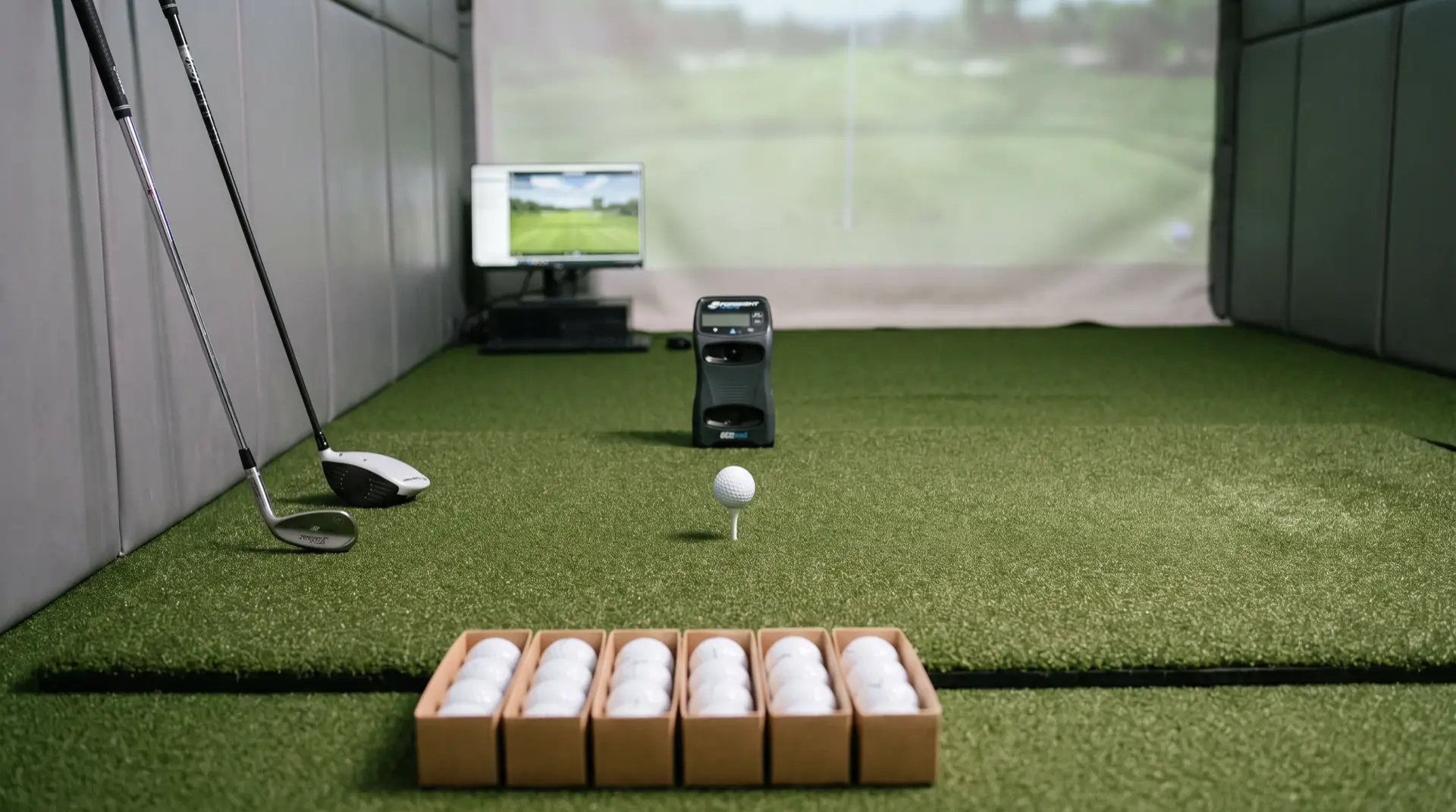
A Golf Galaxy ball fitting is $19.99. You hit balls from the brands the store carries in one of its TrackMan-supported bays while an advisor tracks distance, trajectory, spin and feel, and you can bring the ball you play now to compare. Golf Galaxy doesn’t publish a session length.
The same ball comparison comes free inside its $29.99 to $49.99 Signature club fitting and the $149.99 full-bag fitting, so if you’re buying clubs this year, book the club fitting and ask for the ball comparison. Our Golf Galaxy fitting explainer covers what to expect in the bay.
Club Champion charges $25 for its ball fitting and waives the fee if you start its golf ball subscription on the same day (the offer runs through December 31, 2026). You add it to a club-fitting booking, hit on the studio’s launch monitors, and the fitter recommends across the major brands the studio carries, with no house ball to steer you toward. The Club Champion comparison has the fuller picture.
These two measure you, which no online tool can. If you’ve never seen your driver ball speed or your 7-iron spin, $19.99 buys a real number with the screen turned on (the free Titleist session hides it unless you ask), and that number is worth more than the ball recommendation that comes with it. The recommendation is limited to the shelf (Golf Galaxy) or to the balls the studio stocks that day (Club Champion). Direct-to-consumer brands such as Vice, Snell and Cut rarely make it into the bay.
Ballnamic: the paid online fitting
PING’s Ballnamic sells fitting codes at $15 for one, $29 for three and $39 for five, valid for 12 months. You enter your driver and 7-iron launch conditions (exact numbers if you have them, or Ballnamic estimates them from your distances and flight), answer questions about wedge spin and feel, and get a top five ranked by match percentage with projected flight charts. Every ball in the database was hit hundreds of times on PING’s swing robot with a TrackMan behind it.
Two limits, both from Ballnamic’s own FAQ. It only tests urethane balls with three or more pieces priced at $20 or more, so the Callaway Supersoft (~49), Wilson Duo Soft (~37) and every other two-piece ball is out before you start.
It is also U.S. only. For a golfer who already plays premium urethane and has launch-monitor numbers, it is the most data-heavy fit on this list; the Ballnamic comparison goes deeper.
Brand selectors: free, fast, and one brand each
Every major manufacturer runs a free online selector, and each one recommends only its own balls. MyGolfSpy’s July 2026 review of six of them rated Titleist’s the most complete and closed with the right caution: brand tools are “at best, a starting point.”
Titleist’s selector asks a dozen or so questions in under five minutes (handicap, rounds per year, current ball, green firmness, then spin and flight on half wedges, approaches and the driver) and picks from seven models. It never asks your swing speed, which matches what Michael Rich, who leads Titleist’s ball fitting and education team, said in a Team Titleist Q&A: choosing a ball by swing speed “is a flawed approach.” TaylorMade’s Ball Recommender asks about ten questions, including iron style, 7-iron distance and wind, and its results page is built around the TP5 and TP5x in their various finishes. Callaway’s and Srixon’s each run four questions.
We’ve reviewed the Titleist, Callaway and Srixon tools one at a time.
Use a brand selector after you’ve chosen the brand. It is good at “which Srixon,” and silent on “whether Srixon.”
What no fitting can measure
A launch-monitor fitting measures ball speed, launch, spin and carry, indoors, off a mat, for three or four swings per ball. That is a real measurement and the best one on this page. It still misses the half of the fit that lives on your course:
- How the ball behaves on your greens. Firmness, grain and whether you play in the morning dew change how much a given wedge spin is worth. A ball that spins 5,400 rpm on a 35-yard pitch and one that spins 4,100 both show “carry” on a simulator screen; the difference between them is rollout, and rollout depends on the green.
- Feel, which is yours to judge. Titleist’s lineup page says feel “is very closely tied to acoustics,” and Mike Madson, who runs golf ball R&D at Acushnet, describes putting headphones on golfers and finding “they can’t tell the difference” between high- and low-compression balls. A fitter can show you spin; feel is a preference only you can rank.
- Three swings of noise. Even the robot’s carry scattered 1.9 to 5.2 yards of standard deviation per model in the 2026 test. A human’s three-shot average with each ball sits inside that noise, so a fitting that says ball A carried 2 yards farther than ball B has told you the two are the same off the driver.
- The shots you hit most. Trillium Rose, a Golf Digest Top 50 teacher, makes the point in Titleist’s own ball-testing guide: driver speed isn’t the deciding factor because “the majority of a player’s shots are with much slower speeds and eventually on the green.”
This is why the order below ends with a sleeve on the course.
What each path can hand you at your speed
The same golfer gets a different answer from each option, because each one draws from a different pool. Here is the pool each tool can pick from at three driver speeds, with BallCaddie’s top three from the live engine for an all-around, smart-value profile at each speed. The engine is fit-first and leans premium; price never adds a point, and the cheaper ball wins a tie.
| Driver speed | Titleist app can pick | Ballnamic can pick | Brand selector can pick | BallCaddie engine’s top 3 |
|---|---|---|---|---|
| 85 mph | One of 4: Pro V1, Pro V1x, Left Dash, AVX | Any urethane 3-piece-plus ball over $20 | That brand’s models only | Pro V1 (~92), Callaway Chrome Tour (~94), TaylorMade Tour Response (~74) |
| 95 mph | Same 4 | Same pool | Same limit | Srixon Q-Star Tour (~70), Pro V1 (~92), TaylorMade TP5 (~93) |
| 100 mph | Same 4 | Same pool | Same limit | Callaway Chrome Tour X (~99), Bridgestone Tour B X (~100), Srixon Z-Star XV (~96) |
Read the 95 mph row. A $39.99 ball tops a $57.99 one because the profile’s short game weighted wedge spin, and the Q-Star Tour spun 5,702 rpm on the robot’s 35-yard pitch, more than the Pro V1’s 5,443.
The Titleist app and the brand selectors can’t produce that row; the Q-Star Tour isn’t in their pool. Ballnamic can, since the Q-Star Tour clears its $20 urethane bar. The two-piece balls that fit many slower swings don’t clear it.
The order that works
Of the 3,222 golfers who had taken the BallCaddie quiz as of October 30, 2026 (our own quiz answers, counted that morning), 47% say they want more distance off the tee and 33% call tee shots their weakest area, against 21% who name the short game. Those are self-reported answers. They also describe a golfer walking into a fitting asking about the one club where the balls are nearly identical. The sequence below starts where the differences are.
- Get the spec range, free. Take the BallCaddie fitting quiz with this year’s driver carry. Section 2 of the report names your compression band, cover and flight profile, and Section 4 shows how many of the 72 balls fell outside it (61 of 72 for the sample profile on the report page). The quiz and the six-section report are free; naming your #1 ball is the $29 part.
- If you don’t know your swing speed, get measured. A $19.99 Golf Galaxy bay gives you a driver ball speed and a 7-iron spin number in one visit, and the free Titleist session will too if you ask the fitter to show the numbers (the screen is blank by default). Re-run the quiz with the measured number if it moved you more than 5 mph.
- Buy two sleeves inside the range, not a dozen. Pick one ball from the top of your scored catalog and one cheaper ball inside the same spec range. Six balls, about $25.
- Test them on the course. The on-course sleeve test alternates the two balls from the same spots: chips first, full wedges second, driver last. If the cheaper ball checks the same on your greens, you have your answer and $18 a dozen back.
- Then buy the dozen. None of those five steps costs more than $25 before the balls themselves.
When to pay for a launch-monitor session anyway
- You have never seen your own numbers. A measured 94 mph beats a guessed 100, and the quiz, Ballnamic and every brand tool are only as good as the speed you type in.
- You are buying clubs this year. Golf Galaxy and Club Champion fold the ball comparison into the club fitting for nothing extra.
- You already play a $55 urethane ball and want to know which one. Ballnamic’s match percentage is the most precise answer available for that question, and $15 is about the price of a sleeve.
- Your fit changed. Ten mph of lost speed or a move to firm greens is worth a new look; the 7 signs you’re playing the wrong ball lists what to watch for.
Skip the paid session if you already know your speed within 5 mph, your problem is on and around the greens, and the quiz’s spec range plus two sleeves can settle it.
For deeper dives
- How to choose a golf ball by swing speed, the pillar this post hangs off.
- All fitting tools compared, one table for Ballnamic, Club Champion and every brand selector.
- How to test golf balls on the course, the two-sleeve protocol step 4 points to.
- The strokes-saved audit, what the wrong ball costs in strokes rather than rpm.
- Golf ball compression chart, the band your report names, ball by ball.
- MyGolfSpy’s 2026 ball test, explained, where the robot numbers on this page come from.
Sources
- MyGolfSpy, A guide to the best and worst online golf ball fitting tools
- MyGolfSpy, 2026 golf ball test
Stop guessing your golf ball
Take the 90-second fitting quiz · matched from a 72-ball catalog · sign up to see your match
Take the quiz →Related posts
At 100 mph almost any compression works: in 2026 robot testing 47 of 48 balls finished within 8.3 yards off the driver. Picks by spin, flight and feel.
Yes. In 2026 robot testing at 86 mph the Pro V1 was the longest of 48 balls. What an 85 mph swing pays for it, and where our fitting engine draws the line.
Usually no. Of 2,800 fittings, 1,127 were 16+ handicap, and only 7% got a Pro V1 or V1x as their #1 ball. Swing speed and short game decide it, not handicap.
The best golf balls for cold weather by swing speed, what robot testing says cold costs (21 yards on a frozen ball), and why a warm ball beats a softer one.
Frequently asked questions
- What should you bring to a golf ball fitting?
- Bring the ball you play now, because Golf Galaxy and Bridgestone both start by measuring it against the recommendation, and the comparison is the useful part. Bring your own driver, 7-iron, pitching wedge and a lob or sand wedge: the Titleist 12-swing session uses all four, and Bridgestone's driver-only events need just the driver. Wear your usual glove and shoes so the swings look like yours. If you already have a measured driver swing speed or ball speed from a lesson or a launch-monitor range, bring that number too; it lets the fitter skip the warm-up guesswork and gives you something to type into an online fitting afterward.
Stop guessing your golf ball
Take the 90-second fitting quiz · matched from a 72-ball catalog · sign up to see your match
Take the quiz →