🎯 New here? BallCaddie matches golfers to the right ball. → Take the 90-second quiz
Back to BlogTP5x vs Pro V1: Which Tour Ball Fits Your Swing?
TaylorMade TP5x vs Titleist Pro V1: robot-test driver, iron and wedge spin numbers, the 5-point compression gap, and the swing speed that decides it.
Answer a few questions about your swing and BallCaddie matches you against a 70+ ball catalog.
Take the 90-second quizQuick answer
The TaylorMade TP5x (~98) and Titleist Pro V1 (~92) both list at $57.99 a dozen and finished 0.7 yards apart in Today’s Golfer’s 2025 robot test. The compression gap decides it: play the TP5x above 105 mph, where the firmer 5-layer build holds up, and the Pro V1 from 90 to 105 mph. Under 90 mph, neither ball earns its price.
Head-to-head specs
| Spec | TaylorMade TP5x | Titleist Pro V1 |
|---|---|---|
| Price per dozen | $57.99 | $57.99 |
| Construction | 5-piece | 3-piece |
| Cover | Cast urethane | Cast urethane |
| Compression | ~98 (high) | ~92 (high) |
| Dimples | 322 | 388 |
| Trajectory | High | Mid |
| Driver spin | Mid | Low |
| Greenside spin | Tour-level | Tour-level |
| Best swing speed | 105+ mph | 90–105 mph |
How they’re built differently
These two balls solve the same problem with opposite philosophies. TaylorMade stacks layers; Titleist tunes one core.
TP5x: five layers, three of them core
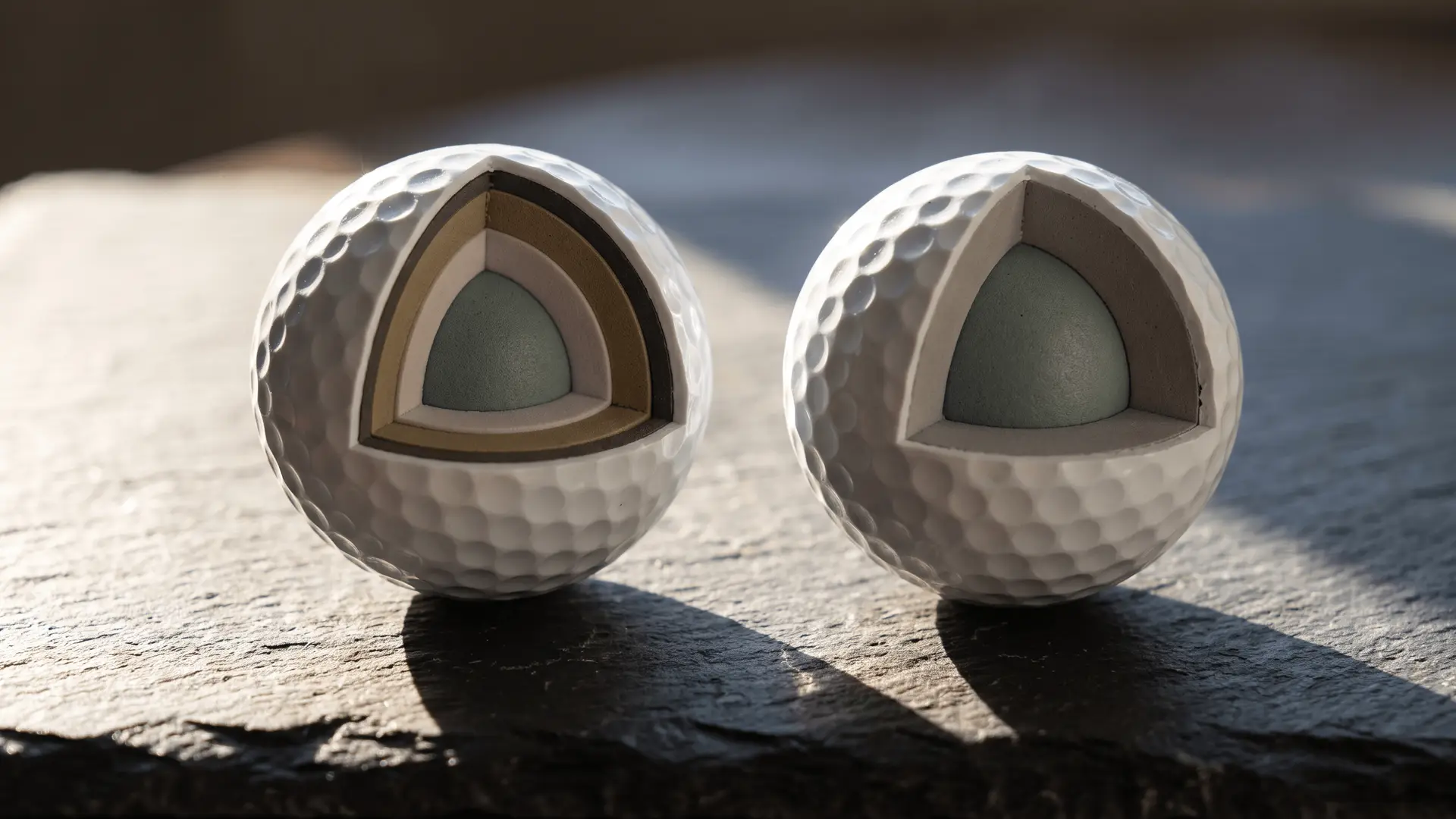
The TP5x is the only 5-piece ball a major manufacturer still sells. Underneath the cast urethane cover sit two mantle layers and a three-stage core that TaylorMade calls a Speed Wrapped Core, wrapped in a 322-dimple Tour Flight pattern. Each layer is tuned to a different strike speed, so a wedge at 46 mph engages only the soft cover and inner core while a driver at 114 mph compresses the whole stack.
The 2026 refresh that reached retail on February 12 kept all five layers and reworked the mantle materials, adding a thinner microcoating in place of conventional paint. TaylorMade’s claim for it is ball speed and coat-to-coat consistency rather than a new spin profile.
Pro V1: three layers, one gradient core
The Pro V1 does the same job with two fewer layers. Titleist’s technical page describes a high-gradient core (soft in the center, progressively firmer toward the outside), a high-flex casing layer, and a soft cast urethane cover over 388 tetrahedral dimples. The gradient inside the single core replaces the job TaylorMade hands to separate mantles.
Fewer interfaces means fewer things to build wrong, which shows up in the lab. MyGolfSpy’s Ball Lab teardown scored the Pro V1 at 85 out of 100 and called it the most consistent ball it had tested to that point. Its TP5x report scored 82, flagged 6% of the sample, and found one ball with serious layer intrusion.
What the robot data says off the driver
They are the same ball off the tee. Today’s Golfer’s 2025 robot test ran 2,232 shots through a Foresight GCQuad, and at 114 mph driver speed the two balls landed inside the margin of a mis-struck drive:
| Driver @ 114 mph | TP5x | Pro V1 |
|---|---|---|
| Ball speed | 163.7 mph | 163.9 mph |
| Launch angle | 11.0° | 11.1° |
| Backspin | 2,700 rpm | 2,684 rpm |
| Carry | 272.5 yds | 273.2 yds |
Two-tenths of a mph, sixteen rpm, seven-tenths of a yard. TaylorMade markets the TP5x as its lowest-spinning tour ball, and against the softer TP5 that holds up, but against the Pro V1 it spun 16 rpm more in this test. Both balls sit comfortably inside the 2,200–2,600 rpm window TrackMan’s optimizer targets for swings in the 95–105 mph range, and neither is going to fix a ballooning drive on its own.
If your driver spin is the problem, a lower-spin model like the Titleist Pro V1x Left Dash (~105) or the Callaway Chrome Tour X (~99) moves the number further than switching between these two will.
Irons and greenside spin
The gaps widen slightly with the shorter clubs, and they lean TaylorMade. From the same test:
| Shot | TP5x | Pro V1 |
|---|---|---|
| 7-iron backspin (80 mph) | 4,609 rpm | 4,598 rpm |
| 7-iron carry | 157.2 yds | 155.3 yds |
| 40-yard wedge backspin | 6,042 rpm | 5,692 rpm |
The 7-iron result repeats. Today’s Golfer’s 2024 test with Loughborough University put the TP5x 2.2 yards past the Pro V1 with a 7-iron; the 2025 run put it 1.9 yards past. Two independent test years, same direction, roughly two yards of iron carry to the TP5x at effectively identical spin.
The wedge number cuts against the folklore. The Pro V1 has spent two decades as the greenside-spin benchmark, and here the TP5x beat it by 350 rpm on a 40-yard pitch. That is a real measured gap, and it is also a 6% difference on a shot where lie, groove wear, and how cleanly you catch it move spin more than the ball does. Both covers are cast urethane, both stop.
Feel, flight, and the compression gap
Feel is the one difference you will notice without a launch monitor. The TP5x is firmer and clicks off the putter face; the Pro V1 feels softer at impact and duller on short putts. If your distance control on lag putts is dialed in on one, switching costs you a few rounds of recalibration.
One honest note on those numbers. BallCaddie’s catalog lists 98 and 92, drawn from the ordering that independent gauges agree on. The absolute figures move a lot between labs, because each one calibrates its own tester: Today’s Golfer’s gauge ranks the TP5x above both Titleist tour balls on a scale where the Pro V1 reads 98, and MyGolfSpy’s Model 55-M has measured Pro V1 samples at 87. Use compression numbers to rank balls against each other, not as an absolute reading. The golf ball compression chart puts every ball in the catalog on one consistent scale for exactly that reason.
Flight is the claim worth checking against your own numbers. TaylorMade builds the TP5x as its high-flighted tour ball and Titleist tunes the Pro V1 for a penetrating mid window, which is how BallCaddie’s catalog classifies the two. Off the driver in the 2025 test that gap never showed up: 11.0° for the TP5x against 11.1° for the Pro V1, a tenth of a degree apart. If you already fight a steep descent angle, neither ball flattens it for you, and the fix is loft and shaft rather than a ball switch.
Price per dozen
They cost the same now. The Pro V1 has sat at $57.99 for years, and Titleist does not run manufacturer-sponsored discounts on it. The 2026 TP5x refresh raised the standard white model from $54.99 to $57.99, erasing the $3 gap that used to be the tiebreaker between them.
At $57.99 a dozen, both balls cost $4.83 each. Lose two a round across 20 rounds and that’s 40 balls, about $193 spent on golf balls alone. The Kirkland Signature cast-urethane ball benchmarks within a few yards of the Pro V1 off the driver at roughly a third of the price, which is the comparison worth running before either of these goes in your bag. The best value golf ball guide has the full breakdown.
Which one fits you
Play the TP5x if:
- You swing 105 mph or faster and fully compress a 98-compression core.
- You launch the driver or your long irons too low and want help getting the ball up.
- You want the extra couple of yards of iron carry the robot data keeps showing.
Play the Pro V1 if:
- You measure between 90 and 105 mph, where TrackMan puts most amateurs who play tour balls.
- You want a flatter, wind-resistant flight and a steeper, more predictable descent.
- You prefer a softer feel on and around the greens.
- You value shot-to-shot consistency, where the Ball Lab teardowns give Titleist the edge.
Play neither if your driver speed is under 90 mph. At that speed you cannot compress either core enough to collect what you paid for, and the best golf ball for a slow swing speed guide covers what does work.
The honest verdict
Off the driver these are the same golf ball, and no amount of marketing changes a seven-tenths-of-a-yard gap. What separates them is a few points of compression and the flight window that comes with it. Above 105 mph the TP5x gives you a firmer core to compress and about two yards of iron carry; between 90 and 105 the Pro V1’s softer core fits more swings, and its build consistency is the best in the category.
The way most golfers get this wrong is picking the firmer ball because tour players play it. TrackMan’s amateur data puts the average male driver swing speed at 94 mph and the average female at 83 mph. Both sit under the TP5x’s window. Measure before you buy.
Run your numbers through the BallCaddie fitting quiz and it scores your swing speed, typical miss, and greenside priority against the full ball catalog in about 90 seconds, including both of these and the value alternatives that match them.
For deeper dives:
- How to choose a golf ball for your swing speed — the compression-to-speed framework this whole comparison rests on.
- Golf ball compression chart — every ball on one calibrated scale, so the 98-vs-92 gap has context.
- TP5 vs TP5x — the in-family comparison if you have already settled on TaylorMade.
- Pro V1 vs Pro V1x — the Titleist version of the same decision, on the same swing-speed axis.
- Pro V1 vs TP5 — the softer half of this matchup, for swings in the 85–100 mph band.
- Titleist Pro V1 review — the single-model deep dive on the Ball Lab numbers and who the Pro V1 actually fits.
Key takeaways
- Same price, same driver performance. Both $57.99 after the 2026 TP5x increase, and 0.7 yards apart in carry at 114 mph.
- The TP5x is 6 points firmer (~98 vs ~92) and needs 105+ mph to pay off. The Pro V1 fits 90–105 mph.
- Iron carry leans TP5x by about two yards at matched spin, repeated across Today’s Golfer’s 2024 and 2025 robot tests.
- Greenside spin leans TP5x too, by 350 rpm on a 40-yard wedge — a 6% gap, and a practical tie.
- Build consistency leans Pro V1 — 85 out of 100 in MyGolfSpy’s Ball Lab against the TP5x’s 82.
- Under 90 mph, buy neither. A value urethane ball at a third of the price performs the same off the tee.
Stop guessing your golf ball
Take the 90-second fitting quiz · matched from a 70+ ball catalog · sign up to see your match
Take the quiz →Related posts
Titleist AVX vs Pro V1: same-test robot spin and carry numbers, the 10-point compression gap, the $8 price difference, and which flight fits your game.
Srixon Z-Star vs Titleist Pro V1 — 2025 specs, MyGolfSpy robot-test deltas, and the $3/dozen MSRP gap. Which tour ball fits your game and your wallet?
Independent TaylorMade TP5 review: 5-layer cast urethane, high flight, high greenside spin, and the swing speeds and short games it actually fits.
The Pro V1 Left Dot is a 3-piece urethane Pro V1 variant with a lower, more penetrating flight and reduced long-game spin. Who it fits, who it doesn't.
Frequently asked questions
- Is the TP5x or Pro V1 better?
- Neither wins outright. In Today's Golfer's 2025 robot test they finished 0.7 yards apart in driver carry at 114 mph, so the decision comes down to swing speed. The TP5x is a 5-layer ball at roughly 98 compression built for 105 mph and up. The Pro V1 is a 3-layer ball at roughly 92 compression that fits 90 to 105 mph. TaylorMade positions the TP5x as the higher-flighted of the two, though driver launch was a dead heat in that test at 11.0° against 11.1°. Measure your driver speed first.
- What swing speed do you need to play the TaylorMade TP5x?
- About 105 mph and up with the driver. At roughly 98 compression the TP5x core needs real clubhead speed to fully compress, and below about 95 mph you give up the ball speed the firmer construction was built to deliver. TrackMan puts the average male amateur at 94 mph, which sits under that line. If you measure in the 90s, the Pro V1 or the softer TP5 is the better fit at the same price.
- Does the TP5x spin more than the Pro V1 around the green?
- In Today's Golfer's 2025 robot test, yes. On a 40-yard wedge shot the TP5x produced 6,042 rpm against the Pro V1's 5,692 rpm, a 350 rpm edge to the TaylorMade. Both use cast urethane covers, so both deliver tour-level greenside grip, and a 350 rpm gap is small enough that lie, strike quality, and groove wear move it more than the ball does. Treat it as a tie in practice.
- Is the TP5x firmer than the Pro V1?
- Yes, by a handful of compression points. BallCaddie's catalog lists the TP5x at 98 and the Pro V1 at 92. Independent gauges agree on the ordering but not the absolute numbers, because every lab calibrates its own tester. MyGolfSpy's Ball Lab has measured Pro V1 samples at 87, while Today's Golfer's gauge ranks the TP5x well above both Titleist tour balls. The TP5x feels firmer and clicks more off the putter face.
- Do more tour pros play the TP5x or the Pro V1?
- The Pro V1, by a wide margin. It is the most-played model on the PGA Tour, with Scottie Scheffler, Brian Harman, Viktor Hovland, and Corey Conners among its users. The TP5x has a smaller but strong staff including Collin Morikawa, Dustin Johnson, and Tommy Fleetwood. Tour counts reflect equipment contracts as much as performance, so use them as a quality signal rather than a fitting recommendation.
- Is the TP5x worth $57.99 a dozen?
- Only if you swing fast enough to compress it and sharp enough around the greens to use urethane. The 2026 refresh moved the TP5x from $54.99 to $57.99, matching the Pro V1 exactly, so price no longer separates them. If you lose two or more balls a round, a cast-urethane value ball like the Kirkland Signature at roughly a third of the price returns more per dollar than either tour ball does.
Stop guessing your golf ball
Take the 90-second fitting quiz · matched from a 70+ ball catalog · sign up to see your match
Take the quiz →