🎯 New here? BallCaddie matches golfers to the right ball. → Take the 90-second quiz
Back to BlogPXG Golf Balls: Two Tour Balls, One Price, and a Ball Lab Red Flag
PXG sells two urethane tour balls at $39.99 a dozen. The robot data, the July 2026 Ball Lab quality score, and which of the two fits your swing.
Answer a few questions about your swing and BallCaddie matches you against a 70+ ball catalog.
Take the 90-second quizQuick answer
PXG sells two golf balls, both three-piece urethane, both $39.99 a dozen — about $3.33 a ball against $4.83 for a Pro V1. The Xtreme Tour is the softer, lower-spinning, higher-flying one; the Xtreme Tour X is firmer, spins more, and was among the longest balls at 116 mph. The catch is quality: MyGolfSpy’s July 2026 Ball Lab teardown scored the Xtreme Tour 71 out of 100, a C- and Not Recommended, on diameter consistency that graded F.
The lineup at a glance
| Ball | Compression | Cover | Spin | Flight | Colors | Price/dozen |
|---|---|---|---|---|---|---|
| PXG Xtreme Tour (~94) | ~94 | 3-piece urethane | Low | Mid, penetrating | White, yellow | $39.99 |
| PXG Xtreme Tour X (~101) | ~101 | 3-piece urethane | High | Mid-to-high | White only | $39.99 |
| Military editions of both | same | same | same | same | White | $44.99 |
| For comparison: Titleist Pro V1 (~92) | ~92 | 3-piece urethane | High | Mid | White, yellow | $57.99 |
Two balls, four SKUs. The Military editions carry officially licensed USMC, Army, Navy and Air Force stamps and cost $5 more; the ball inside is the same.
What $39.99 buys
PXG’s own store lists both balls at $39.99, and PGA TOUR Superstore matches it while running a buy-three-get-one promotion — four dozen for $119.97, or about $29.99 a dozen.
| What you pay | Per dozen | Per ball |
|---|---|---|
| PXG Xtreme Tour or Tour X, list | $39.99 | $3.33 |
| Same, under the buy-three-get-one promo | ~$29.99 | ~$2.50 |
| Kirkland Signature V3 (~95) | ~$15 | $1.25 |
| Maxfli Tour (~94) | $39.99 | $3.33 |
| Titleist Pro V1 (~92) | $57.99 | $4.83 |
The gap to a Pro V1 is $18 a dozen, or $1.50 a ball. Over 20 rounds losing three balls a round, that’s a $90 difference. The gap down to a Kirkland is larger still — $25 a dozen — which is the more interesting comparison and the one we come back to below.
PXG’s price has also moved. When Golf Monthly reviewed the Xtreme Tour X at launch in September 2024, reviewer Joe Ferguson quoted $34.99 to $39.99 and called it “pitched about right.” It has stayed there since, while premium tour balls have not.
Two balls that lean opposite directions
PXG is unusually direct about the split. Its golf ball page says the Xtreme Tour “offers a softer feel, low spin off the tee, and a penetrating flight for max distance,” while the Xtreme Tour X “delivers a firmer feel, more spin around the greens, and a higher trajectory.”
That is backwards from what most golfers assume about an X model, and it’s worth reading twice. At most brands the X is the firmer, lower-spinning bomber. At PXG the X is the firmer, higher-spinning one, and the plain Tour is the distance-first ball.
MyGolfSpy’s 2026 robot test, which ran 48 balls through driver, iron and wedge conditions, measured the same split:
| Test condition | Xtreme Tour | Xtreme Tour X |
|---|---|---|
| Driver total distance, 116 mph | — | Among the longest; narrowly outside the seven-ball statistical tie |
| Driver spin, 116 mph | — | ~2,400 rpm, ~100 rpm above field median |
| 7-iron distance, 90 mph swing | — | 38th of 48 (7th off the driver) |
| Driver carry, 86 mph | 4th-longest carry in the field | — |
| Peak height, 86 mph | Among the four highest-flying balls | — |
| Driver spin, 86 mph | Bottom half of the field | — |
| 35-yard greenside spin | Below the best ionomer ball in the test | — |
The dashes are honest: MyGolfSpy calls out individual balls in its written observations rather than publishing a full 48-row table for every metric, and each ball only appears where it did something notable. Both PXG balls did.
The Xtreme Tour X was 7th off the driver and 38th off the 7-iron
At the 116 mph driver condition, seven balls finished in a statistical tie for total distance, and MyGolfSpy put the Xtreme Tour X “close behind” that group alongside the Wilson Staff Model X (~102) and Callaway Chrome Tour Triple Diamond (~101).
What makes it interesting is the spin. MyGolfSpy singled out the Xtreme Tour X and the Titleist Pro V1x (~102) together: both “sit in the longest group while spinning around 2,400 rpm under the conditions tested, roughly 100 rpm above the field median.” Long and spinny at the same time is the rare combination, and one of the two costs $18 less.
Then the irons happen. On the 7-iron test — a Titleist T100 at 90 mph swing speed — the Xtreme Tour X dropped from seventh off the driver to 38th of 48. It has company: the Pro V1x went fourth to 42nd. MyGolfSpy calls it a pattern that holds year over year: off irons, “the firmest balls tend to fall off and mid- and low-compression models rise to the top.” Its own read is that “iron distance belongs fairly low on the list of reasons to play a given ball,” and we agree. If you are picking a tour ball for approach control rather than approach yardage, that ranking costs you nothing. Know it’s there before you blame the ball.
The Xtreme Tour is the slower-swing sleeper — with one asterisk
At the 86 mph driver condition, the Xtreme Tour did something a firm urethane ball is not supposed to do at that speed: it carried the fourth-longest of 48 balls, behind only the Callaway Chrome Tour X (~99), Srixon Z-Star XV (~96) and Wilson Staff Model X. It was also among the four highest-flying balls in the field, and it sat in the bottom half of the driver spin chart despite mid-to-high compression.
High launch, low spin, long carry, at a swing speed 8 mph below the 94 mph TrackMan lists as the male amateur average. That is a real fitting result, and it lines up with the catalog’s low spin category for this ball.
The asterisk shows up on the wedge. On MyGolfSpy’s 35-yard greenside wedge test, the Xtreme Tour was one of only three urethane balls — with the Snell PR3 (~91) and the white Kirkland Performance+ — that spun less than the highest-spinning ionomer ball in the test. MyGolfSpy’s conclusion is blunt: “You need urethane to get greenside spin but it’s not guaranteed just because you’ve bought urethane.”
Across the whole field, urethane balls averaged roughly 1,250 rpm more greenside spin than ionomer ones. The Xtreme Tour is paying urethane prices at the low end of that advantage. If short-game spin is why you’re leaving a $20 ball behind, this specific model is not the upgrade. Our urethane vs. ionomer breakdown covers where the cover difference does and doesn’t show up, and the full 2026 test walkthrough has all seven findings.
Ball Lab gave it a C- and a Not Recommended
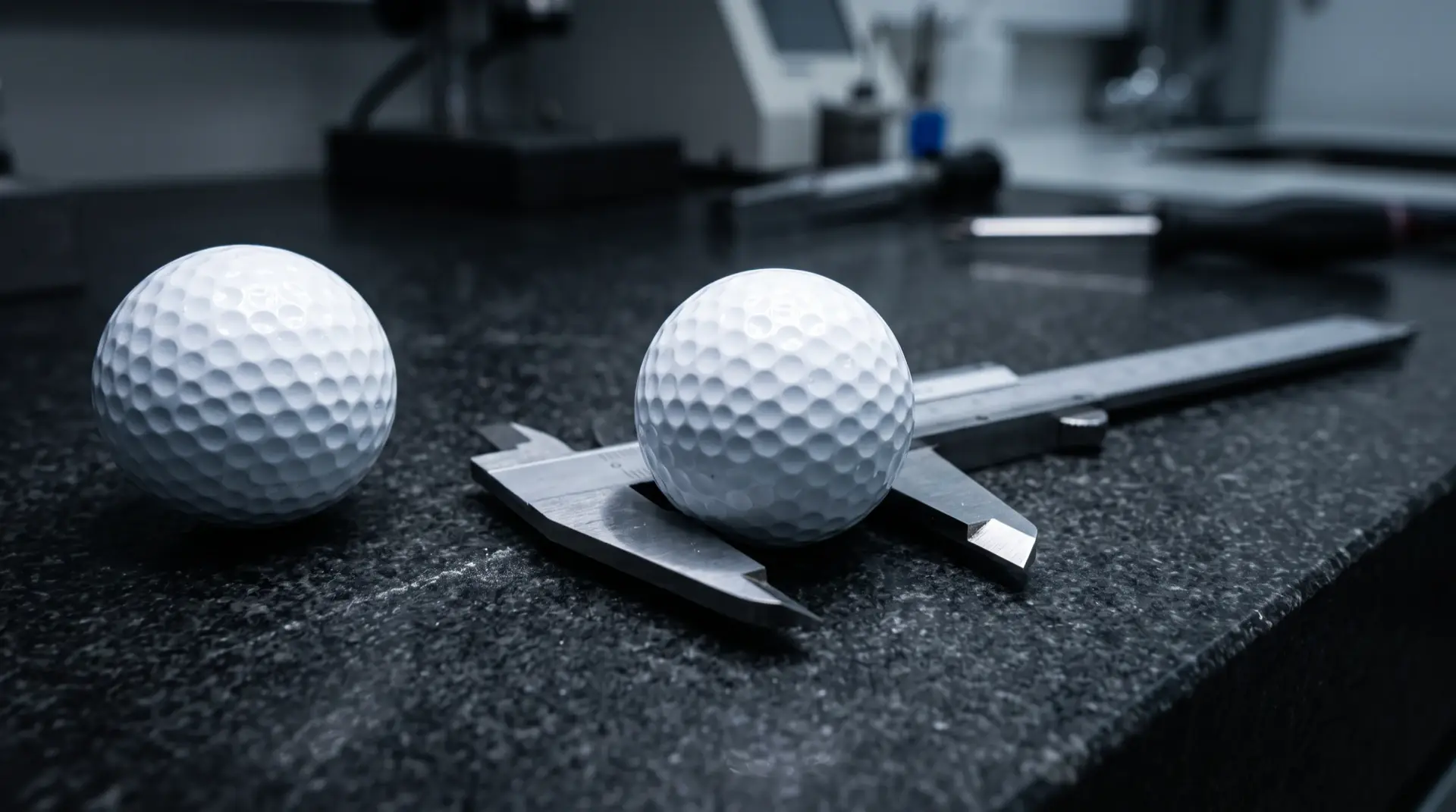
On July 29, 2026, MyGolfSpy published a Ball Lab teardown of the 2025 Xtreme Tour: 36 balls from three boxes, measured for weight, diameter, compression, roundness and balance.
| Ball Lab metric | Result | Grade |
|---|---|---|
| Overall Quality Score | 71 / 100 | C-, Not Recommended |
| Diameter consistency | Significant box-to-box size variation | F |
| Good ball rate | 35 of 36 (97.2%) | 1 ball out of round |
| Compression consistency | 8.5-point delta, 86.8 to 95.3 | B- |
| Compression symmetry | 1.0 vs. field average 1.9 | A- |
| Weight consistency | 1.6080 oz avg, SD 0.0029 | B- |
Read those two extremes together, because they say different things. Compression symmetry measures how evenly a single ball is built across three points on its own surface — the Xtreme Tour graded A-, meaning each individual ball is internally consistent and won’t behave differently depending on which side you strike. Diameter consistency measures whether ball 4 in box 1 is the same size as ball 9 in box 3, and there it graded F. Box 3 held the largest balls in the sample, including five that measured noticeably thinner at the pole.
Every ball cleared the USGA minimum diameter of 1.680 inches and the maximum weight of 1.6205 ounces, so nothing here is illegal. MyGolfSpy’s own summary is that without the diameter problem, “the PXG Xtreme manufacturing quality would otherwise qualify as average to slightly above average.”
How much a size spread costs you in strokes is genuinely unknown. The first commenter on that article asked exactly that and got no number back, because there isn’t a published one. Our honest read: it’s a yellow flag on a $39.99 ball, not a reason to pull a ball you already like out of play. It sits next to the Kirkland yellow teardown that measured zero defects at half the price, and that comparison is the uncomfortable one.
Same factory as the Kirkland, different ball
The Xtreme Tour is built in Vietnam, in the plant that also produces the white Kirkland Signature V3 (~95) for Costco. That isn’t a rumor — a reader asked in the Ball Lab comments whether the two are the same ball, and MyGolfSpy’s Tony Covey answered directly:
“Same factory. Same cover, but core formulations are unique and the balls perform differently.”
The second sentence is the one to hold onto. MyGolfSpy tested them separately in 2026 and they landed in different places. A shared cover supplier and a shared assembly line don’t make a rebadge.
One caveat on the plant name: MyGolfSpy’s own teardowns have called that Vietnamese factory SM Parker in one write-up and SM Global Vietnam in this one, while identifying SM Global as a Chinese plant elsewhere. The shared-factory fact is confirmed by the editor; treat the specific plant name as unsettled. Our Costco ball breakdown traces the same supply chain from the Kirkland side.
Three sources, three different compression numbers
Three sources measured or published a compression figure for these balls, and all three disagree:
| Source | Xtreme Tour | Xtreme Tour X |
|---|---|---|
| PXG’s published testing | 97.8 | 108 |
| MyGolfSpy Ball Lab gauge (2025 model) | 91 (firm) | not tested |
| BallCaddie catalog | ~94 | ~101 |
That spread is normal and it’s why our compression chart exists. Gauges apply load differently, so a number is only comparable against other numbers from the same instrument. PXG’s own figure for the Xtreme Tour reads about seven points firmer than MyGolfSpy’s gauge does, so this is not a case of a manufacturer flattering itself with a soft number.
What every source agrees on: both balls are firm, the Tour X is roughly 7 to 10 points firmer than the Tour, and neither is a slow-swing soft ball. Plugged In Golf’s Matt Saternus, who tested both at launch, put the feel plainly: “Off a wedge or iron, both balls are more crisp and responsive than soft.” The fitting logic behind compression tiers explains why that matters less than most marketing implies.
Which PXG ball should you play?
Both are conforming — the USGA lists them under Parsons Xtreme Golf on its conforming ball list — so this is a fitting question, not a rules one.
Play the Xtreme Tour X if:
- You swing over 100 mph. It measured among the longest balls at 116 mph while spinning above the field median, which is the profile fast swingers pay Pro V1x money for.
- You want greenside spin from a PXG. Saternus measured it spinning “measurably more” than the Tour with wedges, consistently across pure strikes and mishits, and PXG’s own 60-yard pitch data puts it about 200 rpm above the Tour.
- You don’t mind a firm ball. Golf Monthly’s one criticism was “a relatively hard-feeling golf ball.”
Play the Xtreme Tour if:
- You’re under about 95 mph and want carry. Fourth-longest carry at 86 mph, top-four peak height, and Plugged In Golf found the Tour a yard longer than the Tour X at an 85 mph driver swing.
- You fight a high-spin driver. Bottom half of the spin chart at low speed, with a penetrating flight.
- You want yellow. The Tour comes in high-visibility yellow; the Tour X is white only. Worth knowing that PXG’s own data shows the yellow spinning about 70 rpm less than the white with a wedge — a real difference, if a small one.
Skip both if greenside spin is where you score. The Xtreme Tour specifically underdelivers there for a urethane ball, and at $39.99 you’re within reach of the highest-spinning models that don’t make you choose. And if the value case is what brought you here, the Kirkland Signature V3 (~95) is urethane at about $15 with a cleaner Ball Lab card — our value ball guide runs that math per round.
Find the ball that fits your numbers
Two PXG balls at one price is a smaller decision than the one underneath it: whether a firm three-piece urethane ball fits your swing speed and your miss at all. That answer depends on numbers PXG’s product page can’t see. BallCaddie’s 90-second fitting quiz scores your speed, spin tendency and budget against the full catalog, and you’ll need to sign in to see your match. You can also browse the catalog by cover and price tier, or compare two balls side by side on the specs that decide it.
For deeper dives on what this post touches:
- How to choose a golf ball for your swing speed — the fitting order that sets your compression tier before you pick a brand.
- Golf ball compression chart — every ball we track on one gauge, and where ~94 and ~101 land against the field.
- The 2026 MyGolfSpy ball test — the robot data quoted above, all seven findings.
- Urethane vs. ionomer covers — the ~1,250 rpm greenside gap, and why buying urethane doesn’t guarantee you get it.
- Kirkland Signature performance: data vs. hype — the ~$15 urethane ball from the same Vietnamese factory.
- Best value golf ball in 2026 — price-per-round math across the value-urethane tier.
Key takeaways
- PXG sells two balls, four SKUs. Xtreme Tour and Xtreme Tour X at $39.99, plus Military editions of each at $44.99. Both are three-piece urethane with a 338-dimple pattern.
- The X is the firmer, higher-spinning one, which is backwards from most brands. PXG says so on its own site and the robot data agrees.
- The Xtreme Tour X was among the longest at 116 mph while spinning ~100 rpm above the field median, then ranked 38th of 48 for 7-iron distance.
- The Xtreme Tour carried fourth-longest at 86 mph and flew among the four highest — a genuine slower-swing result from a firm ball.
- Greenside spin is the weak spot. The Xtreme Tour was one of three urethane balls in the 48-ball field that spun less than the best ionomer ball on a 35-yard shot.
- Ball Lab scored it 71, C-, Not Recommended, on an F for diameter consistency — while grading compression symmetry A-, the best mark on its card.
- Same Vietnamese factory as the white Kirkland, per MyGolfSpy’s editor, with unique core formulations and different measured performance.
Stop guessing your golf ball
Take the 90-second fitting quiz · matched from a 70+ ball catalog · sign up to see your match
Take the quiz →Related posts
MyGolfSpy sawed open a Cut DC and measured an exceedingly thick cover. What that costs the DC, and what reviewers found in the Blue, Grey and Red.
Plugged In Golf gauged the Snell PR3 firmer than the PR4, and MyGolfSpy put it last for distance at mid speed. The 2026 evidence on Snell's four balls.
The $22 Mizuno RB 566 against the RB Max, Pro S and Pro X. What the 2026 robot test measured, and the two Mizuno balls no robot has tested at all.
The Noodle outlived the brand that created it and sells for $0.92 a ball. How it compares with the Distance+ and SpeedSoft, with the 2026 robot data.
Frequently asked questions
- What golf balls does PXG make?
- Two, sold as four items. The Xtreme Tour and the Xtreme Tour X are both three-piece urethane balls at $39.99 a dozen on pxg.com, and each also comes in a Military edition at $44.99 with officially licensed USMC, Army, Navy and Air Force stamps. The Xtreme Tour comes in white or high-visibility yellow; the Xtreme Tour X is white only. PXG says both share a high-speed polybutadiene core, an ionomer mantle layer, a urethane cover and a 338-dimple pattern. The original PXG Xtreme, the 2023 one-ball model, is no longer listed as its own product on PXG's golf ball page.
- What is the difference between the PXG Xtreme Tour and the Xtreme Tour X?
- PXG's own answer is that the Xtreme Tour is softer with lower spin and a flatter, more penetrating flight, while the Xtreme Tour X is firmer, spins more, and flies higher. MyGolfSpy's 2026 robot test backs that split. The Xtreme Tour X was among the longest off a 116 mph driver while spinning around 2,400 rpm, roughly 100 rpm above the field median. The Xtreme Tour flew among the four highest at 86 mph and sat in the bottom half of the driver spin chart there.
- Are PXG golf balls any good?
- The performance holds up and the manufacturing consistency is the open question. MyGolfSpy's July 2026 Ball Lab teardown of the 2025 Xtreme Tour gave it a Quality Score of 71, a C- grade and a Not Recommended verdict, driven almost entirely by diameter consistency that graded F across 36 balls. Compression symmetry graded A-, the best mark on the card. On the robot, both balls performed like tour balls. If you want measured on-course numbers, the balls deliver; if you want box-to-box uniformity, one independent lab says look elsewhere.
- How much do PXG golf balls cost?
- $39.99 a dozen direct from pxg.com and $39.99 at PGA TOUR Superstore, which at the time of writing runs a buy-three-get-one promotion that drops the effective price to about $29.99 a dozen, or $2.50 a ball. A Titleist Pro V1 lists at $57.99, about $4.83 a ball. PXG's price has come down since launch — Golf Monthly's 2024 review of the Xtreme Tour X quoted $34.99 to $39.99 against a $49.99 launch figure widely reported at the time.
- What compression are PXG golf balls?
- Three sources publish a figure and none of them match, which is normal for compression. PXG's own published testing lists the Xtreme Tour at 97.8 and the Xtreme Tour X at 108. MyGolfSpy's Ball Lab gauge measured the 2025 Xtreme Tour at 91, calling it firm, with individual balls ranging from 86.8 to 95.3. BallCaddie's catalog carries the Xtreme Tour at 94 and the Xtreme Tour X at 101. Different gauges read differently, so compare balls within one source rather than across three. Every reading puts both PXG balls in the firm tier.
- Who makes PXG golf balls?
- A contract factory in Vietnam, and it is the same plant that makes the white Kirkland Signature Performance+ V3 for Costco. MyGolfSpy editor Tony Covey confirmed it directly in the comments of the July 2026 Ball Lab teardown: "Same factory. Same cover, but core formulations are unique and the balls perform differently." That last clause matters. Shared factory and shared cover material do not make the two balls interchangeable, and MyGolfSpy's 2026 robot test scored them separately with different results.
- Are PXG golf balls conforming for tournament play?
- Yes. Both the Xtreme Tour and the Xtreme Tour X appear on the USGA's Conforming Golf Balls list under Parsons Xtreme Golf. Ball Lab's measurements also cleared the physical limits: every ball in the 36-ball sample came in under the USGA maximum weight of 1.6205 ounces and above the minimum diameter of 1.680 inches. The diameter problem MyGolfSpy flagged is about variation between balls, not about any ball being illegal.
Stop guessing your golf ball
Take the 90-second fitting quiz · matched from a 70+ ball catalog · sign up to see your match
Take the quiz →